3 in 4 High Schoolers Misuse Tech at School, Fordham Finds
A Fordham survey of 2,024 students finds 76% misuse tech daily at school — and the school-issued laptop, not the phone, is the bigger problem.
Drafted with an AI writing assistant and checked against its sources by the editor before publishing. How we use AI.
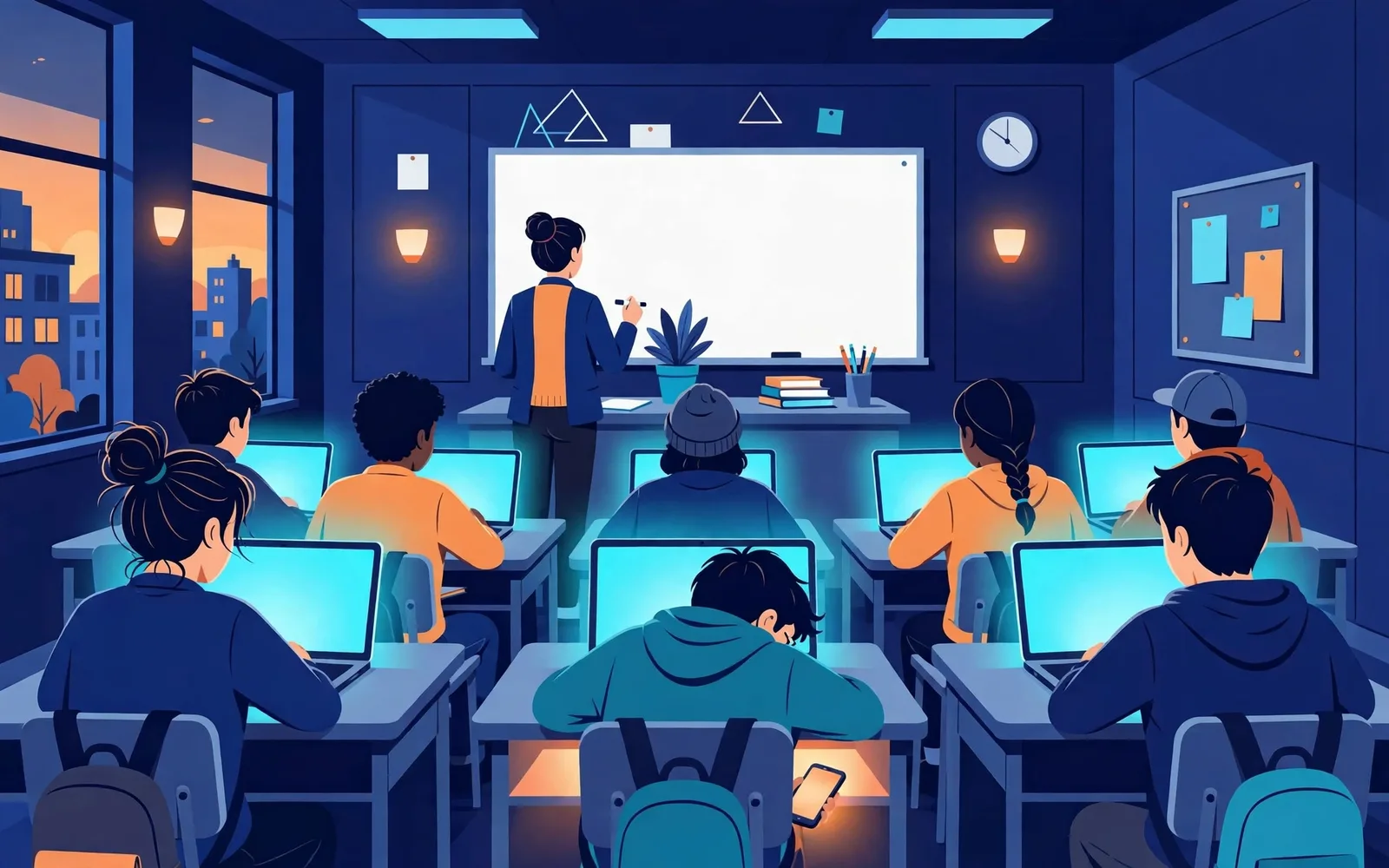
A Fordham Institute survey of 2,024 US high school students and recent graduates found 76% misuse technology daily during school hours — half scroll social media, a third watch off-task YouTube, and a quarter have used AI during tests — with school-issued devices, not phones, driving most of it.
Three out of four American high school students say they misuse technology every single school day. That is the blunt headline from a new national survey by the Thomas B. Fordham Institute, and it lands at a moment when parents and schools thought they had finally found the answer: take the phones away. The survey's authors say the phones were never the whole problem. The devices schools hand out themselves, the AI tools sitting one tab away, and grading rules that let students pass without mastering the material are doing just as much damage — and in many classrooms, more.
The survey, published in September 2026 as part of Fordham's report High Tech, Low Standards: High School in the Age of Distraction, asked 2,024 people — 1,011 current high school students and 1,013 recent graduates aged 18 to 22 — what actually happens with technology during the school day. It was fielded in February and March 2026 by Impact Research and UpONE Insights, and it was nationally representative. This was not a poll of teachers guessing, or of parents worrying from the sidelines. Fordham asked the students themselves, and the students were strikingly honest.
What they described is a school day that looks very different from the one on the timetable. Half of them said they scroll social media at least once a day during school. About a third watch YouTube videos that have nothing to do with their assignments, and about a third play recreational games. Roughly one in five said they use AI without their teacher's permission every day. And these are the students who admitted it. The real numbers, the report's author Brian Fitzpatrick notes, are almost certainly higher.
If that sounds like a story about teenagers being teenagers, the next numbers make it harder to shrug off. Of the students who use AI, 48 percent said they use it to solve maths problems for them, 36 percent to summarise books so they do not have to read them, 29 percent to write the first drafts of essays or reports, and 26 percent to get help during quizzes and tests. More than half — 58 percent — agreed that AI has made homework meaningless. Almost as many, 57 percent, said AI lets students get good grades without doing any real work. Read that again. A majority of the young people in American high schools now believe, in their own words, that the work they are graded on no longer measures what they know.
That is the finding that should stop every parent in their tracks, because it is not really about cheating. It is about what school is for. When a sixteen-year-old can hand in an essay she did not write, pass a maths test with answers she did not work out, and still collect the grade, the grade stops meaning anything — and she knows it. The survey found something else that fits the same pattern: the students who reported the heaviest technology use during the school day were also far more likely to say that missing school would not hurt their grades. Technology, in other words, is not just distracting students from learning. In the worst cases it is teaching them that learning is optional.
The number that matters most: 76 percent
Seventy-six percent. That is the share of respondents who said they personally engage in at least one form of illicit technology use daily during high school. The report defines "illicit" plainly: using technology in ways the school does not allow, during school hours. Scrolling TikTok between classes counts. So does messaging friends during a lesson, shopping online, watching YouTube, or opening a chatbot without permission.
The figure is worth pausing on because it is not a fringe. It is not the "bad kids" or a handful of classrooms with lax teachers. Three in four is the mainstream. In a class of thirty, that is twenty-two or twenty-three students doing something with a screen every day that their school has told them not to do. And because the survey asked about behaviour rather than attitudes, it is harder to dismiss than the usual opinion polls. Students were not asked whether they think phones are a problem. They were asked what they do. Then they told the researchers.
There is a temptation, when a number is this big, to treat it as a generational verdict — proof that today's teenagers simply cannot concentrate. The report itself warns against that reading. Fitzpatrick's argument is not that students have become worse. It is that the environment around them has become impossible. Schools spent a decade putting a screen on every desk, then acted surprised when the screens got used for everything except the lesson. "Technology isn't the enemy here," the report's foreword says. "But the findings suggest we need far less of it in today's high schools."
That is a careful sentence, and it matters. Fordham is not arguing for a return to chalk and paper. It is arguing that the current balance — most of the school day on a device, with the whole internet one click away — has tipped past the point where the technology helps more than it hurts.
AI is not a side story. It is the story
For parents, the most unsettling part of the survey may be the section on artificial intelligence, because it describes a change that happened fast and mostly out of sight. Two years ago, AI cheating was a novelty — a story about one clever student and one stunned teacher. Now it is routine, and the students themselves describe it without embarrassment, as a normal part of getting through the day.
About half of the students who use AI said they use it for legitimate purposes: explaining a difficult concept, brainstorming ideas. That matters, and the report is fair about it. AI can be a genuinely good tutor. The problem is that the same proportion use it to bypass learning altogether. The split is almost exactly even, and that is what makes the situation so difficult for schools. You cannot ban a tool that half the students use well and half use to avoid work, at least not without taking something useful away from the first group.
The numbers on how AI is used tell the story in detail. Nearly half of AI users get it to solve maths problems. More than a third use it to summarise books or texts so they do not have to read them. Almost three in ten let it write the first draft of an essay or a report. And one in four — 26 percent of all respondents — said they had used AI to help during a quiz or a test. That last figure is the one teachers find hardest to hear, because a test is supposed to be the one place where what a student knows is measured cleanly. If a quarter of students are getting AI help during tests, the measurement is broken. District Administration's summary of the report puts it plainly: AI misuse and lenient grading are making the distraction problem worse, not better.
Pew Research Center's own polling points in the same direction. In a survey of 1,391 American teenagers aged 13 to 17, conducted in the autumn of 2024, 26 percent said they had used ChatGPT for schoolwork — double the 13 percent who said so in 2023. And a College Board research brief published in October 2025 found that 69 percent of high school students had used ChatGPT to help with assignments and homework in a survey that May. The Fordham numbers are not an outlier. They sit squarely in the middle of a fast-moving trend, and every survey that asks the question finds the line moving in the same direction.
What is striking, though, is how students themselves feel about it. Only 18 percent of the teenagers in Pew's survey said it was acceptable to use ChatGPT to write an essay, and 42 percent said it was not acceptable. The students know the line. They just cross it anyway, because the system around them makes crossing it easy and rarely punishes it. That gap — between what teenagers believe is right and what they actually do — is the real story of this survey. It is not a story about bad kids. It is a story about a system that makes the wrong choice the easy one.
The device in the backpack is not the problem. The device on the desk is
Here is the part of the Fordham report that most surprised the people who have followed the phone-ban debate. The biggest source of distraction in American high schools is not the phone in a student's pocket. It is the laptop or tablet the school issued to that student.
Sixty-two percent of respondents said they spend more than half of their in-class time on a school-issued device — about 900 minutes a week, according to the report. Nearly one in three said they spend more than three-quarters of class time on a screen. Think about what that means in practice. In a six-period day, a typical student is looking at a school screen for most of four periods, and for some students it is most of five. That is before anyone counts the phone in their pocket, the social media they check between classes, or the homework they do on a screen at night.
And those school devices are not locked down the way parents assume. Two-thirds of respondents said YouTube is accessible on their school-issued device. Half said they use school-day technology for social media. About a third use it for games or off-task YouTube viewing. The report puts it bluntly: "A key reason that illicit tech use is so pervasive is that school-issued devices provide direct access to the platforms driving it." The school bought the distraction, issued it to every student, and then asked teachers to police it.
This is the finding that reframes the whole phone-ban conversation. Over the past two years, the debate has been dominated by pouches, lockers, and bell-to-bell bans. Those matter — and the Fordham data shows they do help, which we will come to. But a school can lock every phone in a Yondr pouch at 8 a.m. and still hand every student a device with YouTube, social media, and a chatbot on it five minutes later. The pouch solves the phone problem. It does not solve the screen problem. And the screen problem, measured in minutes, is much bigger.
Some schools are starting to act on this. In September 2026, Los Angeles Unified — the second-largest school district in the country — announced it would restrict access to AI platforms for all students during the 2026-27 school year while it reviews how the tools should be used in teaching. New York City Public Schools announced a similar pause on AI use for elementary and middle school students the same month. And an opinion piece in The 74 argued that districts should scale back one-to-one laptop programmes and bring back computer labs — using the devices where they are genuinely useful, rather than putting one on every desk all day. These are early moves, and none of them is settled policy. But they show that the conversation is shifting from "take the phones" to "rethink the devices," which is exactly where the Fordham evidence points.
Weak grading makes everything worse
The fourth finding in the Fordham report is the one that gets the least attention in the headlines, and it may be the most important. Students told the researchers that the grading system itself makes cheating and distraction easier to get away with.
Many schools now allow unlimited retakes on tests, accept late work with little or no penalty, and grade in ways that let students pass a course without mastering the material. When a student knows she can retake a test as many times as she likes, or hand in an AI-written essay a week late with no consequence, the cost of not learning drops to almost nothing. And when the cost of not learning is nothing, a surprising number of students — quite rationally — choose not to learn.
Fitzpatrick is blunt about this in the report. Education Next's analysis reaches the same conclusion in different words: for all the talk of AI tutoring, students are clear that they mostly use it to evade the rigours of learning. "Taken together, our results suggest that American high school students are caught up in — and often contribute to — a disturbing and interconnected set of problems: rampant distraction, widespread AI misuse, heavy dependence on screens, and grading practices that make it easier to earn high marks without mastering the material." The four problems feed each other. Distraction makes AI misuse easier. AI misuse makes weak grading invisible. Weak grading removes the reason to pay attention in the first place. Break any one link and the chain weakens. Leave all four in place and you get exactly what the survey measured: a school day in which three-quarters of students are doing something other than learning, and most of them still pass.
This is also where the survey connects to something parents already worry about, often without the vocabulary for it: chronic absenteeism. The students who reported the heaviest technology use were far more likely to say that missing school would not affect their grades. If a student believes she can miss a week, catch up with a chatbot, and still pass, then showing up becomes optional — and in many American high schools, showing up has become a genuine problem. The report does not claim that technology caused the absenteeism crisis. It does show that the two problems travel together, and that a student who has learned to outsource her learning to a screen has very little reason to sit in a classroom at all.
Phone bans help. They just do not finish the job
None of this means phone bans are pointless. The Fordham survey is clear that they help, and the numbers are worth knowing. K-12 Dive's report on the survey lays out the headline figures, and the 10 Minute Teacher podcast walked through all four findings with Fitzpatrick on 17 November. In schools with full phone bans — phones locked in a pouch or held in a central office — 33 percent of students said they still used social media daily at school. In schools where each teacher sets their own policy, that figure was 64 percent. A strict, school-wide ban roughly halves daily social media use. That is a real effect, and any parent whose child's school is debating a ban should know it.
But 33 percent is still one in three. Even in the strictest schools, a third of students are on social media every day. The ban moves the number; it does not eliminate the behaviour. And the reason is now obvious: the ban covers the phone, not the Chromebook.
The same pattern shows up in the Brookings Institution's research on how phone bans hold up over a school year. Researchers at the University of Southern California surveyed a nationally representative sample of teenagers in October 2025 and again in May 2026. At the start of the year, 28 percent of teens said they had used their phone during core classes. By the end of the year, that figure had climbed to 42 percent. Nearly half of the teenagers — 44 percent — said their teachers had become less strict about enforcing the rules as the year went on. The adults in their households mostly did not notice: only 13 percent of parents and grandparents said enforcement had loosened, and 60 percent said nothing had changed.
Bell-to-bell bans held up better than partial ones. In schools where phones were banned for the whole day, in-class phone use rose from 25 percent to 35 percent over the year — a ten-point rise. In schools with looser rules, it rose from 32 percent to more than 50 percent. The lesson is consistent across both studies: the stricter and more consistent the rule, the better it works — and even the best rules erode over time unless the school keeps enforcing them. A ban announced in September is not a ban enforced in May. As one Fordham commentator put it, if leaders want to ban phones from classrooms, they need to design policies that do not rely solely on teacher enforcement, because teacher enforcement is exactly what fades first. Education Week's coverage of the Brookings findings makes the same point: students find workarounds, and teachers grow less vigilant, as the year wears on.
The test-score evidence tells a similar story of modest, real gains. A major study from Harvard, Dartmouth and the testing company NWEA, released in November 2026 and covering about 3.3 million students in 4,600 schools, found that strict phone bans — pouches, central storage, or phones kept off campus — were worth roughly one to two extra weeks of learning a year. That is a genuine gain, and it is about half the size of the learning American students have been losing each year since 2013. But it is small, and the study's lead author, Thomas Kane, has been careful to say so. The effect is small, and the phone use that happens outside school — the late-night scrolling, the homework done with a phone buzzing beside it — matters at least as much. We covered that study in detail in Do School Phone Bans Work? Harvard's 3.3M-Student Study, and the same caveat applies here: a ban is a start, not a solution.
Put the three studies together — Fordham, Brookings, Harvard — and a coherent picture emerges. Phone bans reduce distraction. Strict bans reduce it more than loose ones. But bans alone cannot fix a school day in which most of class time is spent on a school-issued device with the whole internet on it, where AI can do the homework, and where the grading system rarely catches any of it. The parents who campaigned for phone bans were right to do so. They were wrong only if they thought the pouch was the finish line.
The counter-argument: is cheating actually worse?
Before this becomes a counsel of despair, it is worth hearing the other side, because the evidence is genuinely mixed — and parents deserve the full picture, not just the alarming half.
Researchers at Stanford's Graduate School of Education, Victor Lee and Denise Pope, have run anonymous surveys of American high school students for more than fifteen years through the Challenge Success project. Their baseline finding is striking: for over a decade, 60 to 70 percent of students have reported engaging in at least one cheating behaviour in the previous month — and that figure has stayed essentially flat since ChatGPT arrived. It may even have dipped slightly. In other words, students were already cheating at high rates long before AI existed. AI has changed how they cheat, not necessarily how often.
Turnitin's own platform data points the same way. Of the more than 200 million writing assignments its AI detector has reviewed, only about 11 percent showed evidence of AI use, and just 3 percent were generated mostly by AI. Those figures have been roughly steady since the detector launched in 2023. More recently, Turnitin reported that about 15 percent of essay submissions had more than 80 percent AI-generated writing between October 2025 and February 2026, up from about 3 percent when the detector launched in April 2023 — a real rise, but one that describes a minority of submissions, not the whole system.
What do we make of the tension between Fordham's 76 percent and Stanford's flat line? The two studies are measuring different things. Stanford asks whether students cheated at all in the past month, in any way, including the old-fashioned kind — copying homework, glancing at a neighbour's test. Fordham asks whether students misuse technology every day. Both can be true at once: the overall rate of cheating may be stable, while the daily, technology-driven form of it — the scrolling, the messaging, the AI shortcut — has become far more common. The honest conclusion is that AI has not created a new crisis of dishonesty so much as it has industrialised an old one, making it faster, easier, and harder to detect.
There is also a fairness point that the Fordham report itself acknowledges. About half of the students who use AI use it well — to explain a hard concept, to brainstorm, to practise. Those students are disproportionately the ones who already know how to learn. The students who use it to bypass learning are disproportionately the ones who were already struggling. If schools respond by banning AI outright, they risk taking a useful tool away from the students who use it best, while the students who were misusing it simply find another way. The answer is not to ban the tool. It is to teach students the difference between using it and being used by it — and to design assignments that cannot be completed by a chatbot in the first place.
What Fordham says schools should do
The report ends with five recommendations, and they are worth reading in full because they are practical rather than rhetorical. First, reduce the amount of time students spend on devices — not to zero, but to the point where screens are a tool for specific tasks rather than the default setting of the school day. Second, put more weight on supervised, in-class, paper-and-pencil and oral exams, and design homework around preparing for them. Third, make grading expectations school-wide and explicit: end routine retakes, enforce real consequences for late work, so that the rule is the school's and not each teacher's private policy. Fourth, make sure the firewalls on school-issued devices actually work, and use the settings schools already have to limit off-task use. Fifth, adopt stricter bans on cell phones and other personal devices — bell-to-bell, school-wide, and enforced by the school rather than left to individual teachers.
Fitzpatrick himself has gone further in public since the report came out. In an opinion piece for The 74, he argued that districts should sharply curtail or eliminate one-to-one device programmes and bring back computer labs and laptop carts instead — treating computers as tools for specific lessons rather than universal educational aids. "The average classroom in this country should be phone, tablet, smartwatch, and laptop free most of the time," he wrote, "and the easiest place to start is school-purchased tech." It is a deliberately provocative position, and not everyone agrees with it. Lina Eroh of the Overdeck Family Foundation, responding in the same debate, warned that removing devices wholesale could hurt the students who need technology most, including those in schools with staffing shortages. The argument is live, and it will be fought school board by school board over the next year.
For parents, the practical questions are more immediate, and they do not require waiting for a school board vote. Ask your child's school three things. First, what is actually blocked on the school-issued device — is YouTube open, is social media reachable, is there a working filter, and who checks that it still works? Second, what is the phone policy, and is it school-wide or left to each teacher? The Fordham and Brookings data both say the school-wide version works roughly twice as well. Third, how are tests and homework designed — are there in-class, paper-based assessments that show what your child actually knows, or is most of the grade built from take-home work that a chatbot could have written?
At home, the most useful conversation may be the simplest one. The survey found that students know the line between legitimate AI use and cheating — most of them can state it clearly. What they lack is a reason to stay on the right side of it when nobody is watching. That is a conversation about character, not about technology, and it is one that parents are better placed to have than any school policy. Ask your teenager, without accusation, what they actually do with AI on a school day. Then ask what they think it is doing to them. The survey suggests the answers will be more honest — and more interesting — than you expect.
What this means for your family
The Fordham survey is not a reason to panic, and it is not a reason to take your child's laptop away. It is a reason to stop pretending that the phone pouch solved the problem. The school day your child lives in is a screen day: most of class on a school device, a phone in the pocket, a chatbot one tab away, and a grading system that often cannot tell the difference between work done and work outsourced. That is the environment. The question is what you do inside it.
Three things are worth doing this week. First, find out what your child's school actually does about devices — not what the policy says on the website, but what happens in the classroom. Second, talk to your child about AI the way you would talk about any other shortcut: not as a moral panic, but as a practical question about what they are actually learning. And third, if your school is debating a phone ban, support the strict version — but ask, in the same meeting, what the school is doing about the laptops. The pouch is a good start. It was never the whole answer.
If you want the wider context on phone bans, our earlier reporting covers the evidence in depth: the Harvard study of 3.3 million students in Do School Phone Bans Work?, the Los Angeles survey of 160,000 students in LAUSD's $6 Million Phone Ban, and the data on what students actually do on their phones during the school day in Teens Spend a Third of the School Day on Phones. And if the daily numbers matter to you, our study on phones before age 13 and teen wellbeing is the research most parents ask about first.
Frequently asked questions
What did the Fordham survey actually find?
In a nationally representative survey of 2,024 current high school students and recent graduates, 76 percent said they misuse technology every day during school hours. Half scroll social media daily at school, about a third watch off-task YouTube or play games, and roughly one in five use AI without teacher permission daily. Among students who use AI, 48 percent use it to solve maths problems, 36 percent to summarise books they have not read, 29 percent to write first drafts, and 26 percent to get help during quizzes and tests.
Do school phone bans work?
Yes, but only partly. In schools with full bans, 33 percent of students still used social media daily, compared with 64 percent where each teacher set their own policy — so a strict, school-wide ban roughly halves the problem. But a third of students still get through, and the Brookings Institution found that enforcement fades over the school year: in-class phone use rose from 28 percent in October 2025 to 42 percent by May 2026. Harvard's study of 3.3 million students found strict bans add about one to two weeks of learning a year — a real gain, but a small one.
Is AI cheating getting worse?
It depends what you measure. The share of students using AI for schoolwork is rising fast — Pew found 26 percent of US teens had used ChatGPT for schoolwork in 2024, double the 13 percent in 2023, and the College Board found 69 percent of high school students had used ChatGPT for assignments by May 2025. Turnitin's detector data shows about 15 percent of essay submissions were more than 80 percent AI-written between October 2025 and February 2026, up from 3 percent in 2023. But Stanford's long-running surveys find that the overall rate of cheating — around 60 to 70 percent of students reporting at least one cheating behaviour in a month — has stayed flat since ChatGPT arrived. AI has changed how students cheat more than how often.
What should schools do, according to the report?
Fordham makes five recommendations: cut the time students spend on devices; rely more on supervised, in-class, paper-and-pencil and oral exams; make grading rules school-wide, with real consequences for late work and an end to routine retakes; make sure the firewalls on school-issued devices actually work; and adopt stricter, bell-to-bell phone bans. The report's author has also argued publicly that schools should replace one-to-one laptop programmes with computer labs and laptop carts.
What can parents do right now?
Ask your child's school what is actually blocked on the school-issued device, whether the phone policy is school-wide or left to individual teachers, and how much of your child's grade comes from supervised in-class work versus take-home assignments. At home, talk to your teenager about how they actually use AI during the school day — the survey shows most students know where the line is, even when they cross it.