Teens Spend a Third of the School Day on Phones: JAMA Data
Two JAMA studies tracked what students really do on phones at school: a third of the day, 64 checks, mostly TikTok. What the data says — and what actually helps.
Drafted with an AI writing assistant and checked against its sources by the editor before publishing. How we use AI.
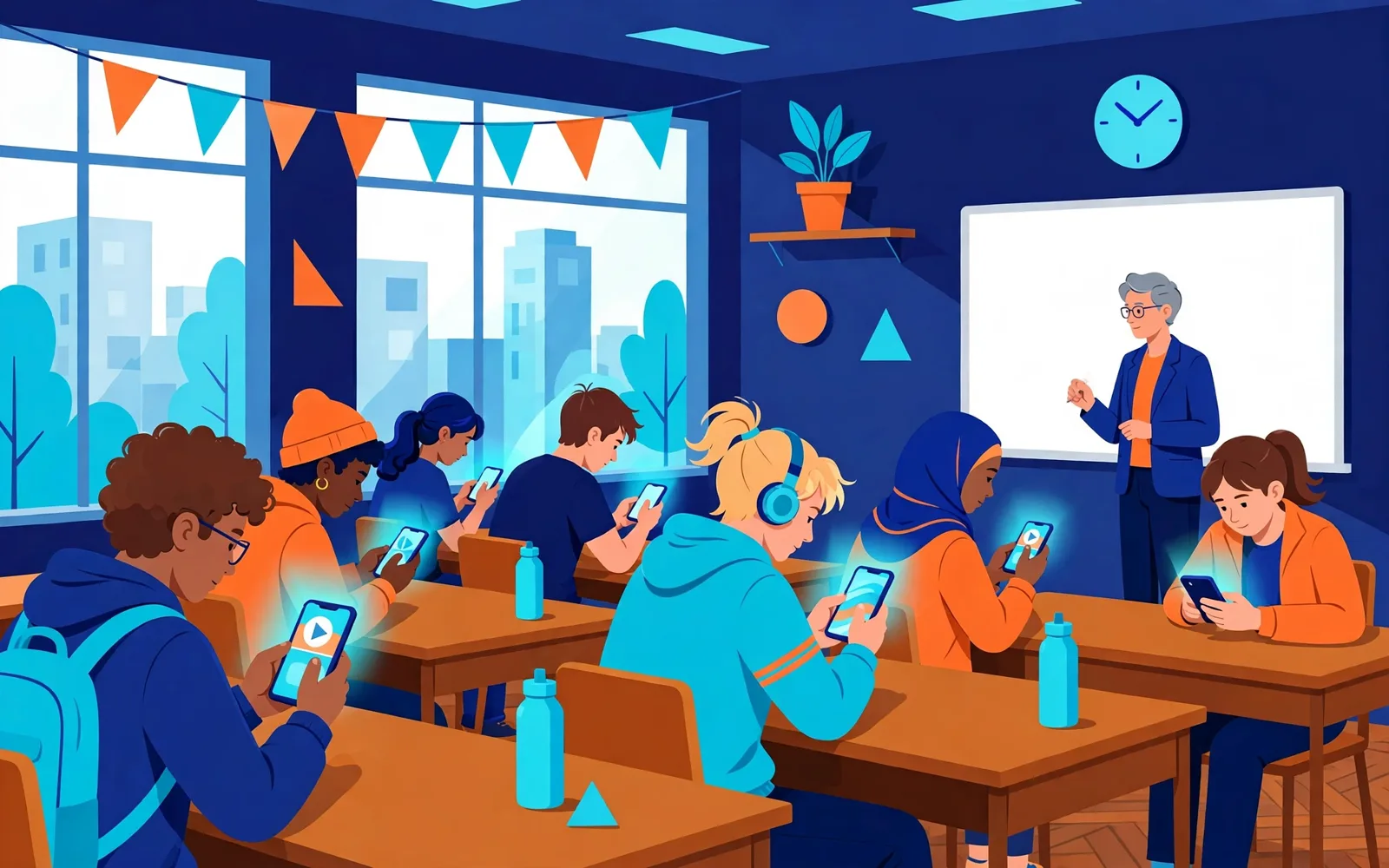
Students spend roughly a third of the school day on their phones — about one to two hours — mostly on TikTok and other social apps, checking around 64 times a day, and the frequent checking is linked to weaker attention and impulse control, according to peer-reviewed JAMA research.
Ask a teenager how much they use their phone at school and you will get a shrug, a guess, or a confident "barely at all". Ask their phone, and you get a very different answer.
This week, The Boston Globe put fresh numbers in front of Massachusetts lawmakers who are debating a statewide school phone ban, and the numbers are hard to ignore. Researchers tracking real phone use — not surveys, not self-reports, but the devices themselves — found that students spend roughly an hour of every school day on their phones, and most of that time goes to TikTok, YouTube and other social apps. A second, smaller study that followed students hour by hour put the figure even higher: more than two hours a day, or about a third of the school day, with the average teenager checking their phone 64 times before the final bell.
Parents have suspected this for years. Teachers have been saying it for longer. What is new is the quality of the evidence. For the first time, researchers can show exactly when the checking happens, which apps win the attention, and what the habit does to a teenager's ability to focus. And the picture it paints is more complicated than "phones are bad, ban them" — or "phones are fine, leave them alone".
The short answer
Students spend about a third of the school day on their smartphones — roughly one to two hours depending on the study — and nearly three-quarters of that time goes to social media and entertainment, led by TikTok. They check their phones dozens of times a day, in every hour of the school day, not just at lunch. The students who check most often show weaker attention and impulse control on lab tests. And children under 13, who are not supposed to have social media accounts at all, spend most of their school phone time on TikTok anyway.
That is the headline. The rest of this article is the evidence behind it, what it does and does not prove about school phone bans, and what parents can actually do with the information.
Study one: 11,382 students, 600,000 school days
The biggest dataset comes from Aura, the family online-safety company, working with the University of North Carolina at Chapel Hill's Winston Center on Technology and Brain Development. The peer-reviewed study, published by the JAMA Network, analysed de-identified data from 11,382 American students aged 10 to 17, covering more than 600,000 days of smartphone activity collected through the Aura app between September 2024 and February 2025. Phone use was counted between 8am and 2.30pm on weekdays, so the figures describe the school day itself, not the evening scroll.
The headline findings are blunt. Students spent nearly an hour on their phones during the school day. Nearly three-quarters of that in-school screen time went to social media, led by TikTok, then YouTube, Instagram and Snapchat. Total weekday smartphone use averaged 2.9 hours, and about a third of it happened during school hours.
The age split matters. Students aged 14 to 17 averaged 1.1 hours of phone use per school day. Students aged 10 to 13 averaged 48 minutes. And almost one in 12 students — 7.7% — averaged more than two hours of phone use during the school day alone.
"Parents often feel like they're flying blind when it comes to how their kids use technology — especially at school," said Dr Scott Kollins, Aura's chief medical officer and a co-author of the study, when the data was released. "This research offers a clearer picture. It's not about blame; it's about awareness."
Kollins, who is also a clinical psychologist, put the scale of it plainly to the Globe this week: "An hour might not seem like a lot. But it's taking away a pretty substantial chunk of a school day that some people already think is too short."
One finding in particular should stop parents in their tracks. Children under 13 — who are not supposed to have social media accounts under the platforms' own rules — were spending most of their phone time on TikTok and similar apps. The age gate, in practice, is not holding. A child can be 11 years old, sitting in a classroom, watching TikTok for most of their screen time, and nobody in the room would know unless they looked over their shoulder.
Study two: 79 students, tracked hour by hour, 64 checks a day
If the Aura study shows the scale, a second JAMA Network Open study shows the texture. Researchers Eva Telzer and Kaitlyn Burnell at UNC-Chapel Hill followed 79 young people aged 11 to 18 from the south-eastern United States, capturing their iPhone Screen Time reports at every hour of the day for two weeks. The study was published in JAMA Network Open on 9 March 2026. The full text is available on PubMed Central, and UNC's own summary puts the findings in plain language.
Nobody abstained. Not one of the 79 students went a school day without using their phone. On average they spent 2.22 hours of the school day on their smartphones — nearly one-third of the school day, and nearly a third of their total daily use. One in four spent more than three hours on their phone during school.
They checked their phones an average of 64 times during school hours. Sixty-four. That is roughly once every six or seven minutes across a seven-hour school day, and the checking was not confined to breaks. The researchers found phone use in every hour of the school day, from first period to last.
"Smartphones are no longer something students use occasionally during school — they're present during every hour of the day," Telzer said. "Our findings show that frequent phone checking may undermine the very skills students need to succeed in the classroom."
What were they doing in those two-plus hours? Social media took the biggest share — an average of 40 minutes during school hours — followed by entertainment apps at about 14 minutes. Together, social media and entertainment accounted for more than 70% of school-day phone time. Schoolwork, messaging and everything else fought over the remainder.
The age gap showed up here too, and it was stark. High school students aged 15 to 18 spent about 23 minutes per hour on their phones during school, roughly double the 11.5 minutes per hour recorded for middle schoolers aged 11 to 14.
The checking habit is the problem, not just the hours
Here is the finding that changes how parents should think about this. Telzer and Burnell's team also tested the students' cognitive control — the brain's ability to focus, resist impulses and stay on task — using a standard go/no-go task that measures inhibitory control. The students who checked their phones most frequently scored worse. More frequent checking was associated with lower scores on the test, a result the researchers describe as poorer cognitive control.
Crucially, total screen time alone did not show the same link. It was the checking — the repeated, habitual interruption — that tracked with weaker attention. That distinction matters, because it points to a mechanism any parent will recognise: it is not only the minutes that disappear, it is the constant breaking of concentration. A student who checks their phone 64 times a day is not just losing two hours. They are losing the thread of the lesson 64 times, and having to find it again 64 times.
"What surprised us most was the sheer amount of time teens are on their phones during school," said Burnell. "Students were on their phones every hour during school, spending one-third of the school day on their phones, with social media and entertainment accounting for over 70% of their time."
The researchers are careful about what this proves. The study is cross-sectional, which means it shows an association, not a proven cause. It is possible that students with weaker attention are drawn to checking more often, rather than the checking causing the weaker attention. The sample is also small — 79 students from one school district — so it should be read alongside the bigger studies, not on its own. But the pattern it found, hour-by-hour objective tracking linked to a lab measure of attention, is exactly the kind of evidence that self-report surveys could never provide.
Study three: the same pattern in a national sample
A third study, published in JAMA in January 2026, used data from the Adolescent Brain Cognitive Development (ABCD) Study — the large, federally funded project tracking thousands of American teenagers. Researchers analysed passive sensing data from 640 adolescents with an average age of about 15, collected on Android devices during school hours between September 2022 and May 2024.
The results line up. Adolescents spent an average of 1.16 hours using smartphones during school hours. Social media took the most time — about 30 minutes — followed by video apps such as YouTube at about 15 minutes, and games at about 15 minutes. The games named in the data will be familiar to any parent of a teenager: Roblox, Clash Royale and Pokemon Go.
Three studies, three different samples, three different methods — a commercial app's de-identified data, iPhone Screen Time reports, and a federal research project's passive sensors — and they converge on the same story. Students use their phones for roughly an hour or two of every school day. Most of that time is social media and video. The checking never really stops.
What the apps are
Put the three studies together and a clear hierarchy emerges. TikTok is first. In the Aura data, TikTok led all social apps during school hours, ahead of YouTube, Instagram and Snapchat. In the Telzer study, social media dominated, with entertainment — largely short video — second. In the ABCD data, social media took twice as much school time as video or games.
This matches what teenagers tell researchers about their wider habits. Pew Research Center's December 2025 survey of 1,458 American teens aged 13 to 17 found that about nine in ten use YouTube, about six in ten use TikTok and Instagram, and 55% use Snapchat. More than half visit TikTok daily, and about one in five say they are on TikTok "almost constantly" — up from 16% in 2022. Across five major platforms, 36% of teens say they use at least one almost constantly. And 97% of teens say they use the internet daily, including four in ten who say they are online almost constantly.
Common Sense Media's 2026 Census, published in October 2026, adds the wider context. A typical American teenager now spends about eight hours a day on screen media for entertainment — three hours on TV and video, two hours gaming, two hours on social media, and an hour using AI. More than four in ten teens spend ten or more hours a day. Nearly half of teens think they spend too much time on screens for entertainment.
Read against that backdrop, the school-day figures stop looking like a school problem and start looking like a whole-day problem that happens to include school. The phone is not a device students pick up at 3pm. It is with them all day, and school is simply one of the places the habit plays out.
Why this is landing in statehouses right now
The reason these studies are in the news this week is that lawmakers are deciding what to do about them. The school phone ban movement has moved fast. Pennsylvania became the 25th state to enact a bell-to-bell policy when Governor Josh Shapiro signed Senate Bill 1014, a law that will require every school in the state to keep student phones out of use from the first bell to the last by the 2027–28 school year. More than 1.7 million students will be covered. The law applies to public, charter, cyber charter, private and career schools, covers lunch, recess and the time between classes, and lets each school write its own policy — but does not require schools to physically take devices away.
Rhode Island became the latest state to ban phone use in schools this year. Central Falls High School, which has had a no-phone policy since 2023, offers an early glimpse of what that looks like in practice: teachers there say students talk to each other more, and students say the adjustment was hard at first and then normal.
Massachusetts is the state to watch next. Its Senate passed a bell-to-bell bill, S.2581, by 38 votes to 2, and the House passed an amended version 129 to 25 in April 2026. The bill has been in a conference committee since May, and the debate flared again this month as Senate leaders pushed it forward and the Globe resurfaced the Aura data. Governor Maura Healey has said she supports a ban. If it passes, Massachusetts would join the majority of states that now restrict phones in school. Already, about 80% of the state's school districts have some kind of phone policy, according to testimony from the Massachusetts Association of School Superintendents, and the state opened a $1 million grant fund in September 2026 to help schools go phone-free.
California, meanwhile, shows how messy implementation can be. State law now requires every public school to have a policy limiting or prohibiting smartphone use, but what that means in practice varies wildly. Some schools use strict no-phone rules with escalating consequences. Others block social media on the school network while letting students keep their phones. Los Angeles Unified, the district that made headlines for its $6 million phone ban, dropped its Yondr locking pouches this year and stopped the daily ritual of collecting devices — a reminder that the policy is only as good as the enforcement behind it.
Do bans actually work? The honest answer is complicated
This is where parents deserve straight talk, because the evidence does not point in one direction.
On one side, a large Harvard-led study of 3.3 million students, released in November 2026, found that strict phone bans were linked to real learning gains — the equivalent of one to two extra weeks of learning per year. We covered that evidence in detail in our guide to whether school phone bans work. And the Los Angeles Unified survey of more than 160,000 students found that middle schoolers in particular reported better focus, with 58% saying they could focus better most or all of the time — though high schoolers were split, and many said the ban changed little. You can read the full breakdown in our report on LAUSD's $6 million phone ban.
On the other side, the best-known study of wellbeing found no benefit at all. The SMART Schools study, led by the University of Birmingham and published in The Lancet Regional Health Europe in 2025, compared 1,227 pupils aged 12 to 15 across 30 English secondary schools — 20 with restrictive phone policies and 10 with permissive ones. Restrictive schools did cut phone use during the school day, by about 40 minutes, and social media use by about 30 minutes. But there was no difference in mental wellbeing, anxiety, depression, sleep, physical activity, or English and maths attainment. And total phone use across the whole day did not change: pupils simply made the minutes back after the bell.
"There is no evidence that restrictive school policies are associated with overall phone and social media use or better mental wellbeing in adolescents," the authors concluded. Scott Kollins made the same point to the Globe this week: "It is not terribly clear from the research that has been published that purely banning in schools, bell to bell, is going to have a big positive impact."
Both things can be true. A ban can reduce distraction during lessons — and the Harvard data suggests it can add real learning time — while doing nothing for a teenager's overall wellbeing, because the phone is still there for the other 18 hours of the day. The SMART Schools finding is not that bans fail. It is that bans alone are not enough. The habit does not live in the school building. It lives in the pocket, and it goes home with the child.
What schools are trying instead of — or as well as — bans
Not every school is reaching for a ban. Some are reaching for technology to fight technology. At Harvard-Westlake School in Los Angeles, one of the country's best-known private schools, upper school students in grades 10 to 12 now install an app called Opal that blocks TikTok, Instagram, Snapchat, X, Discord, Threads, Pokemon Go, Roblox, Clash Royale and Reddit during school hours. If a student disables it, the front office is notified on a dashboard. Teachers there say the halls feel different this year — students chat more, greet teachers as they walk in — and some students say they are sleeping better. Opal was originally built for adults trying to cut distractions at work; schools are now its fastest-growing market, and school plans start at $20 per student per year.
Other schools are trying network-level blocks, geofencing that disables social apps on campus, and old-fashioned honour systems. Some, like Rosemont High School in Sacramento, run strict no-phone policies even at lunch. Others, like West Sonoma County Union High School District, let students keep their phones but block social media, cameras and most apps while they are on campus.
The common thread is that none of these approaches works on autopilot. Pouches get broken into. Apps get deleted. Network blocks get bypassed with mobile data. Every enforcement tool creates a new workaround, and every workaround needs a response. That is why the schools reporting the best results tend to be the ones that treat the policy as a culture change, not a piece of hardware — with teachers, students and parents all pulling in the same direction.
What parents can actually do
A school policy, whatever it is, covers six or seven hours a day. Parents cover the rest. Here is what the research actually supports.
1. Look at the real numbers together, not the guesses. Open your child's Screen Time or Digital Wellbeing report with them, on a normal weekday. Look at the school-hours slice specifically. Most teenagers are genuinely surprised by their own numbers — and so are most parents. The conversation that follows is worth more than any lecture, because it starts from facts instead of accusations.
2. Target the checking, not just the total. The Telzer study's sharpest finding is that frequent checking, not total hours, tracked with weaker attention. That means the fix is not only "less phone" but "fewer interruptions". Help your teenager turn off non-essential notifications, especially from social apps, during school hours. A phone that buzzes 64 times a day is a different device from one that buzzes four times.
3. Make the bedroom a no-phone zone at night. The same habit that fragments attention in class fragments sleep at night. Common Sense Media's 2026 Census found that nearly half of teens think they spend too much time on screens, and earlier research has repeatedly linked heavy evening screen use to poorer sleep. A charging station in the kitchen or hallway, used by the whole family, removes the argument about singling anyone out.
4. Talk about the under-13 problem directly. If your child is under 13 and on TikTok or Instagram, the platforms' own rules say they should not be. The Aura data shows under-13s are spending most of their school phone time on TikTok — which means the age gate failed at sign-up, and nobody checked afterwards. This is not a lecture topic. It is a practical one: sit down, look at the account together, and decide what changes.
5. Ask the school what its policy actually is — and how it is enforced. A ban on paper and a ban in practice are different things. Ask whether phones are collected, locked away, or simply "not allowed". Ask what happens on the third offence, not the first. Ask whether teachers have a consistent approach, or whether it depends on the classroom. The LAUSD experience shows that even a well-funded policy can quietly unravel if enforcement fades.
6. Model the habit you want. Teenagers notice what adults do far more than what adults say. If the phone is on the dinner table, on the nightstand and in the hand during every pause, the message is that constant connection is normal. Family phone-free windows — meals, the first hour after school, the car — work better than rules aimed at one person.
7. Keep the good parts. This matters, because the story is not all negative. Pew's research found that 74% of teens say social media helps them feel more connected to what is going on in their friends' lives, and 63% say it gives them a place to show their creative side — findings we covered in our daily fact on teens and connection. The goal is not to make the phone disappear. It is to make sure the phone serves the teenager, and not the other way round.
Frequently asked questions
How much time do teens actually spend on their phones at school?
Between one and two hours a day, depending on the study. The Aura study of 11,382 students found nearly an hour per school day. The Telzer study of 79 students, tracking hour by hour, found 2.22 hours. The ABCD study of 640 adolescents found 1.16 hours. All three agree that a substantial share of the school day — roughly a fifth to a third — goes to the phone.
What apps do students use most at school?
Social media, led by TikTok, then YouTube, Instagram and Snapchat. In the Aura data, nearly three-quarters of in-school screen time went to social media. In the Telzer study, social media and entertainment together accounted for more than 70% of school-day phone time. Games such as Roblox, Clash Royale and Pokemon Go also appear in the data.
How often do students check their phones during school?
An average of 64 times during school hours, according to the Telzer study — roughly once every six or seven minutes. The checking happens in every hour of the school day, not just at lunch or between classes.
Does checking your phone a lot affect attention?
The Telzer study found that students who checked their phones more frequently scored worse on a lab test of cognitive control, which measures attention and impulse control. Total screen time alone did not show the same link. The study shows an association, not proof of cause — it is possible that students with weaker attention check more often — but the pattern is consistent with what attention researchers would expect from constant interruption.
Do school phone bans work?
The evidence is mixed. A Harvard-led study of 3.3 million students linked strict bans to small learning gains, and LAUSD's survey found many middle schoolers reporting better focus. But the SMART Schools study in England found that restrictive policies cut in-school phone use by about 40 minutes without improving wellbeing, anxiety, sleep or grades — and total daily phone use did not change. Bans reduce distraction during lessons; on their own, they do not change a teenager's overall relationship with their phone.
Are children under 13 really on TikTok at school?
According to the Aura data, yes. Children under 13 spent most of their school phone time on TikTok and similar apps, even though the platforms require users to be at least 13. The age checks at sign-up are easy to get around, and there is little checking afterwards.
The bottom line
For years, the argument about phones in schools has run on anecdote: teachers saying students cannot focus, parents saying the phone is a lifeline, teenagers saying everyone does it. Now there is objective data, and it is less comforting than any side of that argument would like. Students are on their phones for a large share of the school day, mostly watching short video and scrolling social feeds, checking dozens of times a day in a pattern linked to weaker attention. Children too young for the apps are on them anyway.
But the data also refuses to hand anyone a simple victory. Bans cut in-school use and may add learning time, yet they do not touch total screen time or wellbeing. The phone is not a school problem. It is a habit problem, and habits are built and broken at home as much as in the classroom.
The most useful thing a parent can take from this week's numbers is not a position in the ban debate. It is a picture of what a normal school day actually looks like for a teenager in 2026 — and a reason to look at the real numbers, with your teenager, instead of guessing.