Teen Burnout: School Pressure, Screens and Stress
Teen burnout is exhaustion and lost confidence from school pressure, late-night screens and too little sleep — here is how parents can spot it and help.
Drafted with an AI writing assistant and checked against its sources by the editor before publishing. How we use AI.
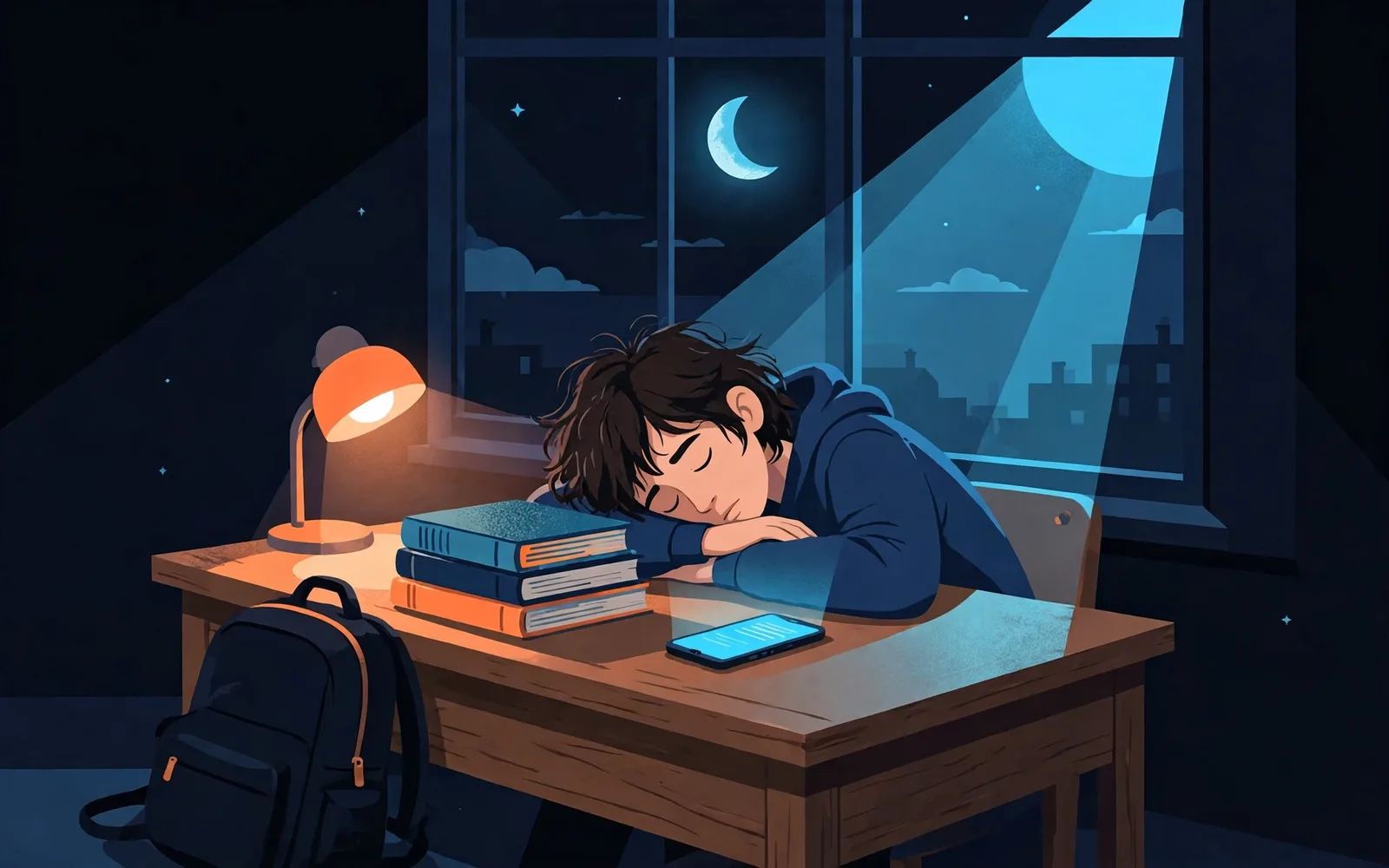
Teen burnout is long-term exhaustion from school pressure, late-night screen use and too little sleep. It shows up as constant tiredness, cynicism about school and falling effort, and it improves with protected sleep, a lighter workload and steady family routines over several weeks.
Teen burnout is what happens when school pressure, constant screen use and too little sleep pile up for months until a teenager runs out of energy, loses interest in school and starts to feel like nothing they do is good enough. It is not laziness, and it is not a phase a teenager can simply snap out of. It is a slow, grinding exhaustion that builds week after week, and the research says it is now one of the most common problems facing teenagers in the United States, the United Kingdom and across Europe.
If your teenager used to care about school and now seems flat, cynical about their classes, tired no matter how much they sleep, and quick to say "what's the point," you are probably looking at burnout, not bad attitude. The good news is that burnout is reversible. It takes weeks, not days, and it takes changes at home, at school and in the evening routine, not a single lecture. This guide explains what teen burnout looks like, what the research says causes it, the warning signs parents most often miss, and a practical recovery plan your family can actually follow.
What teen burnout actually is
The word burnout comes from the world of work. The World Health Organization describes burn-out in its International Classification of Diseases (ICD-11) as a syndrome that comes from chronic stress that has not been managed well, with three parts: feelings of energy depletion or exhaustion, growing mental distance or cynicism toward the work, and reduced effectiveness. The WHO is careful to say burnout is an occupational phenomenon, not a medical condition in itself, and that it should not be used loosely for every kind of tiredness.
Teenagers do not have jobs in the usual sense, but school is their work. Researchers who study young people have taken that same three-part shape and applied it to school life, calling it school burnout. A teenager with school burnout is exhausted by school demands, has become cynical and detached about studying, and feels like an inadequate student. That definition comes from research on educational burnout published in the journal Sustainability, which reviewed how the School Burnout Inventory measures exactly those three parts in students. A separate study of more than 1,000 high school students preparing for exams, published in Psychological Science and Education, found the same three-part pattern: emotional exhaustion from heavy academic demands, a detached and indifferent attitude toward learning, and a sense of inadequacy shown in falling grades and lower confidence.
That distinction matters, because burnout is different from an ordinary bad week. A bad week ends. Burnout does not end on its own, because the demands that caused it are still there on Monday morning. A tired teenager recovers after a good night's sleep and a quiet weekend. A burned-out teenager wakes up tired, goes to school tired, comes home tired, and slowly stops believing that effort will change anything. That loss of belief is the part parents should take most seriously. When a teenager stops trying, it is rarely because they stopped caring. It is usually because trying stopped feeling like it worked.
Burnout also overlaps with anxiety and depression, and the lines between them are blurry. That is why researchers warn against treating the label as a diagnosis. A long-term Finnish study that followed 673 students from age 12 to late adolescence, published in the Scandinavian Journal of Psychology, found that exhaustion in ninth grade predicted both later depressive symptoms and later use of antidepressants. Cynicism in ninth grade also predicted later depressive symptoms. The message for parents is plain: school burnout in the early teen years is not a small problem that sorts itself out. Left alone, it can grow into something more serious. Caught early, it is very fixable.
How common is teen burnout?
There is no single official count of teen burnout, because no government survey uses that exact label. But every large survey of teenage stress, sadness and sleep points in the same direction, and the numbers are hard to ignore.
The American Psychological Association found that 83 percent of teenagers say school is a somewhat or significant source of stress, and that teenagers report average stress levels of 5.8 out of 10, higher than the 5.1 reported by adults. Nearly half of teenagers said their stress levels were unhealthy. School sits at the top of the list of stressors, ahead of family, friends and money worries. Those figures come from the APA's Stress in America survey, and they have been repeated in later surveys with the same basic result: school is the single biggest source of stress in most teenagers' lives.
The Centers for Disease Control and Prevention found in its 2023 Youth Risk Behavior Survey that 40 percent of American high school students had persistent feelings of sadness or hopelessness in the past year, and 29 percent said their mental health was poor most or all of the time in the past month. The CDC's detailed analysis, published in the Morbidity and Mortality Weekly Report, put the numbers at 39.7 percent for persistent sadness or hopelessness, 28.5 percent for poor mental health, and 20.4 percent for seriously considering suicide. Girls were hit harder than boys: 53 percent of female students reported persistent sadness or hopelessness, compared with 28 percent of male students. These are not burnout numbers on their own, but they describe the same exhausted, overwhelmed population, and they show that the problem is not a few struggling teenagers. It is roughly two in every five.
In the United Kingdom, the picture is similar. Ofcom reports that nine in ten children own a mobile phone by age 11, and teenagers aged 15 to 17 spend the equivalent of two days a week online. The UK Parliament's House of Commons Library notes that almost three-quarters of teenagers aged 13 to 17 have come across at least one potential harm online. None of this proves that phones cause burnout, and parents should be wary of anyone who claims a simple cause. But it does show the environment teenagers live in: always reachable, always compared, always on.
One more number helps explain why burnout has become so visible in the last few years. A study of perfectionism in young people, reported by the American Psychological Association, found that perfectionism among young people has risen significantly since the 1980s. Young people today are more likely to set impossibly high standards for themselves, to believe others expect perfection from them, and to judge themselves harshly when they fall short. Perfectionism is fuel for burnout, because a perfectionist teenager never feels done. There is always a better grade, a cleaner essay, a higher score, and the finish line keeps moving.
Put these pieces together and the scale of the problem becomes clear. Most teenagers find school stressful. Two in five feel persistently sad or hopeless. Most are online for hours every day, often late at night. And a growing share hold themselves to standards they cannot meet. Burnout is what happens when those pressures run for months without a break.
School pressure: where burnout starts
For most burned-out teenagers, school is where it begins. The pressure does not come from one bad teacher or one hard exam. It comes from the steady accumulation of homework, tests, grades, college talk, comparison with classmates, and the feeling that every term matters more than the last.
Homework is the most visible part. In many American high schools, students now carry hours of homework a night on top of a full school day, sports, music, part-time work and family duties. The work itself is not the whole problem. The problem is that the work never stops. There is always another assignment, another test to revise for, another grade to protect. A teenager who finishes one essay at midnight is already behind on the next one. That feeling of never catching up is one of the classic early signs of burnout, and it is also one of the hardest for parents to see, because from the outside the teenager looks busy and productive.
Exams make it worse. Exam season compresses months of pressure into a few weeks, and the students who are already running on empty are the ones most likely to fall apart during it. The 2025 study of exam-preparing high school students published in Psychological Science and Education found that burnout was strongly linked to academic load, extra classes and tutoring, and the quality of relationships between teachers and students. Students who felt supported by their teachers coped better. Students who felt judged or ignored burned out faster. That finding matters, because it means burnout is not only about how much work a teenager has. It is also about whether anyone at school notices how they are doing.
Then there is the pressure that comes from home, often with the best intentions. A study of 616 seventh-grade students published in the European Journal of Psychology of Education, reported by Science Magazine, found that parental academic pressure reaches teenagers through specific costs: the effort it takes, the activities they have to give up, the emotional strain, and the fear that their worth depends on their grades. Students who felt studying forced them to give up things they loved, or who felt the pressure as an emotional burden, were more likely to burn out. The study also found that the fear of failure, the sense that grades decide self-worth, was linked to higher achievement in the short term but at a real cost to wellbeing. Parents do not need to lower their expectations to protect their teenager. They do need to make sure their teenager knows that love and respect do not depend on a grade.
Perfectionism ties all of this together. A teenager who believes they must be the best at everything will treat a B as a failure, will rewrite an essay five times, and will stay up until 2 a.m. rather than hand in work that feels imperfect. That teenager is not being dramatic. They are following a rule they have absorbed from somewhere, often from a mix of school culture, social media and family expectations, that says good enough is not good enough. The American Psychological Association reporting on the perfectionism research notes that this pattern has grown steadily over decades, and that it is linked to anxiety, depression and burnout. If your teenager cannot hand in work they know is imperfect, cannot accept a grade below an A without a spiral, or panics over small mistakes, perfectionism may be doing more damage than the workload itself.
There is also a quieter source of school pressure that parents underestimate: social pressure inside school. Teenagers compare grades, compare college lists, compare who got into which class, and compare who seems to be coping. Social media makes that comparison constant, but it happens in hallways and group chats too. A teenager who feels behind their friends will often work harder and sleep less rather than admit they are struggling, because admitting it feels like falling further behind. That is why burnout often looks like overwork from the outside. The teenager who is up latest, doing the most extra work, and refusing help is sometimes the one closest to breaking.
None of this means school is the enemy, or that teenagers should be protected from challenge. Challenge is healthy. What burns teenagers out is challenge without recovery: term after term of high demand, with no real break, no control over the pace, and no one checking whether the load is sustainable. Adults would call that an unreasonable job. Teenagers do not get to quit theirs.
Screens and late-night scrolling: the second engine
If school pressure starts burnout, screens usually keep it going, especially late at night. This is the part of the story where parents and teenagers argue most, and where the research is most often misunderstood. Screens do not cause burnout on their own. A teenager can spend hours gaming with friends and feel fine. What matters is what screens replace, when they happen, and whether the teenager can stop.
The numbers on teen screen use are now very large. Pew Research Center found that nearly half of American teenagers say they are online almost constantly, roughly double the share from a decade earlier. In Pew's 2025 survey of teenagers and social media, 45 percent said they spend too much time on social media, up from 36 percent in 2022, and 45 percent said social media hurts their sleep. Almost half said they had already cut back on social media on their own. Teenagers are not blind to this. Many of them know the feed is eating their evening. Knowing it and stopping it are different things, especially at 11 p.m. when the brain is tired and willpower is at its lowest.
The U.S. Surgeon General's advisory on social media and youth mental health, published by the U.S. Department of Health and Human Services, warned that social media poses a profound risk of harm to the mental health of children and adolescents. The advisory, summarized in the HHS press release, cited research showing that adolescents who spend more than three hours a day on social media face about double the risk of poor mental health outcomes, including symptoms of depression and anxiety. The advisory was careful to say the evidence is still developing and that social media also has benefits, such as community and self-expression. But its central message was that the current evidence does not show social media is safe for young people, and that families should treat heavy use as a real health question, not a lifestyle preference.
The mechanism that matters most for burnout is sleep displacement. Every hour a teenager spends scrolling after bedtime is an hour they are not sleeping, and the scrolling itself makes sleep harder to reach. Bright screens suppress melatonin, the hormone that signals sleep, and the content keeps the brain alert: messages to answer, videos that autoplay, friends posting at midnight, and the low-level fear of missing something. A teenager who meant to check one message at 10:30 p.m. can easily surface at midnight, wired and wide awake, with homework still unfinished and an alarm set for 6:30 a.m. Do that four nights a week for a term and you have a teenager who is permanently underslept, and underslept teenagers look very much like burned-out teenagers: irritable, forgetful, slow to start, and quick to give up.
There is a second mechanism that is easier to miss. Social media is a comparison machine, and comparison is exhausting. A teenager who spends the evening watching classmates post grades, trophies, holidays and perfect-looking lives will go to bed feeling behind, even if their own day was fine. That feeling does not switch off when the phone does. It follows them into the next school day, where it adds to the pressure to perform. Over weeks, that steady drip of comparison wears down the same confidence that school pressure is already attacking.
A third mechanism is the loss of downtime that is genuinely restful. Teenagers need time when nothing is demanded of them: time to be bored, to walk, to listen to music, to do nothing much at all. That kind of time is when the brain recovers. But for many teenagers, the phone fills every gap: the bus ride, the wait for dinner, the ten minutes before bed. The brain never gets a real break, because there is always one more feed to check. Burnout researchers call this a lack of recovery, and it is one of the strongest predictors of burnout in adults too. A teenager whose evenings are schoolwork followed by scrolling followed by more schoolwork has no recovery in their day at all.
Parents often respond to this by taking the phone away, which usually starts a fight and rarely fixes the problem. A better approach is to change the structure around the phone rather than fighting over the phone itself. Charging phones outside the bedroom overnight is the single most effective change most families can make, and it is recommended by pediatricians for exactly this reason. A phone that is not in the room cannot buzz at 1 a.m. A teenager who has to walk to the kitchen to check a message will check far fewer messages. That one change protects sleep, and protected sleep is the foundation of recovery. If your teenager also games late, the same rule applies to the console or the laptop: the bedroom is for sleeping, and the devices live elsewhere at night.
It is also worth saying what screens are not. They are not the whole story, and blaming the phone for everything lets the school load off the hook. Many burned-out teenagers would still be burned out with no phone at all, because the workload and the pressure would still be there. The phone is an accelerant, not the original fire. Fix the phone and you buy back sleep and time. Fix the load as well, and you actually put the fire out.
Sleep: the missing piece
Sleep is where school pressure and screens meet, and it is the piece parents can measure most easily. Teenagers aged 13 to 18 need 8 to 10 hours of sleep a night, according to the American Academy of Sleep Medicine and the CDC. Most do not get it. The Centers for Disease Control and Prevention has found that roughly three in four American high school students do not get enough sleep on school nights, and the share getting at least eight hours has not improved in recent years. That is not a small gap. It is a population of teenagers running a daily sleep debt of one to three hours, five nights a week, for most of the school year.
Part of the problem is biology. During puberty, the body clock shifts later, so teenagers genuinely struggle to fall asleep before 11 p.m. and genuinely struggle to wake up at 6:30 a.m. Early school start times fight that biology, and the American Academy of Pediatrics has recommended that middle and high schools start at 8:30 a.m. or later for exactly this reason. Parents cannot change the school timetable, but they can stop treating a teenager who cannot fall asleep at 10 p.m. as lazy or defiant. They are fighting their own body clock, and losing.
The rest of the problem is the evening. Homework runs late, screens run later, and sleep gets whatever time is left. That is backwards. Sleep is not the leftover after everything else is done. It is the thing that makes everything else possible: memory, attention, mood, and the ability to cope with stress. A teenager who sleeps six hours will learn less, remember less, and feel worse than a teenager who sleeps eight hours and studies two hours less. The research on this is consistent, and it is one of the few areas where the advice is simple: protect the hours, and the grades usually follow.
Sleep loss also makes burnout harder to see, because a tired teenager and a burned-out teenager look the same in the morning. Both are slow, grumpy and hard to wake. The difference shows up over time. A tired teenager perks up after a good weekend of sleep. A burned-out teenager does not, because the exhaustion is not only about sleep. It is about months of pressure with no recovery. If your teenager sleeps ten hours on Saturday and still dreads Monday, sleep alone is not the fix. They need the load to change too.
The practical rule is simple and worth writing on the fridge: screens off one hour before bed, phones charging outside the bedroom, and a wake time that stays roughly the same even on weekends. A teenager who sleeps until noon on Saturday and then cannot sleep on Sunday night is not catching up. They are shifting their body clock further out of line with Monday morning, and Monday will hurt more. A steady wake time, even if it feels unfair on weekends, is one of the most effective sleep habits there is.
Warning signs parents miss
Burnout rarely announces itself. It creeps in, and the early signs look like ordinary teenage behaviour, which is why so many parents only notice it when grades have already fallen or the teenager has stopped going to things they used to enjoy. The signs below are worth watching for, especially when several of them appear together and last more than two or three weeks.
The first sign is exhaustion that sleep does not fix. Your teenager sleeps nine hours and still wakes up tired. They come home from school and fall asleep on the sofa. They say they are tired in a flat, permanent way, not the tired of a busy day. That is different from normal tiredness, and it is the most consistent early sign of burnout in the research.
The second sign is cynicism about school. Listen for phrases like "what's the point," "none of this matters," "the teachers don't care," or "I'm stupid anyway." A teenager who used to talk about a favourite subject and now rolls their eyes at all of it is not necessarily being rude. They may be protecting themselves. If caring hurts, because caring and still failing hurts, then not caring feels safer. That detachment is one of the three core parts of burnout, and it is easy to mistake for laziness.
The third sign is a drop in effort that does not match ability. Homework handed in half done, revision that never starts, assignments left until the night before, and a shrug when the grade comes back. Parents often read this as not trying. Burnout researchers read it differently: the teenager has learned that effort does not reliably lead to success, so effort feels pointless. That is not a motivation problem. It is a learned response to months of pressure.
The fourth sign is withdrawal. The teenager stops going to the club they liked, stops seeing friends, eats alone in their room, and spends more and more time in bed. Our guide to bed rotting explains why teenagers retreat to bed and when that retreat is a warning sign rather than a rest day. A teenager who stays in bed all weekend, every weekend, is not recharging. They are hiding from a week they cannot face.
The fifth sign is physical. Headaches, stomach aches, trouble falling asleep, waking up in the night, getting sick more often, and changes in appetite are all common when stress has been running high for months. Teenagers rarely say "I am stressed." They say "my stomach hurts" on Monday morning, or they develop a headache every Sunday evening. Take those complaints seriously, even if the doctor finds nothing wrong. The body is often the first to say what the teenager cannot.
The sixth sign is emotional flatness or sudden irritability. Some burned-out teenagers go quiet and flat, answering in one word and showing little interest in anything. Others become quick to anger, snapping over small things, crying over a minor setback, or melting down over homework that would not have bothered them a year ago. Both patterns mean the same thing: the teenager has no emotional reserves left. There is nothing in the tank.
The seventh sign is the one parents miss most often: the teenager who looks fine. Some burned-out teenagers keep their grades up, keep smiling, and keep saying they are fine, right up until they break. High achievers are especially good at hiding burnout, because their whole identity is built on coping. If your teenager is doing everything right and still seems hollow, tense or joyless, believe what you see, not what they say. Ask twice, and ask when you are doing something together, not face to face across a table.
| Sign | Normal tiredness | Burnout |
|---|---|---|
| Energy | Tired after a busy day, better after a good night's sleep | Tired every morning, even after a full night's sleep |
| Attitude to school | Complains about homework but still cares about some subjects | Says "what's the point" about all of it, detached and cynical |
| Effort | Works less on a bad day, catches up later | Stops trying for weeks, because effort feels pointless |
| Mood | Grumpy when tired, back to normal after rest | Flat or irritable most days, small setbacks cause big reactions |
| Sleep | Sleeps well on weekends and feels better | Sleeps long hours and still wakes exhausted |
| Friends and hobbies | Still sees friends and enjoys some activities | Withdraws, quits clubs, spends most free time alone in bed |
| Body | Occasional headache or stomach ache | Frequent headaches, stomach aches, illness, appetite changes |
| Recovery | A quiet weekend fixes it | Weeks of rest barely help, and Monday dread returns fast |
If three or more rows in the right-hand column describe your teenager, and the pattern has lasted more than a few weeks, treat it as burnout until proven otherwise. You do not need a diagnosis to act. You need a plan.
Burnout, depression or anxiety? How to tell them apart
Parents often ask whether their teenager is burned out or depressed, and the honest answer is that the two overlap a great deal, and only a professional can tell them apart with confidence. Burnout is tied to a specific area of life, usually school. A burned-out teenager may still enjoy time with friends, a game, or a hobby, even if they hate school. Depression tends to colour everything: nothing is enjoyable, nothing feels worth doing, and the low mood does not lift on holiday. Anxiety tends to show up as worry, restlessness, panic about school, and fear of failure, often alongside burnout rather than instead of it.
That overlap is why the Finnish study mentioned earlier matters so much. School burnout in ninth grade predicted later depression, which means burnout can be an early step on the road to depression if nothing changes. It also means that treating burnout early is one of the best ways to prevent something worse.
There are red flags that mean you should get professional help now, not after trying a home plan for a month. If your teenager talks about harming themselves, says life is not worth living, or has hurt themselves, take it seriously immediately. In the United States, call or text 988, the Suicide and Crisis Lifeline, any time. In the United Kingdom, call Samaritans on 116 123. If your teenager has stopped eating, lost weight quickly, is using alcohol or drugs to cope, has stopped going to school entirely, or has been low and withdrawn for more than two weeks, book an appointment with your doctor or paediatrician and say plainly that you are worried about your teenager's mental health. You do not need to have the right label. You need a professional in the room.
For everything short of those red flags, the home plan below is a good place to start, and it works best when the teenager helps build it. A plan imposed on a teenager feels like one more demand. A plan built together feels like relief.
Recovery: a practical plan for families
Recovery from burnout is not a single fix. It is a series of small changes that together give a teenager back three things: sleep, control and rest. The plan below runs over four weeks. It is deliberately slow, because a burned-out teenager cannot absorb a big overhaul, and because fast fixes usually collapse by week two.
Week one is about sleep and nothing else. Agree a bedtime that allows eight to nine hours before the alarm, and work backwards from the wake time rather than arguing about the bedtime. Move phones and laptops to charge outside the bedroom, and switch screens off an hour before bed. Keep the wake time steady, including weekends, within about an hour. Do not try to fix homework, grades or screen time in week one. Just protect sleep. Most families see a small but real change in mood and energy within a week of consistent sleep, and that small change makes the rest of the plan possible.
Week two is about cutting the load. Sit down with your teenager and list everything they are carrying: subjects, homework, clubs, sports, tutoring, chores, part-time work. Then ask which one thing could pause or shrink for a month. One thing, not five. A teenager who drops one club, pauses tutoring for a few weeks, or negotiates one lighter homework week with a teacher will feel the difference immediately. Talk to the school as well. A short email to a form tutor or head of year, saying your teenager is exhausted and you are working on recovery, often opens the door to extensions, reduced homework or a lighter week. Teachers would much rather hear this early than discover it after a crisis.
Week three is about rebuilding control. Burnout grows when a teenager feels they have no say in their own life, so give some back. Let them choose the order they do homework in, choose which evening is screen-free, choose what the family does on Sunday. Help them break big tasks into small, finishable pieces, so they can feel success again. A teenager who finishes a 20-minute revision session and stops has done something real. A teenager who sits for three hours, achieves nothing and feels guilty has done damage. Short, finished work beats long, guilty work every time. This is also the week to rebuild something enjoyable that has no grade attached to it: a walk, cooking together, music, a game, anything that reminds the teenager that life is not only school.
Week four is about keeping the changes. Look at what worked and write it down as a family agreement, not a set of rules imposed by parents. Agree the phone charging spot, the screen-free hour, the steady wake time, and the one evening a week that is protected from homework. Agree what happens when the load creeps back up, because it will, especially before exams. The agreement should include a sentence your teenager can use when they are overwhelmed, such as "I need a lighter week," and a promise from the adults that asking for help will be met with help, not with a lecture about effort.
Through all four weeks, keep one habit that costs nothing and helps more than most parents expect: a regular check-in that is not about school. Ten minutes a day, walking, driving or cooking together, where you ask how they are and then listen without fixing. Teenagers open up sideways, while doing something else, not face to face across a table. The question that works best is often the simplest: "What was the hardest part of today?" Ask it, wait through the silence, and do not rush to solve whatever they say. Being heard is itself a form of recovery.
There is one more piece of recovery that parents resist, because it feels like giving up: letting a grade drop. A burned-out teenager who is allowed to get a B, or to hand in imperfect work, or to skip one extra class, will often recover faster than a teenager who is pushed to keep every grade perfect while running on empty. Grades recover. A teenager who breaks does not recover so quickly. If you have to choose between a grade and your teenager's health, the health wins, every time, and most teachers will agree with you if you explain it honestly.
What to say to your teenager
The words parents use matter more than most realise, because a burned-out teenager is already judging themselves harshly, and a careless comment can confirm their worst fear. A few phrases help, and a few hurt, and the difference is usually smaller than parents think.
Say this: "I can see how tired you are, and I am not angry." That sentence does two things. It shows you have noticed, and it removes the fear of punishment, which is often what keeps teenagers silent. Say this too: "Your health matters more than your grades." Teenagers hear the opposite message everywhere else, so they need to hear this one from home, more than once. And say: "We will fix this together, slowly." The word slowly matters. A teenager who hears "we will fix this" may hear "you need to be fixed fast." Slowly tells them there is no deadline on recovery.
Avoid this: "You just need to try harder." A burned-out teenager has been trying harder for months, and that is how they got here. Avoid: "When I was your age..." Comparison across generations does not help, because the world teenagers live in now, with phones, constant comparison and a much longer school day, is genuinely different. Avoid: "Other kids manage fine." Other kids may be struggling too, quietly, and even if they are not, the comparison tells your teenager that their pain is a personal failure rather than a reasonable response to too much pressure.
If your teenager will not talk, do not force it. Leave a door open instead. A short note, a text, or a sentence as you drive can work better than a sit-down conversation. "I am here whenever you want to talk about school, no lecture, I promise" is enough. Then keep the promise. The first time they test it, do not lecture. Just listen.
One special case deserves a mention. If late-night gaming, rather than scrolling, is what keeps your teenager up, the same rules apply, but the conversation is different. Gaming can be social, relaxing and genuinely enjoyable, and taking it away entirely usually backfires. What matters is whether gaming is under control and whether it is pushing sleep and school aside. Our guide to gaming disorder in teens explains what the World Health Organization actually says about gaming disorder, how it differs from ordinary enthusiastic gaming, and how parents can set limits without turning the home into a battleground. If gaming is the main thing standing between your teenager and sleep, read it together and agree the limits as a team.
Working with the school
Parents often feel they have to choose between supporting their teenager and keeping the school happy. In practice, most schools would rather know early than find out late. A teenager who is burning out needs the school to be part of the solution, not an extra source of pressure.
Start with one person, not the whole school. The form tutor, head of year or school counsellor is usually the right first contact. Send a short email: your teenager is exhausted, you are working on sleep and workload at home, and you would like to talk about a lighter load for a few weeks. Ask specifically what is possible: an extension on one assignment, a pause on extra tutoring, a reduced homework load, or permission to drop one subject's extra work. Schools can often do more than parents expect, but only if they are asked.
Ask about the school's own support, too. Many schools now have counsellors, wellbeing staff, or a quiet space where overwhelmed students can take a break. Ask whether your teenager has used them, and if not, whether they would be willing to try. A teenager who will not talk to a parent will sometimes talk to a counsellor, because there is no family history in the room.
If exam season is coming, ask the school about revision planning. Teenagers burn out fastest when revision is a shapeless mountain of "everything." A short, written revision plan with timed sessions, real breaks and a finish time each evening turns the mountain into a set of small hills. Ask the school whether they teach revision skills, and if they do not, build the plan at home together. Twenty-five minutes of focused revision, five minutes of break, and a hard stop at a reasonable hour will beat four hours of staring at a textbook every time.
Finally, keep a note of what you agreed with the school, and follow up after two or three weeks. Burnout recovery is slow, and schools are busy. A short follow-up email saying what is working and what still needs help keeps your teenager on the school's radar without turning you into the parent who emails every day.
Frequently asked questions
Is teen burnout real, or is it just laziness?
Teen burnout is real, and researchers measure it with the same three-part pattern used for adult burnout: exhaustion, cynicism and a sense of inadequacy. A lazy teenager avoids work because they do not want to do it. A burned-out teenager avoids work because months of pressure have convinced them that effort does not help. The difference shows in the pattern: laziness is selective, burnout affects everything, and burnout does not improve after a weekend of rest.
How long does it take a teenager to recover from burnout?
Most families see small improvements in one to two weeks once sleep is protected, and real recovery usually takes four to eight weeks of lighter load and steady routines. If the pressure goes straight back to full strength, burnout returns quickly, so the changes need to last past the first good week. If there is no improvement after a month, or if things are getting worse, talk to your doctor.
Should I let my teenager take a day off school?
One occasional mental health day can help, if it is used for genuine rest and not for catching up on work or scrolling all day. Regular days off are a different matter: they usually make the workload worse and increase anxiety about falling behind. If your teenager is asking to miss school often, that is a sign to talk to the school and your doctor, not a sign to keep them home.
Does cutting screen time cure teen burnout?
No, but it helps a lot, mainly because it protects sleep. The Surgeon General's advisory notes that teenagers who spend more than three hours a day on social media face about double the risk of poor mental health outcomes. Cutting late-night use, charging phones outside the bedroom and keeping one screen-free hour before bed gives back sleep and recovery time. But if the school load stays the same, the burnout will stay too. Screens and school pressure have to be tackled together.
When should I get professional help for my teenager?
Get help now if your teenager talks about harming themselves, has hurt themselves, has stopped eating, is using alcohol or drugs to cope, or has been low and withdrawn for more than two weeks. In the United States, call or text 988. In the United Kingdom, call Samaritans on 116 123. For less urgent worries, your doctor or paediatrician is the right first step, and they can refer you to a counsellor or a child mental health service.
Teen burnout is not a verdict on your parenting, and it is not a verdict on your teenager. It is what happens when a young person carries too much for too long without enough rest, and the fix is not a mystery. Protect sleep, cut the load, give back some control, and keep listening. The research is clear that burnout in the teen years predicts later mental health problems if it is ignored, and it is equally clear that early, practical help works. Start with the phone charger and the bedtime, talk to the school this week, and give your teenager the one message they most need to hear: your health matters more than your grades, and we will get through this slowly, together.