LAUSD's $6 Million Phone Ban: What 160,000 Students Say
Los Angeles spent $6.35m locking up student phones. Its first survey of 160,000 students and 21,000 staff shows mixed results on focus, learning and behaviour.
Drafted with an AI writing assistant and checked against its sources by the editor before publishing. How we use AI.
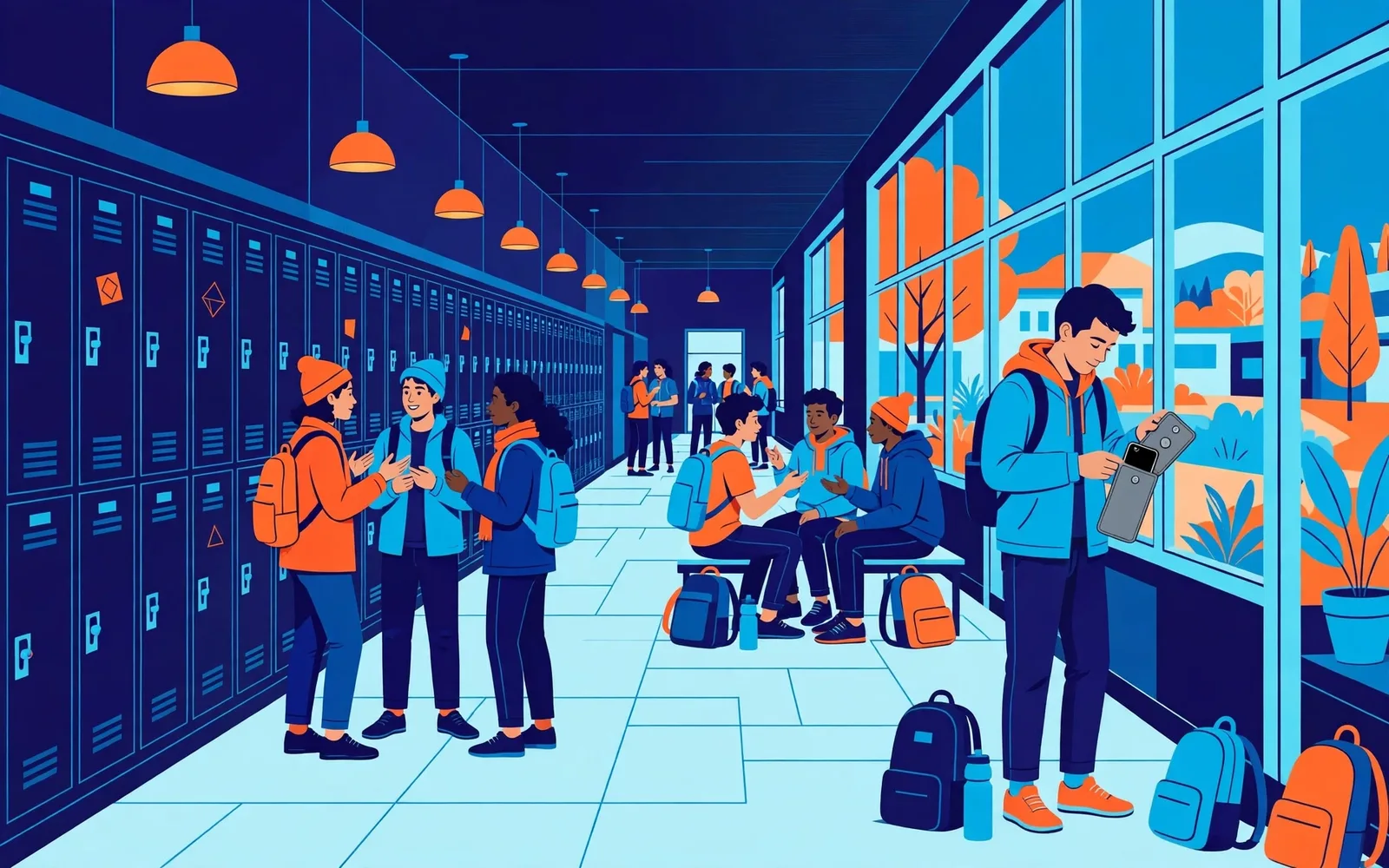
LAUSD's $6.35 million phone ban produced mixed results: most middle schoolers say they focus better without phones, but fewer than half of high schoolers agree, test-score gains began before the ban, and national research finds close to zero average effect on scores — though students do talk to each other more.
Los Angeles Unified spent $6.35 million locking up its students' phones, and now the students have had their say. The verdict, from the first big survey of the district's bell-to-bell phone ban, is messier than either side of the argument would like. Middle schoolers mostly say the ban helps them focus. High schoolers are split down the middle. Teachers say classrooms are calmer but enforcement is a daily grind. And the test scores? They went up — but they were already going up before a single phone went into a pouch.
That is the honest answer to the question every parent in America is asking right now, because Los Angeles is not some small experiment. LAUSD is the country's second-largest school district, with more than 400,000 students, and its phone policy is one of the strictest in the country: no phones from the first bell to the last, including lunch and the corridors between lessons. What happened there matters, because 40 states and the District of Columbia now have some form of school phone restriction, and California will require every district in the state to limit student phones by July 2026. If the biggest, most expensive version of this policy only half works, parents everywhere should know exactly which half.
The numbers come from LAUSD's spring 2026 School Experience Survey, the district's annual poll of students, staff and parents. This year it asked about the phone ban for the first time, and the response was enormous: more than 160,000 students answered, including 95% of middle schoolers and 91% of high schoolers, plus more than 21,000 members of staff. The phone-specific answers were released to LAist after a request, and reported this week by The 74. It is the first public, quantitative measure of how the policy has actually landed on campus — not a press release, not a pilot study, but the whole district talking at once.
Here is what they said. Start with the headline number, because it is the one that will travel furthest: among high school students, 27.3% said the phone ban had not improved their focus at all. Another 28.5% said it had helped only slightly. Just 15.6% said they focused better all the time. Put the other way, 49.9% of high schoolers said they focused better most or all of the time — which means half did, and half did not. That is not a triumph and it is not a failure. It is a coin toss, in a district that spent millions of dollars to remove the coin.
Middle school tells a different story. Nearly 58% of middle school students said they focused better all or most of the time without their phones, a clear majority and a noticeably better result than the older teenagers managed. That gap — between an 11-year-old and a 17-year-old — turns out to be one of the most consistent findings in the whole phone-ban debate, and it shows up in the national research too. Younger pupils, whose phones are newer and whose habits are less fixed, seem to gain more from having the device taken away. Older teenagers, who have spent years building their social lives around a phone, mostly find a way to carry on without it, or to carry on resenting it.
The staff numbers fill in the other half of the picture. Middle school staff estimated that about two-thirds of students "mostly" followed the rules. Among high school staff, that fell to just over half. And 15.8% of high school staff said students were not following the ban at all. About three-quarters of staff said teachers supported the policy, and around 60% reported that students were complying — but compliance, in a high school of two thousand teenagers, is a slippery thing to measure from the front of a classroom.
Elizabeth Ruff, an English teacher at Garfield High School, put the enforcement problem in a single image. "It definitely felt a little bit like playing Whac-A-Mole in terms of trying to do everything else I'm supposed to be doing in the classroom and also be looking out for who secretly has a cellphone behind their book," she told LAist. She also said the change in the room was real. "It's a big difference in terms of [students'] ability and willingness to focus on whatever we're doing in class. Obviously there are always some kids who are distracted … even if it's not their phone. But that has decreased a lot really, really markedly."
That tension — real improvement, real hassle — runs through everything the survey found. The clearest win has nothing to do with grades. Nearly six in ten students said they were interacting with each other more without their phones. Board member Nick Melvoin, who co-sponsored the policy, said he was "really encouraged" by that finding. "This isn't just about trying to be punitive adults," he said. "This is about [students] having a much more engaging day, a more fulfilling day when you're not just scrolling or texting." Myson Thomas, a 17-year-old senior at King/Drew Magnet High School, sounded almost unbothered by the whole thing. "I'm at school to learn, so I'm gonna turn my phone off," he said. "I already take rigorous courses, so it's no point of me using my phone at school."
Then there is Miles, a junior at the Sherman Oaks Center for Enriched Studies, who has been talking to LAist since the restrictions began in 2025. He called the policy "really, really annoying" back then. A year and a half later, his view has hardened, not softened. "I think it's still a pretty useless policy," he said. "It doesn't change anything other than how we hide our phones." He does not use his school's pouches, and he does not use his phone in class either — which is the awkward detail at the heart of this story. Some students never needed the ban. Some students ignore it. The ban's real audience is the large middle group in between, and the survey suggests that group is genuinely divided.
What $6.35 million actually bought
Before judging whether the money was well spent, it helps to see where it went. The school board voted in June 2024 to extend LAUSD's existing class-time ban to the full school day, and allocated $7 million to make it happen. The policy took effect in February 2025. Schools could choose how to enforce it: buy locking pouches or lockers, or rely on the "honour system" and ask students to keep their phones switched off in their bags. About half of schools bought the hardware.
Documents obtained by LAist through a public records request show the district spent about $6.35 million on phone-policy products during the 2024-25 school year. Of that, $5.42 million went to Yondr, the San Francisco company that makes the magnetically sealed pouches, and nearly $930,000 went to products bought through Amazon, including phone lockers. An official board report in January 2025 raised the authorised value of the Yondr purchasing contract from $3 million to $6 million before the policy even started.
Yondr pouches are now a familiar sight in American schools. As of early 2026, around three million students across US schools were using them, according to Stanford's report on the national research. The pouch works like a small fabric safe: the phone goes in, a magnet locks it, and only a special unlocking base at the school exit opens it again. In theory, the phone is present but unreachable. In practice, students have found workarounds, including slipping a dummy phone into the pouch while keeping the real one in a pocket, or breaking the locks open — a problem the Los Angeles Times has documented and LAist's reporting confirms.
Divide $6.35 million by LAUSD's enrolment and the cost looks modest — roughly $15 per student, or about the price of a school lunch for a week. But that is the wrong way to count it, because the money was not spread evenly. It went to pouches and lockers in about half the district's schools, while the other half enforced the same rule on trust and got nothing. And the $6.35 million is only the first year's hardware bill. Pouches wear out, get lost and get broken. Locks need replacing. Nobody has published what year two costs, or what the district will spend when the first batch of pouches reaches the end of its life. For a district that regularly warns about budget shortfalls, that is a question worth asking out loud.
There is also the question of what the money did not buy. It did not buy a phone-free school day for every student, because enforcement varies from campus to campus and from classroom to classroom. Mario Narciso, a social studies teacher at East Valley High School, said his school had tried both pouches and lockers, and that even with uneven enforcement he no longer saw phones as "a huge problem". "At the end of the day," he said, "it's more about that relationship that you have with your kids." That is a generous reading, and it may also be the truest one in this whole debate: the pouch is a tool, not a solution, and what matters most is still the adult in the room.
What the national evidence says — and why it is confusing
LAUSD's survey landed in the same week as a second, much bigger piece of news about phone bans, and the two stories belong together. The national study behind that news is the largest ever done on school phone restrictions: researchers from Stanford, Harvard, Dartmouth, Duke, the University of Pennsylvania and the University of Michigan examined lockable phone pouches in more than 4,600 schools, using GPS data from over 40,000 campuses, standardised test scores, attendance records, discipline data and a survey of more than 100,000 teachers. Their paper, published in the Quarterly Journal of Economics and released as NBER Working Paper 35132, is the closest thing this debate has to a definitive answer. It is also, on first reading, a contradiction.
The study found that pouches work at the thing they are designed to do. Phone use on campus falls sharply — GPS pings from phones drop by about 30% three years after a school adopts pouches, and teachers report far less phone misuse in class. But when the researchers looked for the payoff parents were promised, the picture went soft. The average effect on test scores was close to zero. High schools saw a modest improvement, particularly in maths. Middle schools saw a small negative effect. There was little evidence of any effect on attendance, and no clear evidence of improvements in self-reported classroom attention or perceived online bullying. Discipline got worse before it got better: incidents rose in the first year after a ban, then faded. Student wellbeing dipped at first, then recovered and turned positive in later years.
Matthew Gentzkow, the Stanford economist who co-led the study, was asked to respond to LAUSD's survey data, and his answer is worth quoting in full because it explains the LAUSD numbers better than any press release could. Students, he noted, were more likely to report talking to their friends more than they were to report focusing better in class. "That dovetails with our finding that the academic benefits here, at least as measured by test scores, are maybe somewhat disappointing or somewhat smaller than we might have expected," he said. "Whereas things like these well-being benefits may reflect these important changes outside of the classroom as a result of these policies."
There is one more wrinkle. The same research has also been reported with a much punchier headline: that strict phone bans restore the equivalent of one to two weeks of learning a year. That figure comes from the study's maths and reading estimate of about 0.01 standard deviations, as reported by EdSource when the Harvard-affiliated version of the findings was released on 17 November. Both framings describe the same data. The "one to two weeks" number is real, but it is the optimistic reading — the gain in one subject area, for one age group — while the "close to zero" number is the average across all pupils and all subjects. Parents should know both, because the gap between them is the gap between a policy that transforms learning and a policy that mostly changes the atmosphere in the corridor. If you want the fuller picture, our earlier guide to the national evidence on school phone bans walks through the same study in detail, including the Fordham survey that found more than 30% of high schoolers using YouTube for entertainment during the school day.
Florida offers the counter-example, and it is the one study in the field that actually found a clear test-score gain. David Figlio of the University of Rochester and Umut Özek of the RAND Corporation studied Florida's statewide ban — the first in the country, passed in 2023 — using data on more than 130,000 students in one large urban district. Their working paper found that test scores rose by 1.1 percentile points in the second year of the ban, that unexcused absences fell, and that about half of the score gain could be explained by the improvement in attendance. But the first year was rough: suspensions climbed 12%, with in-school suspensions up about 20%, and the increase fell disproportionately on Black students. By the second year, the discipline spike had mostly faded — the same pattern the national pouch study found.
A synthesis of ten published evaluations, updated on 13 November 2026, puts these results in perspective. Of the ten studies, five measured test scores. Only one — Florida — found a gain whose statistical range clearly excluded zero, at about 0.016 standard deviations. An English study found a larger-looking gain of 0.064 standard deviations, but its range included zero, meaning it could be chance. The big national pouch study found minus 0.003. The synthesis's blunt summary is that phone bans reliably cut phone use in class, but on test scores they show small or no effects. That is not the story anyone put on a campaign poster, but it is the story the data keeps telling.
So why do the LAUSD numbers look the way they do? Because the national pattern and the district pattern are the same pattern. Pouches cut phone use. Younger pupils gain more. Older pupils gain less. Discipline wobbles in year one. Wellbeing takes a couple of years to show up. Test scores barely move. LAUSD is not an outlier. It is a confirmation, at a scale no other district can match, of what the research already said — and it arrived just as California's statewide deadline made the question unavoidable.
The test-score puzzle parents should not be fooled by
There is one claim in the LAUSD coverage that deserves a careful read, because it will be quoted by both sides. LAUSD students have improved their scores on California's standardised reading and maths tests over the last three years. That is true, and it is good news. But those gains began before the district's phone ban started in February 2025, which means the ban cannot claim credit for them. A policy that starts in 2025 cannot explain a trend that started in 2023. The district's own survey does not try to make that claim — it measures perceptions, not test results — and the spokesperson who spoke to LAist was careful to say the data "reflects perceptions and does not definitively establish a causal relationship between the policy and student outcomes".
That caution matters, because the temptation to credit the ban for the test scores will be strong. It is the same temptation that appears in every school debate: a popular policy and a rising graph arrive at the same time, and someone draws a line between them. In this case the line does not hold. What the survey can honestly claim is narrower and, in its own way, more interesting: students say they talk to each other more, teachers say classrooms feel calmer, and about half of students say they focus better. Those are real outcomes. They are just not the outcomes that were promised when the board voted to spend $7 million.
There is also a harder question hiding inside the focus numbers. Fewer than half of high school students said they focused better in class all or most of the time without their phones. But focus is not the same as learning, and learning is not the same as a test score. The national research found no clear improvement in self-reported classroom attention even where phone use fell sharply. One explanation is that the phone was never the only distraction, or even the main one. A bored teenager without a phone is still a bored teenager. Another explanation is that the phone ban works on a different timescale: the QJE paper found wellbeing effects only turned positive after a couple of years, and LAUSD's ban is not yet two years old. The spring 2026 survey may simply be too early to catch the benefit, if there is one coming.
Parents should also notice what the survey did not ask, or at least what has not been published. There is no published breakdown of how the ban affected different groups of students — by race, by income, by special educational needs — and the Florida study is a warning about why that breakdown matters. When suspensions rose 12% in Florida's first year, the increase fell hardest on Black students, and the researchers could not explain why. LAUSD is one of the most diverse districts in America. If its discipline data shows the same pattern, parents deserve to see it before the policy is declared a success.
What this means for your child's school
LAUSD's experience is not a reason to abandon phone bans, and it is not a reason to adopt one blindly. It is a reason to ask better questions before your district spends its own millions. Here are the questions the Los Angeles data suggests every parent should be asking at the next school board meeting.
First, what exactly is the goal? If the goal is calmer classrooms and more face-to-face talk between students, the evidence says a ban can deliver that, and LAUSD's students confirm it. If the goal is higher test scores, the evidence says to expect little, and to wait at least two years before judging. A district that promises a test-score jump is promising something the research does not support. A district that promises a better school day is on firmer ground.
Second, how will it be enforced, and by whom? LAUSD let each school choose between pouches, lockers and the honour system, and the result was uneven enforcement that teachers are still wrestling with. A policy that depends on every teacher playing Whac-A-Mole all day is a policy that will work brilliantly in some classrooms and not at all in others. Ask whether your school has a plan for the students who will not comply, and for the teachers who will be expected to police it. Ask what happens the third time a student is caught, and whether the consequence falls evenly on all students. The Florida data says it might not.
Third, what does it cost, and what does that money displace? $6.35 million bought pouches and lockers for half a district. In a smaller district, the same policy might cost a few thousand dollars — or it might cost nothing at all, if the school chooses the honour system. But the real cost is not the hardware. It is teacher time, administrator time, and the goodwill spent on enforcement. Ask your district to publish the full cost, including replacement pouches, before the vote, not after.
Fourth, how will success be measured? LAUSD deserves credit for asking its students and staff, and for publishing the answers even when they were mixed. Most districts never ask at all. Demand a survey before the ban and a survey a year later, with the results made public. Without that, the debate will be fought on anecdotes — one teacher who loves the ban, one student who hates it — and nobody will ever know what actually happened.
Fifth, what about the phone at home? A school ban covers seven hours of a teenager's day. The other nine waking hours are yours. The research on phones before age 12 and teen wellbeing and on whether teens can really multitask homework and their phones both point the same way: the school gate is not where the problem starts or ends. A family charging station in the kitchen, a no-phones-at-dinner rule, and a contract your teenager helped to write will do more for their attention than any pouch ever will.
There is one more thing parents should take from LAUSD, and it is the most hopeful finding in the whole survey. Nearly six in ten students said they talked to each other more once the phones were away. That is not a small thing. For a generation that has spent its adolescence texting the person sitting next to them, an ordinary conversation in a corridor is a genuine gain. Gentzkow's team found the same thing nationally: the wellbeing benefits of phone bans show up outside the classroom, in friendships and social confidence, not in test scores. If that is the prize, then the ban is worth discussing on its own terms — not as a shortcut to better grades, but as a way of giving teenagers back a school day that belongs to them and to each other.
A wave that is not slowing down
Whatever parents decide, the direction of travel is clear. At least 40 states and the District of Columbia now restrict student phones in some form, and 26 states have gone further with bell-to-bell bans that cover lunch and passing periods, according to a recent tally. California's Phone-Free Schools Act, signed in September 2024, requires every district in the state to adopt phone limits by 1 July 2026 — which means LAUSD's early start will soon be the law for every school in the state, not just the second-largest district.
The movement is not only American. Denmark has moved to ban phones in schools, a story we covered in our guide to Denmark's school phone ban. In Canada, New Brunswick announced this week that its high schools will ban phones from next semester, and students have already staged walkouts in protest. In Britain, the government plans to introduce a social media ban for under-16s in spring 2027, and the big platforms are lobbying hard against it. The argument has moved beyond whether phones distract children in class. It is now about who gets to decide what childhood looks like — parents, schools, governments, or the companies that built the phones.
That is why a survey from Los Angeles matters more than it might seem. The phone-ban debate has been fought mostly on principle and anecdote: one side certain that phones are ruining a generation, the other certain that bans are pointless punishment. LAUSD gave the argument something it has rarely had, which is evidence from the people the policy actually affects, at a scale that cannot be dismissed. The evidence says the ban helps some students and leaves others cold. It says classrooms feel better and grades barely move. It says the social payoff is real and the academic payoff is, so far, mostly a promise. Parents who read the survey carefully will come away neither triumphant nor defeated, but better informed — and that, for a debate this heated, is progress worth having.
Frequently asked questions
Did LAUSD's phone ban improve test scores?
Not that anyone can show. LAUSD students' scores on California's standardised tests have risen over the last three years, but those gains began before the ban started in February 2025. The district's survey measures what students and staff think, not test results. Nationally, the largest study of phone pouches found the average effect on test scores was close to zero, with a modest gain in high-school maths and a small negative effect in middle schools.
How much did LAUSD spend on the phone ban?
About $6.35 million on phone-storage products in the 2024-25 school year, according to documents obtained by LAist: $5.42 million on Yondr locking pouches and nearly $930,000 on products bought through Amazon, including lockers. The board had allocated $7 million, and the Yondr contract alone was raised from $3 million to $6 million in January 2025.
Do students actually follow the ban?
Mostly, and less so as they get older. Middle school staff estimated about two-thirds of students "mostly" complied; high school staff put it at just over half, and 15.8% of high school staff said students did not follow it at all. Some students get around the pouches with dummy phones or by breaking the locks.
Do students focus better without their phones?
About half of high schoolers said so — 49.9% reported focusing better most or all of the time — while 27.3% said the ban had not improved their focus at all. Middle schoolers were more positive: nearly 58% said they focused better all or most of the time.
What is the biggest benefit students reported?
Talking to each other. Nearly six in ten students said they interacted more with their peers without phones, a finding the district's board members highlighted and one that matches the national research, which found wellbeing benefits emerging outside the classroom over a couple of years.
Are other places doing the same thing?
Yes. At least 40 US states and the District of Columbia have some form of school phone restriction, 26 states have bell-to-bell bans, and California requires all districts to limit student phones by July 2026. Denmark has moved to ban phones in schools, New Brunswick in Canada is banning them in high schools from next semester, and the UK plans an under-16 social media ban in spring 2027.
Sources
- The 74: LAUSD Spent Over $6 Million on a Phone Ban. Survey Data Show Mixed Results
- LAUSD School Experience Survey
- Stanford News: Do school phone bans make a difference?
- Allcott, Baron, Dee, Duckworth, Gentzkow and Jacob, "The Effects of School Phone Bans", Quarterly Journal of Economics, September 2026
- NBER Working Paper 35132: The Effects of School Phone Bans
- NBER: The Effects of School Phone Bans (working paper page)
- EdSource: Locking up student cellphones improves learning and test scores, study says
- Figlio and Özek, "The Impact of Cellphone Bans in Schools on Student Outcomes: Evidence from Florida", EdWorkingPaper 25-1315
- IQ Metrics: Do School Phone Bans Work? What 10 Studies Show
- Express Gazette: LAUSD Spends $6M on Phone Lockdowns, But Students Report Little Focus Improvement
- Parriva: LAUSD Cellphone Ban: Is It Helping Students Learn?
- Republican Journal: School Cellphones Banned: Is Your State Next?
- Greignor: A Year On, LAUSD's Cellphone Ban Reveals Mixed Outcomes — and Ongoing Debate