Late-Night Phones Are Stealing Teens' Sleep — Especially Girls
Two studies that tracked teens' phones instead of asking them found late-night scrolling is linked to much shorter sleep — and girls lose most. What parents can do.
Drafted with an AI writing assistant and checked against its sources by the editor before publishing. How we use AI.
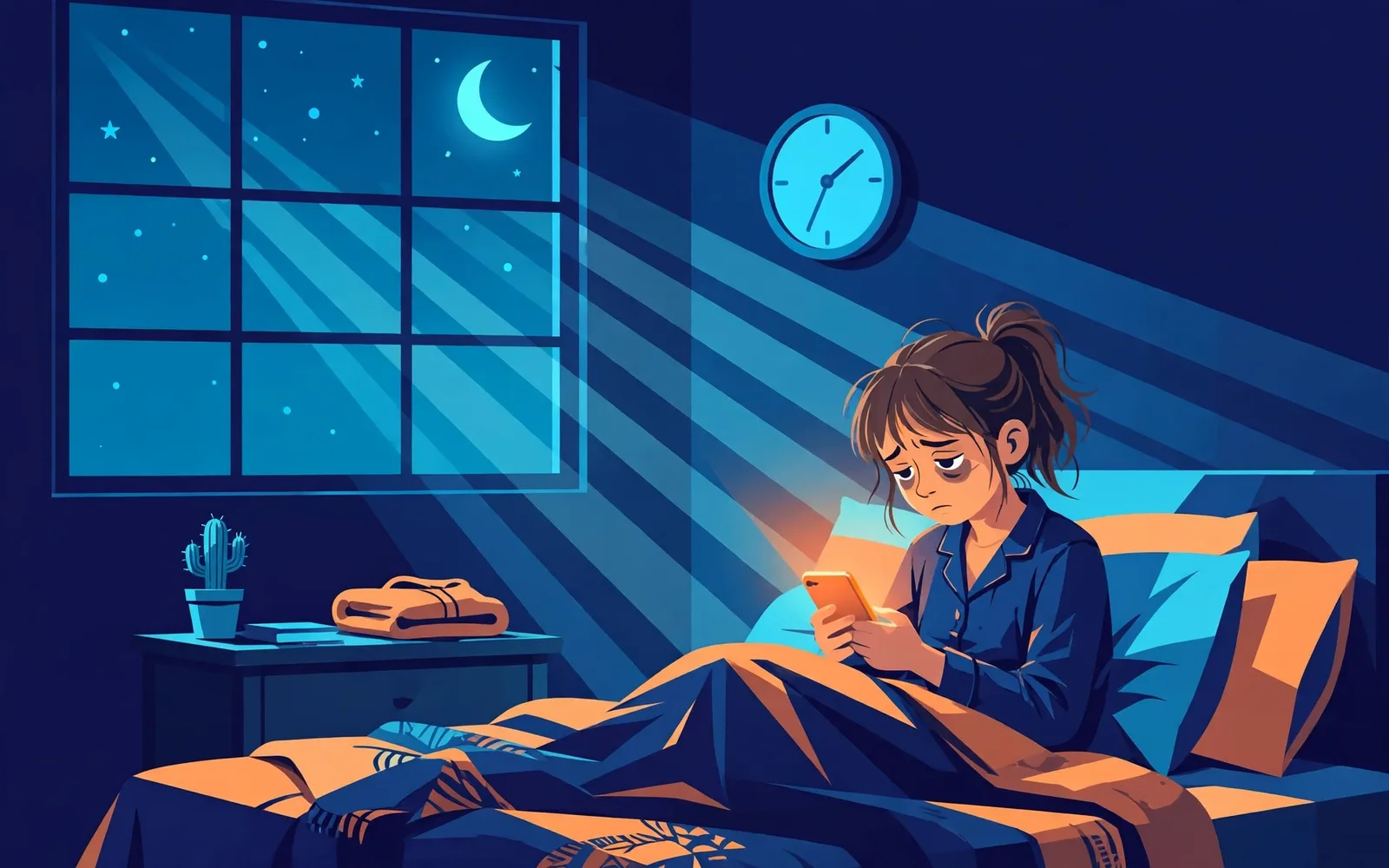
Two 2026 studies that tracked teenagers' phones with software instead of surveys found late-night phone use is linked to much shorter sleep: each extra hour of overnight use cost about 26 minutes of sleep, an extra hour of night-time social media cost 44 minutes, and for girls one extra hour of evening phone use pushed bedtime back by 82 minutes.
It is 11:40 at night and your daughter is still awake. Not because she is studying, and not because she cannot sleep. She is in bed, under the covers, phone inches from her face, thumb moving on its own. You have had the conversation. She has agreed to the rules. And still, most nights, the glow is there.
A new study suggests the glow is doing more damage than most parents realise — and that it is doing the most damage to girls. The research is unusual in one important way: nobody asked the teenagers how much they use their phones. Instead, the researchers put tracking software on the teenagers' own phones and watched what actually happened, minute by minute, for more than two weeks. What they found was not a vague warning about "screen time". It was a set of numbers, and the numbers are hard to argue with.
Every extra hour a teenager spent on their phone overnight was linked to about 26 minutes less sleep. An extra hour of social media at night specifically cost 44 minutes. And for girls, one extra hour of phone use in the evening pushed bedtime back by 82 minutes and cut sleep by 71 minutes. That is not a rounding error. That is the difference between a functioning school day and a miserable one.
What the researchers actually did
The study comes from Stony Brook University and was published in the Journal of Adolescent Health in November 2026. The lead author is Gina Marie Mathew, a researcher in public health at Stony Brook's Renaissance School of Medicine, working with colleagues including Lauren Hale and Dimitri Christakis, a paediatrician at Seattle Children's who has spent years studying children and screens.
They recruited 218 adolescents aged 13 to 18 from across the United States — half of them girls — and installed an app called RealityMeter on their personal phones. The app ran quietly in the background for an average of 17.5 days, logging which apps were used, for how long, and at what time. Nobody had to remember anything or estimate anything. The phone kept the record.
That matters because almost everything we thought we knew about teenagers, phones and sleep came from surveys. A teenager is asked how many hours a day they spend on their phone, and they guess. Sometimes they guess low because they know what the "right" answer is. Sometimes they genuinely have no idea — the whole point of a feed is that time disappears inside it. Either way, the data is soft. This study replaced the guess with a meter.
The researchers also refused to lump all screen time into one big daily total, which is what most studies do. They split the day into pieces: daytime, evening (8pm to 11pm) and night-time (11pm to 6am). And they separated general phone use from social media use. That split turns out to be the whole story, because an hour on a phone at 3pm and an hour on a phone at 11:30pm are not the same hour, and an hour of messaging a friend is not the same as an hour of short video.
Sleep itself was still self-reported — the teenagers filled in surveys about when they fell asleep, how long they slept and how well — which is a real limitation, and one the authors are open about. But the phone side of the equation, the part that is usually the weakest link in this kind of research, was measured properly for once.
The numbers, in plain language
Start with the broad pattern. Teenagers who spent more time on their phones during the day tended to fall asleep later, sleep for fewer hours, and keep more irregular schedules — sleeping in heavily at weekends to make up for the week, a pattern researchers call social jetlag, because the body is effectively flying across time zones every Friday night and back again on Monday morning.
Then the timing detail, which is where the study earns its keep:
- Each additional hour of overnight phone use (11pm to 6am) was associated with about 26 minutes less sleep.
- Each additional hour of night-time social media use specifically was linked to 44.4 fewer minutes of sleep.
- More phone use overall was linked to more catch-up sleep on free nights — the weekend lie-in that never quite pays the debt back.
- Only night-time social media use was linked to poorer sleep quality ratings, and even then the effect was small.
And then the finding that will probably get the most attention: the effects were not the same for boys and girls. Among girls, evening phone use and social media use were associated with significantly later bedtimes and shorter sleep, in a way that was not statistically significant among boys. For a girl, each additional hour of evening phone use was linked to falling asleep 82.2 minutes later and losing 70.8 minutes of sleep. Read that again. One hour of evening scrolling, and bedtime moves by nearly an hour and a half.
Nobody in the study is claiming to know exactly why the gap exists. It could be that girls use social media differently in the evening — more messaging, more social comparison, more emotionally loaded content that keeps the brain switched on. It could be that girls are more likely to be awake worrying about a conversation that happened in a group chat. The study was not designed to answer the "why". It answers the "how much", and the "how much" is large enough that parents of daughters should be paying particular attention.
A second study says the same thing, differently
One study is a data point. Two studies, done by different teams with different teenagers and different methods, pointing in the same direction, is a pattern. And a second, larger study landed a few weeks earlier.
In October 2026, JAMA Pediatrics published research from Columbia University's School of Nursing, again with Lauren Hale and Dimitri Christakis among the authors, using data from the Adolescent Brain Cognitive Development (ABCD) Study — the largest long-term study of brain development and child health in the US. This time the team followed 425 teenagers with an average age of just under 15, pairing a phone-sensing app with Fitbit sleep trackers across 7,591 nights. Both sides of the equation were measured by devices, not by memory.
On nights when a teenager used their phone more than their own usual amount after 10pm, they fell asleep about 65 minutes later and slept about 20 minutes less. The dose-response was almost comically precise: each additional minute of phone use after 10pm, above that teenager's own average, was associated with falling asleep 0.87 minutes later and losing 0.43 minutes of total sleep. Thirty extra minutes after 10pm meant falling asleep roughly 26 minutes later and losing about 13 minutes of sleep.
The ABCD study also caught something the Stony Brook study could not, because it measured sleep with a wrist tracker. Phone use in the final minutes before falling asleep was linked to more time spent awake after sleep onset, concentrated in the first half hour of sleep. Using the phone in the last five minutes before sleep was associated with the most wakefulness. The phone does not just delay sleep. It seems to make the first part of sleep lighter and more broken.
The teenagers in the ABCD study averaged nearly four hours of phone use a day, including about 40 minutes after 10pm. Evening use was mostly social media — YouTube, TikTok, Snapchat and Instagram. That is worth sitting with: the average teenager in the study was already spending the best part of an hour on social media after 10pm on a typical night.
A third piece of the same research programme, presented at the SLEEP 2026 conference in Baltimore, closes the loop on how evenings spiral. On nights when teenagers used their phones for 20 extra minutes in the hour before bed, they used their phones for 8 to 9 more minutes late that same night, between midnight and 5am. Teenagers in that study averaged 46 minutes of phone use in the middle of the night. The hour before bed, in other words, is not just an hour. It is the on-ramp to the rest of the night. Limit the on-ramp, and the rest of the night shrinks with it.
Why this is not just another "phones are bad" study
Parents have heard "phones are bad for sleep" so many times that the phrase has lost its edge. It sits in the same drawer as "eat your vegetables" — true, boring, easy to ignore. These studies are different in three ways, and the differences are what make them worth a parent's time.
First, the measurement. Self-reported screen time is famously unreliable, and it is unreliable in a specific direction: heavy users underestimate the most. When a study replaces the questionnaire with a meter, the associations usually get stronger, not weaker, because the noise drops away. That is what happened here. The numbers are not based on what teenagers think they do. They are based on what their phones recorded.
Second, the timing. Most advice about screens and sleep treats all screen time as equal, which leads to advice that feels impossible: "cut down on screen time" is a instruction nobody knows how to follow, including the adults giving it. These studies say something much more useful. It is not the total that matters most. It is the when. Daytime use barely registers compared with evening and night-time use, and social media at night is worse than general phone use. That turns a vague, unwinnable battle into a specific, winnable one: protect the last hour before bed and the hours after it.
Third, the within-person design of the ABCD study. The researchers did not just compare heavy users with light users, which always leaves the question of whether the heavy users were different in some other way — more anxious, less structured at home, worse sleepers to begin with. They compared each teenager's heavy nights against that same teenager's lighter nights. The same kid, the same phone, the same bedroom. On the nights they used the phone more after 10pm, they slept worse. That does not prove causation — no observational study can — but it rules out a whole shelf of alternative explanations in one move.
The honest caveats still apply, and they matter. Both studies are observational. It is possible that teenagers who cannot sleep reach for their phones, rather than the phone causing the sleeplessness — though the ABCD study's night-by-night design makes that explanation harder to sustain, since the phone use came first in the evening. The Stony Brook sample was recruited online, which may over-represent teenagers who are heavily engaged with their phones. The ABCD sample was limited to Android users with Fitbits. And sleep in the Stony Brook study was self-reported. None of that makes the findings wrong. It makes them findings, not verdicts, and parents should hold them that way.
How much sleep teenagers actually need
Part of the reason these numbers land so hard is that teenagers need far more sleep than most of them get, and the gap is already wide before phones enter the picture.
The American Academy of Sleep Medicine recommends that teenagers aged 13 to 18 sleep 8 to 10 hours every 24 hours on a regular basis, a recommendation endorsed by the American Academy of Pediatrics. The Centers for Disease Control and Prevention repeats the same range. That is not a luxury target. Sleep is when the brain consolidates memory, when growth hormone does its work, when the immune system resets, and when emotional regulation — the ability to not fall apart over a small thing — gets rebuilt for the next day.
Most teenagers do not get close. School start times, homework, sport, part-time work and a biological shift in adolescence that pushes the body clock later all squeeze from one side, and phones squeeze from the other. Against that background, losing 44 minutes to an hour of night-time social media is not a small leak. It is a large share of an already inadequate total. A teenager who needs nine hours and gets seven is running a two-hour deficit. An hour of late-night scrolling can be a quarter of that deficit all by itself.
It also helps explain a puzzle many parents live with: the teenager who is exhausted on Monday, fine by Thursday, wrecked again by Monday. The Stony Brook study found that heavier phone use was linked to more social jetlag — bigger swings between weekday and weekend sleep — and more catch-up sleep on free nights. Weekend lie-ins feel like recovery. The research suggests they are mostly a sign that the weekday debt is real, and that the body is paying interest on it.
Why girls, why evenings, why social media
The study does not settle why girls are hit harder, but there are good reasons to take the question seriously rather than file it under "interesting". Girls in this age group tend to use social media more for communication and social connection, and the content of that communication is often emotionally charged: friendships, status, appearance, who said what in the group chat. A game or a video can be put down. A conversation that feels unresolved cannot, at least not in a teenager's head at 11pm.
There is also the social comparison load. An evening spent looking at other people's highlight reels — bodies, parties, outfits, achievements — is a different kind of stimulation from an evening spent watching a show or playing a game. It keeps the brain's social threat system switched on, which is the opposite of what sleep requires. Sleep needs the body to stand down. Social media, at night, is a standing order to stay alert.
That does not mean boys are unaffected. In the Stony Brook study the overall pattern held for both sexes; the gender difference was in the strength of the evening effect, not in whether an effect existed at all. And in the ABCD study, the late-evening effects applied across the whole sample. The practical point is not "girls have a problem and boys don't". It is that if you have a daughter, the evening phone is a bigger deal than you may have assumed, and the conversation about it deserves more care than a blanket rule handed down at dinner.
None of this means social media itself is the villain in every story. The same research world that produces these warnings also produces studies showing that teenagers who use social media to stay connected with friends report feeling less lonely, and that online friendships can be real friendships. The issue here is narrow and specific: social media, at night, in the hours when the brain is supposed to be winding down. Keep the tool. Change the hour.
What actually works, according to the evidence
The researchers' own conclusion is refreshingly modest. They do not call for banning phones, or for parents to win a nightly war. They suggest that future work should test whether targeting specific phone habits makes a difference, "with particular attention to limiting smartphone use around bedtime and reducing time spent on social media". That is a research agenda, but it is also a parenting agenda, and it translates into a short list of things that are concrete enough to try this week.
Make 10pm the line, not bedtime. The ABCD study's clearest practical finding is that the damage clusters after 10pm. A rule that says "phones off at 10" is easier to understand, easier to enforce and easier for a teenager to accept than "less screen time", because it has a time on it. It also matches the evidence: the same hour of phone use costs far more sleep at 10:30pm than it does at 3:30pm.
Charge the phone outside the bedroom. This is the single most effective change in the research literature on teen sleep, and the least popular with teenagers, for obvious reasons. A phone charging in the kitchen cannot be checked at 1am. A phone charging on the bedside table will be checked at 1am, because willpower at 1am is not a plan. If a full ban feels like too much, start with school nights only. The Stony Brook study's weekend catch-up finding suggests school nights are where the debt is built.
Protect the last 30 minutes, not just the last five. The ABCD study found that phone use in the final five minutes before sleep was linked to the most broken sleep in the first half hour after falling asleep. That is the worst possible window to be scrolling. A wind-down that starts half an hour before bed — phone down, lights low, something boring — gives the brain time to actually switch off. It does not have to be a meditation retreat. It can be a book, a shower, or just lying there. The point is the absence of the feed.
Go after social media first. If your teenager uses their phone in the evening for music, homework or messaging a friend, the evidence says that is not the main problem. Social media at night is. That means the conversation can be specific instead of general: not "get off your phone", which starts an argument about everything, but "no social apps after 10", which is a rule about one thing. Teenagers argue less with specific rules, partly because specific rules are easier to see as fair.
Talk to daughters differently, not more strictly. The gender gap in the Stony Brook study is a reason to listen, not to lecture. Ask what is actually happening on the phone in the evening. Often the answer is not "watching videos". It is a group chat that never ends, a friend who is upset, a post that got an unexpected reaction. Those are real social pressures, and a teenager who feels heard about them is more likely to accept a boundary around them. A rule imposed on a problem you have not understood feels arbitrary. A rule that follows a conversation feels like help.
Do not let the weekend lie-in fool you. Sleeping until noon on Saturday feels like the system working. The research suggests it is mostly the system compensating — and that the compensation is incomplete. A teenager who sleeps in by three hours at the weekend is not "catching up" in any full sense. They are still carrying the weekday deficit into Monday, and the swing itself, the social jetlag, is linked to worse mood and worse attention. Consistent wake times, even at weekends, do more than heroic lie-ins.
Model it, or do not be surprised. Teenagers are extremely good at spotting hypocrisy and extremely bad at admitting it bothers them. A parent who scrolls in bed until midnight while telling a teenager to put their phone away is not giving advice. They are giving a demonstration. The household rule works best when it is a household rule — phones charging in the kitchen at 10pm, including yours.
What this does not mean
It does not mean your teenager's phone is the sole reason they are tired. Adolescence itself moves the body clock later, school starts early, homework loads are real, and anxiety and low mood both damage sleep and drive phone use. A teenager who is lying awake at 1am because they are worried about an exam will reach for their phone, and the phone will make it worse, and both things can be true at the same time. If your teenager is consistently unable to sleep even when the phone is out of the room, that is a conversation for a doctor, not a charger cable.
It also does not mean every teenager is affected equally. The studies report averages, and averages hide wide variation. Some teenagers use their phones late and sleep fine. Some sleep badly for reasons that have nothing to do with a screen. The point of research like this is not to hand every family the same rule. It is to show where the biggest, cheapest wins are for most families, most of the time.
And it does not mean the answer is fear. The last few years have produced a steady drumbeat of alarming headlines about teenagers and screens, and a lot of it has been overblown. The honest picture, from the largest studies, is more mixed than the headlines suggest: heavy, compulsive use is linked to real harms, moderate use is often neutral or even helpful, and the details — what, when, how much, and who — matter more than the totals. These two sleep studies fit that pattern. They do not say phones ruin sleep. They say phones late at night, and social media in particular, cost sleep, and the cost is measurable, and for girls it is large.
The bottom line for parents
Two independent teams, using tracking software instead of questionnaires, have now shown the same thing: what a teenager does on their phone after 10pm matters far more for their sleep than how much they use it during the day. An hour of night-time social media can cost 44 minutes of sleep. For girls, an hour of evening phone use can push bedtime back by more than an hour.
That is a problem with a shape, which means it has a solution with a shape. Not a ban, not a lecture, not a family meeting that ends in tears. A line at 10pm. A charger in the kitchen. Social apps off first. Thirty quiet minutes before bed. It is a small set of changes, aimed at the hours where the evidence says the damage is done — and it is the kind of change a family can actually keep, which is the only kind that counts.
Frequently asked questions
How much sleep do teenagers actually need?
The American Academy of Sleep Medicine recommends 8 to 10 hours every 24 hours for teenagers aged 13 to 18, on a regular basis. The American Academy of Pediatrics endorses the same range. Most teenagers get considerably less, especially on school nights.
Is it the phone, or is it just that bad sleepers use their phones more?
Both can be true, and the studies cannot fully separate them because they are observational. But the ABCD study compared each teenager's heavy-phone nights with their own lighter nights, and sleep was worse on the heavy nights for the same teenager. That makes the "it is only reverse causation" explanation much harder to sustain.
Why are girls affected more than boys?
The Stony Brook study found the evening effect was significantly stronger in girls, but it was not designed to explain why. A likely part of the answer is that girls' evening phone use involves more social communication and social comparison, which keeps the brain alert for longer. More research is needed before anyone can say for certain.
Does daytime phone use damage sleep too?
Less so, according to these studies. Daytime use was linked to later bedtimes and shorter sleep, but the strongest associations by far were for evening and night-time use, and for social media specifically. The hour matters more than the total.
My teenager says they need their phone as an alarm. What do I do?
Buy a cheap alarm clock. It is the oldest trick in this particular book, and it works, because it removes the one legitimate reason for the phone to be in the bedroom. A ten-dollar alarm clock is a lot cheaper than a term of exhausted school days.
Will a weekend lie-in fix a week of short sleep?
Only partly. The Stony Brook study found that heavier phone use was linked to more catch-up sleep on free nights, but also to more social jetlag — big swings between weekday and weekend sleep. Consistent wake times help more than heroic lie-ins.
Should I just take the phone away at night?
Taking the phone away works better as a household routine than as a punishment. Phones charging outside bedrooms, for everyone, at an agreed time, is a rule a teenager can live with. A phone confiscated after an argument is a grievance that lasts longer than the rule does.
Sources
The Stony Brook study is published in the Journal of Adolescent Health: Objectively Measured Smartphone Use Is Associated With Worse Sleep Health Among Adolescents: The Stony Brook University MEDiA Study (PubMed, PMID 42998067, DOI: 10.1016/j.jadohealth.2026.08.039). Medical Xpress covered the findings the same week: Late-night phone use linked to shorter sleep in teens, especially girls. The JAMA Pediatrics study is described by Columbia University School of Nursing: Late-Night Smartphone Use Linked to Poorer Sleep Among Teens, Columbia Nursing Study Finds, and in the JAMA media release: Evening Phone Use and Sleep Outcomes Among Youth (DOI: 10.1001/jamapediatrics.2026.4902). The SLEEP 2026 findings on pre-bedtime use predicting overnight use are reported by Newswise: Bedtime Smartphone Use Predicts Overnight Phone Activity in Teens. The American Academy of Sleep Medicine's recommendation that teenagers aged 13 to 18 sleep 8 to 10 hours is set out here: Pediatric sleep research can help Make Our Children Healthy Again, and the CDC repeats the range in its youth sleep guidance: Sleep | Youth Risk Behavior Surveillance System. Nationwide Children's Hospital explains the same guidance for families: Healthy Sleep Habits for Older Children and Teens. Independent coverage of the JAMA Pediatrics study adds detail on the dose-response figures: Teens lose sleep on nights they use phones after 10pm, tracker study finds and Evening Smartphone Use After 10 PM and Teen Sleep: What the 2026 JAMA Pediatrics Study Found, with further reporting here: Late-Evening Smartphone Use Linked to Poorer Sleep in Adolescents: JAMA. For the wider context on teens and screens, see our earlier reporting on the teen sleep crisis and the 3 a.m. scroll, on sleepmaxxing and teens' obsession with perfect sleep, on the new JAMA study linking heavy short-video use with teen mental health risks, and our daily study on 45% of teens saying social media hurts their sleep.