The teen sleep crisis: what the 3 a.m. scroll is doing
Only 24% of US high schoolers get 8 hours of sleep on school nights, per the CDC's newest data — here is what the 3 a.m. scroll costs and how parents can fix it.
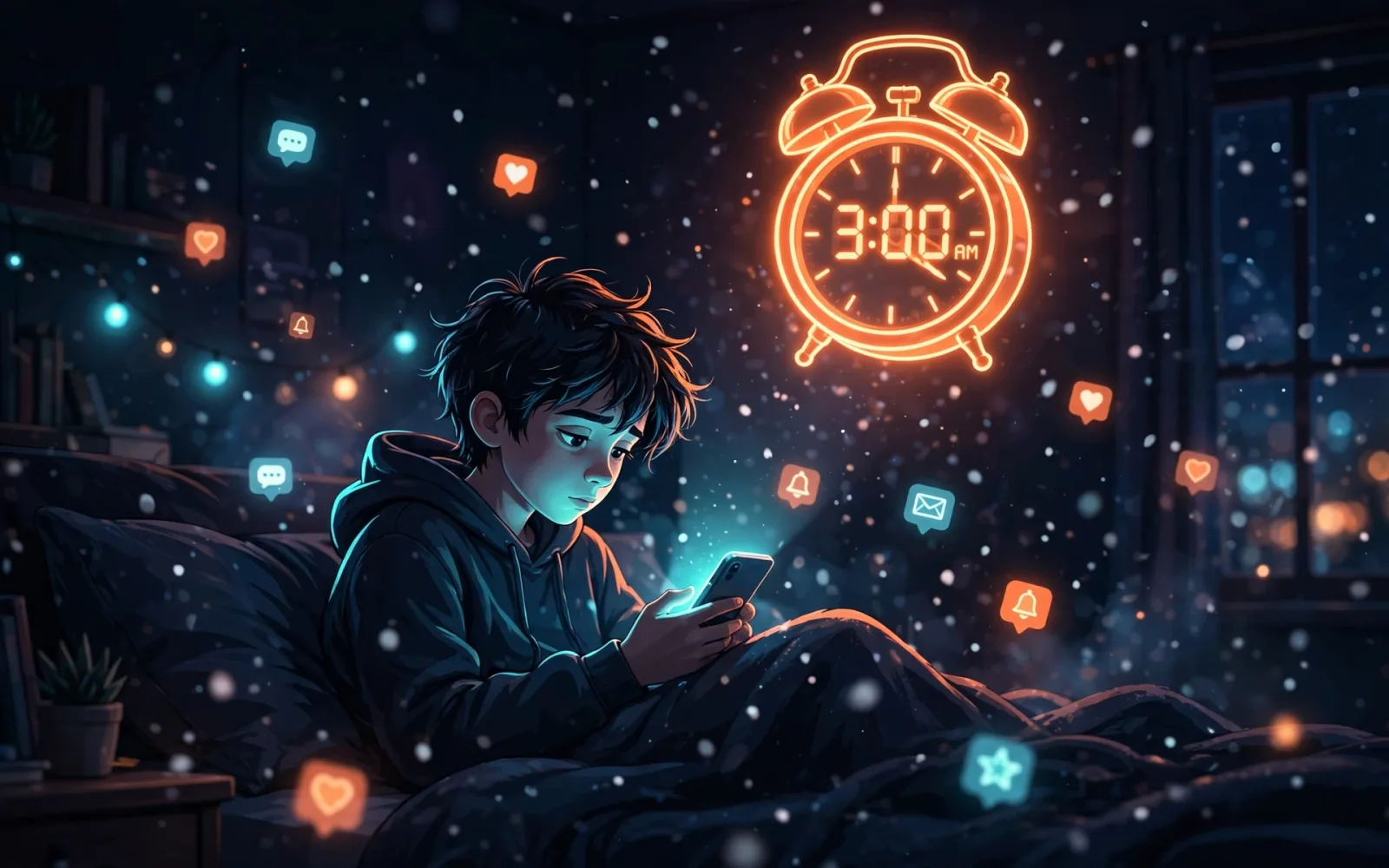
The 3 a.m. scroll keeps roughly three in four US teens from the 8-10 hours of sleep doctors recommend: only 24% of high schoolers get 8 hours on school nights (CDC 2025), late-night screen light and notifications fragment their rest, and the sleep debt shows up as worse grades, mood, and health. The highest-leverage fix is moving the phone's charger out of the bedroom.
It is 3 a.m. and your house is quiet. Except down the hall, where a face glows blue under a blanket. Your teenager is not tossing and turning. They are scrolling.
They are not the exception. They are the statistic. Three out of four American high school students do not get the sleep their growing brains need — and the newest federal data shows the crisis is not improving at all.
The numbers are not recovering
When the CDC released its Youth Health in Focus report in September 2026, there was good news on teen mental health and diet. Sleep was not on the good-news list. Only 24% of high school students got at least 8 hours of sleep on an average school night in 2025 — statistically the same as 23% in 2023, as coverage of the report confirms.
Zoom out and the picture darkens further. A March 2026 analysis published in the Journal of the American Medical Association found that 77% of high schoolers slept fewer than 8 hours in 2023, up from 69% in 2007 — and more teens are now reporting five or fewer hours a night. The rise cut across every group: boys and girls, every race and ethnicity, every grade.
The older CDC trend report fills in the decade-long slide. As Contemporary Pediatrics reported, the share of boys getting 8 hours fell from 35% to 25% between 2013 and 2023; for girls it fell from 29% to 22%. In 2023, Black students (19%) and Hispanic students (24%) were less likely to reach 8 hours than White students (25%).
This is not a small dip. It is a generation-long trend moving in the wrong direction.
The phone owns bedtime
Doctors have long known that screens and sleep do not mix, but the phone's grip on bedtime keeps tightening. The CDC's 2025 data found that about 36% of high school students use social media every hour or more — nearly the same as the 37% measured in 2023. When a third of teens are checking feeds hourly, "bedtime" is more of a suggestion than a boundary.
Teens can feel the damage themselves. A 2025 Pew Research Center survey found that 50% of teen girls and 40% of teen boys say social media has hurt their sleep. The mechanism is simple: bright light delays the body's sleep signal, notifications fragment whatever sleep does happen, and the feed has no natural ending. There is always one more video, one more message, one more reason to stay awake until 3 a.m.
What the sleep debt actually costs
This is not just about groggy mornings. The American Academy of Pediatrics endorses 8 to 10 hours of sleep every night for ages 13 to 18 — a recommendation built by 13 sleep experts who reviewed 864 studies. Regularly sleeping less, the AAP notes, is associated with attention, behavior, and learning problems, plus higher risk of accidents, injuries, hypertension, obesity, diabetes, and depression.
The CDC connects the same dots: insufficient sleep is linked to poor mental health, difficulty concentrating, and risky behaviors like texting while driving or not wearing a seat belt. That is the real cost of the 3 a.m. scroll — not laziness, but a measurable hit to a teenager's mood, grades, safety, and health.
Two bedtimes, side by side
The difference between a tired teenager and a rested one often comes down to one thing: where the charger is.
| Phone on the nightstand | Phone charges in the kitchen | |
|---|---|---|
| 11 p.m. to 1 a.m. | "Just five more minutes" becomes two hours of scrolling | The bedroom gets boring, so sleep arrives sooner |
| During the night | Notifications buzz and light up the room, breaking sleep cycles | No interruptions; sleep stays deep |
| The morning | Snoozed alarms, a groggy rush, a grumpy breakfast | Still tired at first, but alertness builds within days |
| The dynamic | A nightly argument about the phone | The rule is about the charger's address, not the kid's character |
No willpower is required. A teenager cannot scroll a phone that is in another room.
Three rules that actually work
1. Move the charger, not the argument. Tonight, plug the phone in somewhere outside the bedroom — the kitchen counter works fine. This is the single highest-leverage change a family can make. Everything else is commentary.
2. Screens off 60 minutes before bed. The wind-down hour matters: dim lights, a shower, a book, actual conversation. The catch: parents have to model it. A rule nobody over 18 follows will not survive a week.
3. Ask, don't lecture. Two questions open the conversation better than any speech: "What time did you actually fall asleep last night?" and "Do you wake up feeling rested?" Most teens can feel their own sleep debt — they just need permission to admit it.
Structural fixes help too. The AAP has called since 2014 for middle and high schools to start no earlier than 8:30 a.m., because teen body clocks are wired for late nights and early classes make the debt worse. If your school starts early, the kitchen charger matters even more.
Frequently asked questions
How much sleep does my teenager really need?
Teens ages 13 to 18 need 8 to 10 hours per night, per the AAP-endorsed guidelines. Only 24% of US high schoolers hit even the bottom of that range on school nights, according to the CDC's 2026 report.
Why is my teen wide awake at midnight no matter how early they wake up?
It is mostly biology. During puberty, the brain's sleep signal shifts later, so teens genuinely are not sleepy at 10 p.m. That does not mean screens get a free pass — late-night scrolling pushes an already-late bedtime even later. Earlier school start times collide with this biology, which is why the AAP backs starting school no earlier than 8:30 a.m.
Does one late night really matter?
One late night is fine. The problem is the pattern: the JAMA-published analysis shows chronic short sleep has risen across the whole teen population since 2007, and it is the chronic debt — not the occasional late night — that the CDC links to poor mental health and weaker concentration.
Will taking the phone out of the bedroom ruin our trust?
Frame it as a house rule about sleep, not a punishment about behavior — and apply it to everyone. When parents charge their own phones in the kitchen too, it reads as a family habit, not a punishment. Give your teen an old-fashioned alarm clock so "I need it for the alarm" cannot veto the plan.
What if my teen says they need the phone to fall asleep?
That is the habit talking, not the biology. A week of a phone-free bedroom is usually enough to prove it: most families see mornings change first, and moods follow within two weeks. If sleeplessness persists beyond a few weeks, talk to your pediatrician — it may be anxiety, depression, or a sleep disorder rather than a screen problem.
The 3 a.m. scroll is not a character flaw. It is a design problem: a device built to hold attention, sitting two feet from a tired brain every single night. Move the charger, and you change the whole equation.