Sharenting: the risks of posting your kids online
France now holds everyday parents legally responsible for photos of their kids. Here's what the law says, the risks behind it, and a checklist to post safely.
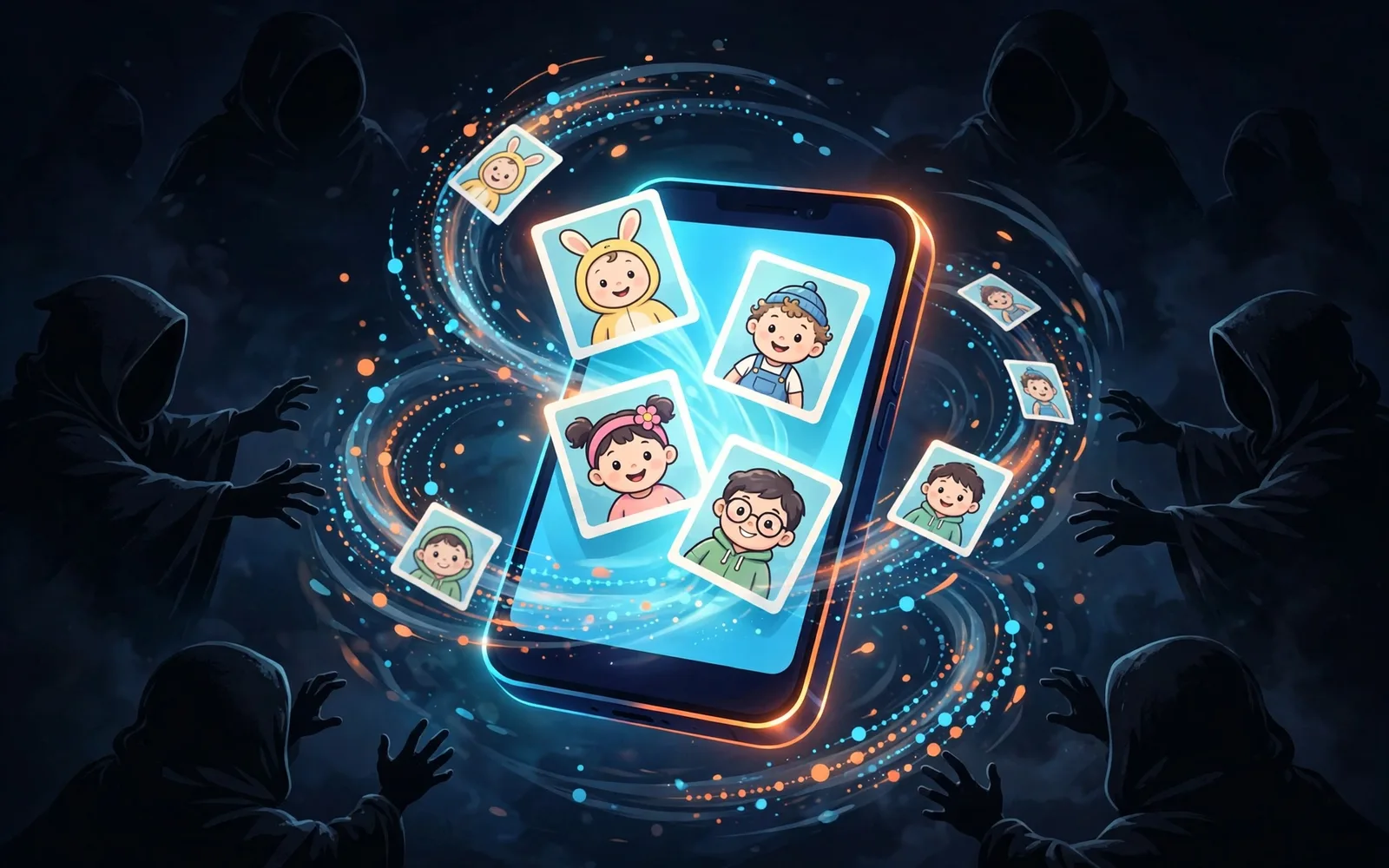
Posting your kids' photos online can expose them to identity theft, blackmail, cyberstalking, and image exploitation — and France now holds parents legally responsible for it. Run every post through the grandma test and the future-teen test, skip bath photos and school names, and use private albums for family sharing.
If you post pictures of your kids online, you probably think of yourself as a regular parent, not a content creator. You're not a family vlogger — you just share the first-day-of-school photo, the Halloween costume, the lost-tooth grin with people you love.
France's new law says that distinction no longer matters. In February 2024, France passed the world's first law aimed directly at sharenting — the habit of parents sharing photos, videos, and personal details of their children on social media. And unlike earlier rules aimed at child influencers, this one applies to everyday parents too.
Sharenting sounds harmless, and usually the intentions behind it are. But the risks hidden in those ordinary posts pushed lawmakers to act. Here's what the law says, what the research shows, and a checklist for sharing safely.
The scale of everyday sharenting
"Sharenting" is a blend of "sharing" and "parenting": posting your child's photos, videos, milestones, and personal stories online. One scholarly analysis describes the problem plainly: every post creates a digital footprint without the child's consent — a permanent mark in the digital world they had no word or choice in.
How big is that footprint? By the time a child turns 13, their parents have posted an average of 1,300 photos and videos of them on social media, according to the Children's Commissioner for England's 2018 report "Who knows what about me?". Add birthday announcements, school names, and locations, and your child's identity is mapped online before they can understand what that means.
The risks behind the law
The French debate that led to the 2024 law named four risks directly: online identity fraud, blackmail, cyberstalking, and the exploitation of children's images. These are not theoretical. French MP Bruno Studer, who drove the legislation, has cited research suggesting half of the images exchanged on child exploitation forums were first posted by parents on social media, as reported by Internet Safe Education.
Other numbers tell the same story from different angles:
- An Australian Institute of Criminology finding, cited in a University of Cincinnati law review, found that around 7% of people who shared images of children online received direct requests for sexually explicit child content from online predators.
- Barclays told the Children's Commissioner that criminals can start identity theft with just a name, date of birth, and home address — details parents routinely give away in birthday posts and tagged locations — and forecast that by 2030 sharenting could account for two-thirds of identity fraud affecting young adults, costing £667 million a year.
- Australia's eSafety Commissioner, Julie Inman Grant, has warned that a photo posted of your child "can end up travelling more widely than you want (or realise) and can be 'harvested' from social media... and used for unintended purposes."
Once a photo leaves your phone, you no longer control where it goes. Strangers can download, screenshot, and re-upload it anywhere — including places you never intended.
What France's law actually says
On 19 February 2024, France enacted LOI n° 2024-120, "guaranteeing respect for children's image rights." Legal scholars note it was the only standalone piece of legislation anywhere in the world directly addressing sharenting as of November 2024. France had already passed a Child Influencers Act in 2020, but that covered only children who appear in monetized videos. The 2024 law goes further: it covers all parents.
According to France's official public service guide, the law says:
- Both parents are jointly responsible for protecting their child's image rights. Posting your child's photos is now legally framed as part of parental authority — the same authority that covers their safety and health.
- The child must be involved in decisions about their image, according to their age and maturity. A teenager's objection carries real weight.
- One parent can take the other to court. If parents disagree about posting, a family judge can prohibit one parent from publishing or sharing the child's image without the other parent's consent.
- Parents who cause harm can be ordered to pay damages to their child.
- In serious cases, a judge can strip parents of control over the child's image rights entirely — a "forced delegation" — when posting harms the child's dignity or moral integrity.
Bird & Bird's legal analysis adds that France's data protection authority, the CNIL, can launch fast-track court proceedings if a request to delete a child's personal data is ignored.
France's approach is already the model other countries are watching.
Your child has privacy rights — even against you
Under the UN Convention on the Rights of the Child, children have an explicit right to privacy (Article 16), and in 2021 the UN Committee on the Rights of the Child issued General Comment No. 25 on children's rights in the digital environment, calling on countries to build laws that protect children's privacy online. The University of Cincinnati's Immigration and Human Rights Law Review frames the point bluntly: by posting our children's lives, "parents curate their child's digital identity long before the child develops the capacity to willfully consent to such sharing."
In plain terms: your child is a person with a right to privacy, not a character in your feed — and what a toddler shrugs at, a 15-year-old may find humiliating.
Sharenting risks vs. safeguards
| Risk | Who it affects | What parents can do |
|---|---|---|
| Identity theft from shared details (name, birth date, school) | Your child, years later | Never post full names with birth dates, school names, or locations |
| Photos copied to exploitation forums | Your child, right now | Keep accounts private; never post bath or partially clothed photos |
| Cyberstalking from location and routine clues | Your whole family | Turn off geotags; avoid real-time "we're here now" posts |
| Blackmail or bullying with old posts | Your teenager | Ask kids aged 7 and up before posting; delete anything they dislike |
| Lost control of the image forever | Your child's future self | Use private albums for family; treat public posts as permanent |
The parent checklist: two tests before you post
You don't have to stop sharing — just share like it matters, because legally and practically, it does. Run every post through two tests:
The grandma test: Would I be okay with this photo on a billboard on the highway? If the idea of strangers seeing it makes you uneasy, don't post it. Your followers list is never as private as you think.
The future-teen test: Would my 15-year-old thank me for this post? Imagine your child at 15 finding it. If they'd cringe, skip it — or keep it in the family album instead.
Then lock in these five rules:
- No bath, swim, or partially clothed photos — ever. This is the single highest-risk category of image.
- No school names, locations, or routines in captions. "First day at Lincoln Elementary!" hands strangers a map. Say "first day of school" instead.
- Use private albums for family sharing. Shared photo albums and private group chats give grandparents the pictures without giving the internet your child.
- Ask kids aged 7 and up before you post. It teaches consent, and it respects the person in the photo.
- Do a yearly photo audit together. Once a year, scroll through what you've posted with your child and delete anything they'd rather not have out there. Make it a ritual, not a punishment.
Frequently asked questions
Is sharenting actually illegal where I live?
Probably not yet — France is the only country with a standalone sharenting law. But most countries already have privacy and data protection laws covering children's images, and France's approach is widely seen as the model others will follow.
I'm not an influencer. Does the French law really apply to me?
Yes. France's 2020 law targeted child influencers; the 2024 law deliberately goes beyond them to cover everyday parents posting family photos. The message is that parental authority over a child's image doesn't depend on whether you earn money from it.
Can my child ask me to take photos down?
Yes. Under the French law, parents must involve the child according to their age and maturity, and a family judge can intervene in disputes. Even where no such law exists, honoring a delete request is the simplest way to respect your child's growing autonomy.
What about photos other people post of my child?
Talk to them first — most people will take a photo down if you ask. If they refuse and the image puts your child at risk, you can report it to the platform and, in serious cases, to your country's data protection authority.
Does a private account make posting safe?
Safer, not safe. Followers can screenshot and re-share, accounts get hacked, and "private" posts travel. Treat anything you post as potentially permanent, and keep the most personal moments in truly private albums.