Fortnite Pirate Token: The Hunt Kids Can't Quit
Fortnite's Pirate Token promises the whole Item Shop free at 1-in-137,500 odds. What the hunt is, why kids grind for hours, and the scams parents must spot.
Drafted with an AI writing assistant and checked against its sources by the editor before publishing. How we use AI.
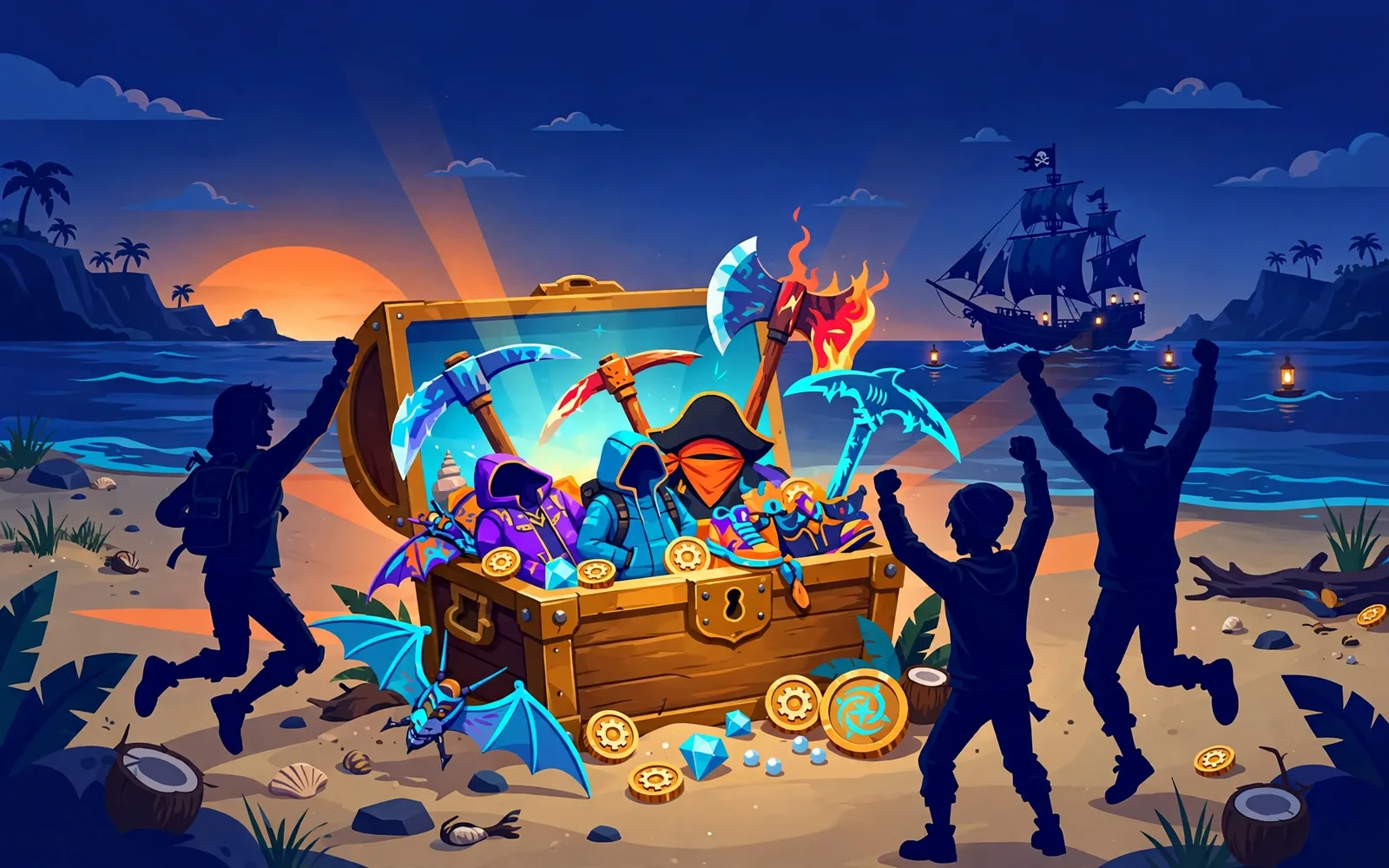
Fortnite's Pirate Shop Token is an ultra-rare drop — 1 in 137,500 per chest — that unlocks two 14-day windows of free Item Shop cosmetics. Kids are grinding for hours and falling for compass and account scams, so parents should talk about the odds, set time limits, and never let a child buy an account or share a login.
Somewhere in your house right now, a child is probably opening virtual treasure chests. Not one or two — hundreds. Maybe thousands. They are hunting for a single item in Fortnite called the Pirate Shop Token, and the odds of finding it are so small that Epic Games, the company behind the game, was forced to publish them after a week of player fury. One chest in 137,500. That is the number at the centre of the biggest gaming story your child is following this month, and it is worth understanding before the next argument about screen time starts.
The Pirate Token — officially called Pirate Shop Access — is a reward hidden inside Fortnite's Treasure Hunters mini-season, which launched on 1 November 2026. Find it, and the game's entire Item Shop becomes free to claim for two separate 14-day windows. Every outfit, pickaxe, glider and emote, without spending a single V-Buck, Fortnite's in-game currency. For a child who has spent months staring at skins they cannot afford, that is not a small prize. It is, in their eyes, the whole shop.
This article explains what the token is, what the real odds are, why children are spending entire weekends grinding for it, why some players tried to report Epic to the US Federal Trade Commission, and — most importantly for parents — the scams that have grown up around the hunt, and what to say to your child about it.
What the Pirate Token actually is
Fortnite's Treasure Hunters is a short pirate-themed mini-season built around One Piece, the long-running anime and manga series. The map changed, new characters arrived in the shop, and a new mechanic appeared quietly in the background: treasure. When a player opens a chest in a normal Battle Royale or Zero Build match, there is a tiny chance that instead of a weapon or shield potion, they find one of seven treasures. The most valuable of these is Pirate Shop Access, the item players call the Pirate Token.
The token does not give its finder gold or V-Bucks. It gives them access. Once activated, every eligible cosmetic in the Item Shop can be claimed for free during a 14-day window — and the finder gets a second activation, for a second 14-day window, at a later point. Real-money bundles, gifting and Battle Pass rewards are excluded, and only one free sidekick can be claimed, but the haul is still enormous: dataminers have estimated the combined value at roughly 1.2 million V-Bucks across both uses, which at normal shop prices represents hundreds of dollars' worth of cosmetics.
There is a catch that matters for the calendar. The token has to be activated before it expires — reporting puts the deadline at 16 December 2026 — and the Treasure Hunters season itself ends in early December, with Polygon reporting 5 December as the season's end. The hunt, in other words, has a clock on it. That deadline is doing a lot of the psychological work here: children know the window is closing, and that urgency is exactly what keeps them opening one more chest.
The token is also tied to the account that finds it. Nobody can sell you one, transfer one to you, or gift one to your child. Remember that sentence. It is the single most useful fact in this article, because almost every scam built around the token depends on a child not knowing it.
The odds, in plain numbers
For the first week of the season, Epic said nothing about the odds. Players knew the token existed, they knew it was rare, and they had no way to know how rare. Community guesses filled the vacuum: one widely shared estimate put the odds at 1 in 700,000 per chest. Then, on 7 November, after days of complaints, boycott calls and attempts to report the company to the FTC, Epic published the real numbers through its Fortnite Status account on X.
Every time a player opens a chest in a normal match, the odds of finding each treasure are:
- Weekly Gold Outfit: 1 in 1,562,500
- Pirate Shop Access (the Pirate Token): 1 in 137,500
- Gizmo (any): 1 in 127
Epic added that the rates had stayed constant since the season launched on 1 November and do not change through the day — except during Treasure Hours, scheduled Saturday windows in which the Pirate Token rate is boosted, normally by 1.5 times, and in the evening session on 7 November by 2 times. It also confirmed that a player cannot receive the same treasure twice, apart from Gizmos.
Those numbers deserve a moment of translation, because "1 in 137,500" does not land with a 10-year-old the way it should. Each chest is a separate roll of the dice. Opening 137,500 chests does not guarantee a token; it is simply the average. A player could find one in their first chest, or open 300,000 and never see one. That is how probability works, and it is why the stories of players opening thousands of chests with nothing to show for it are not bad luck or a rigged system — they are the expected outcome.
Do the time maths with your child, because it is genuinely startling. A fast player might open around 10 chests per match. Ten matches a day is 100 chests a day. At that pace, reaching the average of 137,500 chests would take 1,375 days — nearly four years of daily play. Even during a Treasure Hours boost, the expected wait only falls to about 92,000 chests. The token is not a goal to grind towards. It is a lottery ticket that happens to be dressed up as a treasure chest.
Why children are grinding for hours anyway
If the odds are that bad, why are children spending whole weekends on it? The short answer is that the hunt is designed — deliberately or not — to feel winnable, and the internet keeps showing children proof that somebody, somewhere, just won.
The first reason is visibility. When a player finds the token, the game announces it, clips spread on TikTok and YouTube within minutes, and the finder becomes briefly famous in their corner of the internet. What children never see is the denominator: the millions of players who opened chests that day and found nothing. Psychologists call this survivorship bias, and it is the same reason lottery winners make the news and the millions of losing tickets do not. A child sees five videos of lucky finders and concludes that finding the token is something that happens to people like them, soon.
The second reason is the streamers. Big Fortnite creators turned the hunt into content, and their hours became the story. Dexerto reported that streamer Jynxzi spent more than 75 hours searching for the token, while Stable Ronaldo claimed over 70 hours hunting. When a child watches a favourite creator treat the token as worth 75 hours of their life, the child takes the hint: this matters, and the grind is normal. Neither streamer had found it at the time of reporting, which is itself the point — but that detail rarely survives the retelling in a school playground.
The third reason is the squad effect. Several outlets have reported that when one member of a squad finds the token, everyone in the squad gets it — a claim Epic has not confirmed. Whether or not it is true, the rumour alone changes behaviour: children now hunt in squads, keep their friends playing longer, and feel responsible for each other's luck. The hunt stops being a solo grind and becomes a social obligation. Logging off means letting the squad down.
And the fourth reason is the oldest one in gaming: the fear of missing out. The season ends in early December, the token expires on 16 December, and after that the chance is gone. Scarcity plus a deadline is a powerful combination, and it is aimed squarely at children who have not yet developed the adult skill of walking away from a bad bet.
The backlash: boycotts, the FTC and a mystery system called Clover
By the second week of November, the mood among players had turned. The complaints were not really about the token being rare — rare prizes are part of games. They were about the silence. Epic had launched a mechanic that asked children to gamble their time, and for a week it would not say what the odds were.
One player's post captured the anger: people who barely played were finding the token on day one, they wrote, while longtime players with more than 3,000 chests opened had nothing, and they called on others to "BOYCOTT FORTNITE FOREVER". Others went further and tried to report Epic to the US Federal Trade Commission, arguing that hiding the odds while children played was deceptive. One complaint posted publicly read: "The game is majorly played by children, they can do anything if they wouldn't get it, so take action against Epic Games please."
Epic's first response, on 3 November, did not include numbers. The Fortnite Status account told players that "buying an account or using fake tools is a scam" and that "every player has an equal opportunity to find Pirate Shop Access", just like any other chest in Battle Royale. The odds followed four days later, on 7 November, after players spent a Saturday spamming the hashtag ReleaseTheOdds. The 1 in 137,500 figure was roughly five times kinder than the 1 in 700,000 rumour — but "kinder" is doing a lot of work there. At 1 in 137,500, the token is still, for any individual child, effectively out of reach.
A second controversy runs underneath the odds debate, and parents should know it exists even though it is unverified. Fortnite leakers have claimed that a server-side system nicknamed "Clover" controls the token's drop rate, adjusting it live without exposing numbers in the game's files — which, if true, would explain why dataminers could never find the odds. Epic has not confirmed any such system, and the claims should be treated as claims, not facts. But they matter for a different reason: they show how little trust remains when a company that sells randomised rewards to children will not show its workings. In the absence of transparency, children fill the gap with conspiracy theories, and some of those theories are now shaping how they play.
The scam economy growing around the token
Whenever a rare digital item becomes famous among children, scammers follow. The Pirate Token has produced a whole ecosystem of them in less than a month, and every one of them targets the same vulnerability: a child who wants the token badly and does not know how it actually works.
The most widespread scam is the fake Token Compass. Viral TikTok and YouTube clips — some of them AI-generated, according to Insider Gaming — show a compass that supposedly points to the chest containing the token. There is no such compass. The only compass in Battle Royale and Zero Build is the strip at the top of the screen that shows which direction you are facing. Beebom traced the hoax to a Facebook page called Uncle Frank's Factory, and VGC lists "no Token Compass" among the season's myths. The videos exist to drive children towards fake tools, fake apps and fake websites that want their Epic login — or their parents' payment details.
A second rumour claimed that collecting all 59 Sprites in the Treasure Hunters season would earn a free token. It will not. Sprites are a separate mechanic: collecting them earns XP, Gizmos and a back bling. The rumour appears to have started with posts on X suggesting a developer was "hinting" at a Sprite reward, and Beebom's fact-check is blunt: Epic has shared no information of that sort, and the token can only be found by opening Treasure Hunt chests.
Then there is the account market. Because the token is tied to the account that finds it, accounts said to hold one have been listed for sale at up to $10,000. Token-hunting services charge hourly rates to play on a child's account. AFK farming software promises to grind chests while the child sleeps — and can hand strangers remote access to the family PC. Epic has warned repeatedly that buying an account or using fake tools is a scam and a breach of its terms of service that can end in a permanent ban, and at least one map creator was reportedly banned for promising the token to players who visited his map.
None of this is new behaviour; it is the standard playbook that follows every rare item in every game children play. What is new is the scale and the speed. The token went from unknown to a $10,000 black-market listing in about a week. If your child mentions a compass, a generator, a free token website, or someone selling an account with the token, the answer is the same in every case: it is a scam, the token cannot be transferred, and the only safe response is to close the page and tell an adult.
Why this is bigger than one Fortnite season
It is tempting to treat the Pirate Token as a silly gaming story. It is not. It is the latest chapter in a long argument about randomised rewards and children — an argument regulators around the world have been having for years, and one in which Epic itself has already been on the losing side.
In December 2022, the US Federal Trade Commission announced that Epic would pay $520 million to settle two cases: $275 million for allegedly collecting personal information from Fortnite players under 13 without parental consent, in violation of the Children's Online Privacy Protection Act, and $245 million in refunds for so-called "dark patterns" — design tricks that led players, including children, into unintended purchases. The FTC said players could be charged while waking the game from sleep mode, on a loading screen, or by pressing a button next to an item preview. It was, at the time, the largest penalty the FTC had ever imposed for breaking one of its rules.
The pressure has not stopped since. In January 2025, the FTC announced a $20 million settlement with Cognosphere, the distributor of the game Genshin Impact, over deceptive loot box marketing and children's privacy — requiring the company to stop selling loot boxes to under-16s without parental consent and to disclose drop probabilities in real-money terms. In December 2024, the Dutch consumer protection regulator fined Epic more than €1.1 million over Fortnite's in-game purchases. Each case pushes in the same direction: tell players the odds, show them the real price, and keep children out unless a parent agrees.
Other countries have gone further. Belgium's Gaming Commission concluded in 2018 that paid loot boxes are illegal games of chance. The UK government decided in 2022 not to change gambling law, but instead pressed the industry to adopt principles covering parental consent for under-18 purchases, probability disclosure and spending controls. China has required published drop rates since 2017, South Korea since 2023. From June 2026, the European ratings body PEGI gives any game selling paid random items a minimum age rating of 16. Brazil banned loot boxes in games aimed at or likely accessed by minors in a law that took effect in March 2026. Australia has required at least an M rating for games with paid loot boxes since September 2024. Both major app stores now require games to disclose the odds of randomised items before purchase.
The Pirate Token sits in a grey area inside all of this. It costs no money to chase — only time — which is precisely why it is so effective as a case study. The token shows that the mechanics regulators worry about do not need a price tag to work. A randomised reward, a public leaderboard of lucky winners, a deadline, and a child with a free evening will produce the same grinding behaviour as a paid loot box, and the same frustration when the prize never comes.
The research backs up the concern. The best-known study in this area, Zendle and Cairns' 2018 survey of 7,422 gamers published in PLOS ONE, found that the more severe someone's problem gambling was, the more they spent on loot boxes. Later research has repeatedly found the same association. The mechanism is well understood: rewards that arrive after an unpredictable number of tries keep people going far longer than rewards on a fixed schedule. Slot machines work this way. So do loot boxes. And so, it turns out, does a free treasure chest that might — just might — contain a token worth hundreds of dollars.
What parents can actually do
The good news is that the Pirate Token is one of the easier gaming trends to handle, because the facts are so clearly on your side. You do not need to ban Fortnite or win an argument about whether the game is good or bad. You need a short conversation, a couple of settings, and a rule about scams.
Start with the odds, and do the maths together. Sit with your child and work out the 1,375-day figure — or better, let them work it out. Children who have been told "it's rare" a dozen times often have no idea what rare means in numbers. When they see that opening 100 chests a day would still take nearly four years on average, the grind usually loses its shine. If they play during Treasure Hours, the number improves to about 92,000 chests — still years of play. The token is not a goal. It is a lottery ticket, and treating it like a goal is how weekends disappear.
Second, set a time limit for the hunt specifically, not just for Fortnite generally. Children accept a limit more easily when it is tied to a reason they understand. "We are not spending the whole weekend on a 1-in-137,500 chance" is a fairer rule than "no more Fortnite", and it teaches something transferable: how to spot a bad bet. The same skill applies to every randomised reward they will meet for the rest of their lives.
Third, make the scam rule absolute and simple. The token is tied to the account that finds it, so nobody can sell it, transfer it or generate it. That one fact kills every version of the scam: the compass, the generator website, the account for sale, the service that will "hunt" for an hourly fee, the map that promises the token for visiting. Epic's own warning is worth quoting to your child directly: buying an account or using fake tools is a scam. And the practical rule is just as simple — never give an Epic login to anyone, never download a "token finder" app, and never pay anyone for a shortcut. If something promises a guaranteed token, it is lying by definition, because no legitimate method can guarantee a random drop.
Fourth, check the money settings while you are there. The token itself is free, but the hunt happens inside a shop designed to sell things. Make sure purchases need your approval: on iPhone, Screen Time can block in-app purchases and Ask to Buy routes each request to a parent; on PlayStation, Xbox and Switch, set a spending limit or require a password for every purchase; on PC, keep payment details out of the Epic account. Fortnite's own history makes this worth doing properly — the FTC found that children had been able to buy V-Bucks without parental consent until 2018, and that confusing button layouts led players into unwanted charges. The settings exist now. Use them.
Fifth, talk about the streamers. Your child is not just playing a game; they are watching people play it for a living, and those people are paid — in views, subscribers and sponsorships — to make the hunt look exciting. Jynxzi's 75 hours and Stable Ronaldo's 70 hours are work hours for entertainers, not a sensible target for a child with homework. A short conversation about why a streamer keeps opening chests on camera, even after 70 hours without a token, is one of the most useful media literacy lessons you will ever give.
Finally, keep the conversation light. The Pirate Token is genuinely exciting if you are 11. The chest-opening, the pirate theme, the One Piece crossover, the idea of the whole shop for free — it is fun, and it is meant to be fun. A child who feels lectured will stop listening; a child who feels you understand why it matters will actually hear the numbers. You can say both things at once: the hunt is fun, and the odds are terrible, and those two facts can be true at the same time.
A note on the games your child plays next
The Pirate Token will be gone by Christmas. The pattern will not be. Fortnite has been running limited-time chases since long before Treasure Hunters, and every game your child plays next will have its own version — a rare drop, a limited skin, a seasonal reward that expires. The habits built now carry forward: checking the odds before grinding, recognising a scam, setting a time limit, and knowing when to walk away.
That is also why the regulatory story matters. When the UK, the EU, China, South Korea, Brazil and Australia all move in the same direction — publish the odds, show the real price, get a parent's consent — it is because the evidence keeps pointing the same way: children deserve to know what they are being asked to gamble, whether the stake is money or their time. Epic published the Pirate Token odds only after a week of public pressure, boycott threats and attempted FTC complaints. The odds should have been there on day one. Next time, they might be — and your child will be better equipped to read them.
Frequently asked questions
What is the Fortnite Pirate Token?
The Pirate Token, officially Pirate Shop Access, is an ultra-rare treasure in Fortnite's Treasure Hunters mini-season, which launched on 1 November 2026. Finding it gives the player two 14-day windows in which eligible Item Shop cosmetics can be claimed for free.
What are the odds of finding the Pirate Token?
Epic Games confirmed on 7 November 2026 that the odds are 1 in 137,500 per chest opened in a normal match. During Saturday Treasure Hours the rate is boosted, normally by 1.5 times. Each chest is a separate random roll, so opening thousands of chests does not guarantee a token.
Is there a compass that finds the Pirate Token?
No. The "Token Compass" is a hoax spread through fake TikTok and Facebook videos. The only compass in the game is the heading strip at the top of the screen. Videos claiming otherwise are scams designed to steal logins or sell fake tools.
Can you get the token by collecting all 59 Sprites?
No. Sprites are a separate mechanic that rewards XP, Gizmos and a back bling. Epic has never said Sprite collection leads to a token.
Can someone sell me a Pirate Token or an account with one?
No. The token is tied to the account that finds it and cannot be transferred. Accounts advertised as holding a token, and services offering to hunt for one, are scams — and using them can get the account permanently banned.
When does the Pirate Token hunt end?
The Treasure Hunters season ends in early December 2026, and the token must be activated by 16 December 2026. After that, the chance is gone.
Is the Pirate Token gambling?
It costs no money to chase, so it is not gambling in the legal sense in most countries. But it uses the same variable-reward mechanics as loot boxes — an unpredictable prize, visible winners, a deadline — and researchers have found links between those mechanics and problem gambling behaviour. The time cost is real even when the money cost is zero.
Should I let my child keep hunting for it?
That is a family decision, but the numbers help: at 100 chests a day, the average wait for a token is nearly four years. A time limit, agreed in advance, keeps the fun without letting the grind eat the weekend.
The bottom line
The Pirate Token is a good story that hides a useful lesson. A game offered children the whole shop for free, hid the odds for a week, and watched them spend dozens of hours opening chests for a prize that arrives once in every 137,500 tries. Then scammers arrived with fake compasses, fake generators and $10,000 accounts, and regulators were reminded, again, why randomised rewards and children are a combination that needs rules.
None of that means your child has to stop playing. It means they should play with their eyes open. Tell them the odds. Do the maths together. Agree a time limit. Make the scam rule absolute. And when the season ends in December and the next rare thing arrives — because it will — they will already know the questions to ask: what are the odds, what does it cost, and who is making money from me hoping?
Sources
- IGN: Epic reveals drop rate for Fortnite's Pirate Token following pressure from fans
- Dexerto: Epic reveals Fortnite Pirate Shop Token odds after days of player backlash
- Polygon: Fortnite officially reveals Pirate Shop Access Token odds
- Kotaku: The Pirate Shop Token hunt is tearing Fortnite apart
- DualShockers: Fortnite players are scrambling for an exceedingly rare treasure
- Beebom: Will you get a free Pirate Token by collecting all Fortnite Sprites?
- Fortnite Pirate Token Compass: real or fake?
- Shane the Gamer: Fortnite Pirate Token drop rate revealed at 1 in 137,500 per chest
- Particle: Fortnite's Pirate Shop Token stays live as chest hunt and scam market intensify
- Aprasi: How to get the Fortnite Pirate Shop Token for free (2026)
- NPR/WAMC: Fortnite maker Epic Games will pay $520 million to settle privacy and deception cases
- Syntaqx: Loot boxes and consumer law
- CoinGate: Are loot boxes gambling?
- Lowkey Fluent: What's trending with kids right now (November 2026)
For more on gaming and children, see our guides to competitive gaming for kids, the viral classroom game taking over schools, what parents need to know about GTA 6, and the fact that 1 in 3 teens are on social media almost constantly.