Sleepmaxxing: Why Teens Are Obsessed With Perfect Sleep
Sleepmaxxing is Gen Z's viral quest for perfect sleep: some habits genuinely help teens rest, but others like mouth taping carry risks parents should know about.
Drafted with an AI writing assistant and checked against its sources by the editor before publishing. How we use AI.
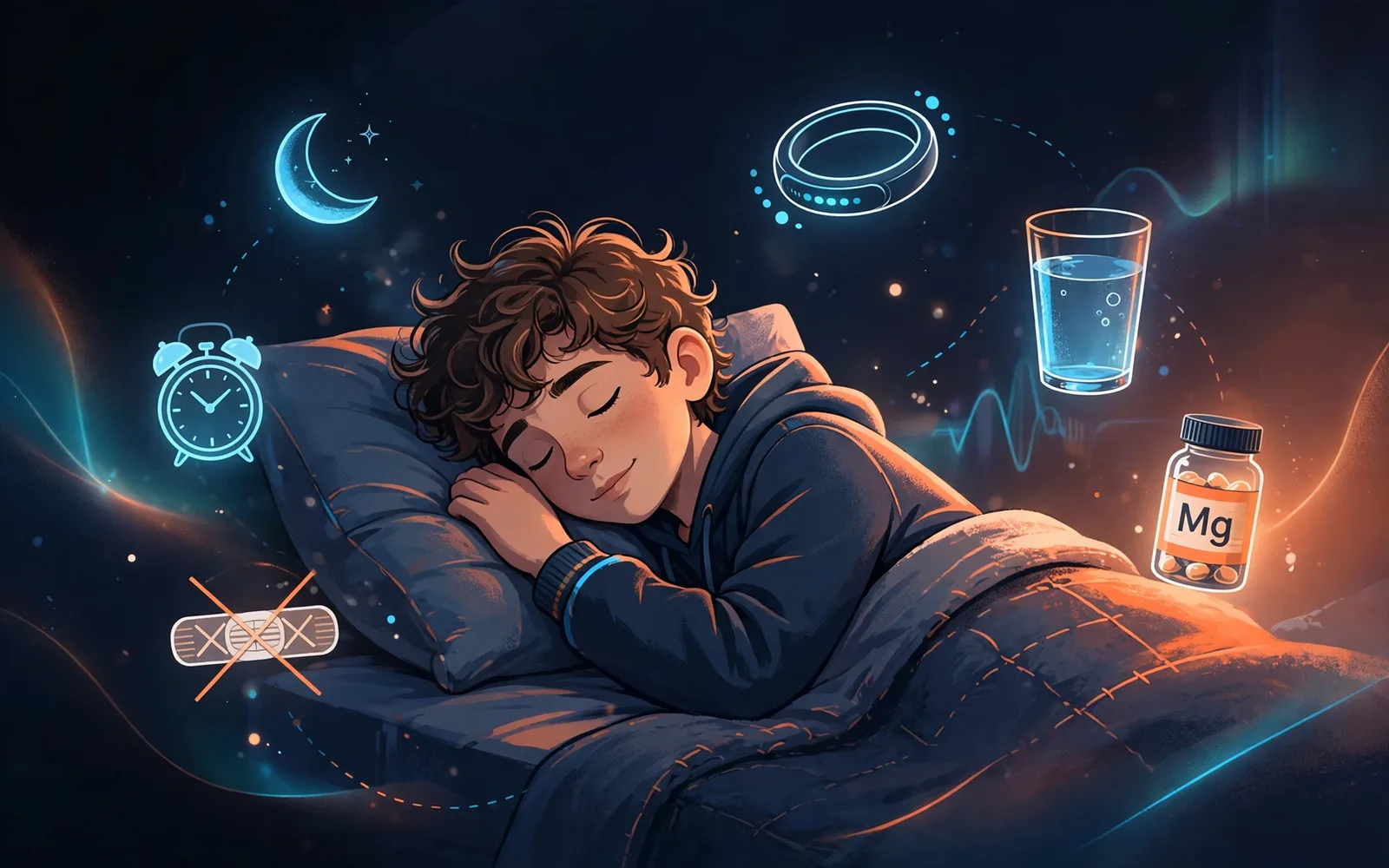
Sleepmaxxing is the viral trend of optimising sleep with routines, gadgets and supplements. The boring parts work brilliantly — regular bedtimes, a cool dark room and a phone-free bedroom — while the flashy parts, like mouth taping, have little evidence and real risks.
Somewhere between homework, group chats and a 1 a.m. scroll, your teenager has picked up a new hobby: sleepmaxxing. If you have heard the word at the dinner table, or spotted a strip of tape, a ring on their finger and a glass of something pink and fizzy by their bed, you are not imagining things. Sleepmaxxing is the viral Gen Z and Gen Alpha trend of trying to optimise sleep the way an athlete optimises training — every variable measured, every hack stacked, every night scored. The short answer to whether it works is this: the boring parts of it work brilliantly, and the flashy parts mostly do not. A regular bedtime, a cool dark room and a phone that charges outside the bedroom will do more for your teen than mouth tape, magnesium powder and a sleep score ever will.
That distinction matters, because sleepmaxxing is not a small niche anymore. Coverage of the trend puts tagged posts at more than 125 million, with US search interest up more than 300 percent year over year, and surveys cited in that coverage finding that about 37 percent of Americans — and 55 percent of Gen Z — say they have tried a viral sleep trend. The Sleep Consultant The trend started on TikTok in early 2025 and spread fast, because it sits on top of a real problem: teenagers are genuinely exhausted. Burlap and Blue This article sorts the trend into what helps, what is harmless hype, and what is actually risky, so you can talk about it with your teen without sounding like you are dismissing something they care about.
What sleepmaxxing actually is
Sleepmaxxing is not a medical programme and it has never been tested as one. Harvard Health put it plainly: a search of PubMed, PsycNet and Google Scholar returns zero results for the terms "sleepmaxx" and "sleepmaxxing", which means the concept as a package has not been scientifically studied at all. Harvard Health What has been studied, one piece at a time, are the ingredients. And the ingredients are a strange mix. On one side there is plain sleep hygiene that doctors have recommended for decades: a consistent sleep and wake time, a cool dark bedroom, less caffeine late in the day, a wind-down routine. On the other side there is a shopping list: mouth tape, magnesium powder, a "sleepy girl mocktail" of tart cherry juice and prebiotic soda, blue-light glasses, nasal strips, a weighted blanket, a smart ring that grades every night, and a strict rule about going to bed before 10 p.m.
The word itself gives away the mindset. "Maxxing" comes from the same internet slang family as "looksmaxxing", the pursuit of maximising your appearance. Sleep has been pulled into the same optimisation culture, where everything is a metric and every metric can be improved. For a generation raised on streaks, scores and step counts, that framing feels natural. The problem is that sleep does not behave like a fitness goal. You cannot grind your way to better sleep, and trying too hard is one of the fastest ways to make it worse — a trap sleep researchers now have a name for, which we will come back to.
It is worth saying clearly that the impulse behind sleepmaxxing is a good one. Teenagers are not wrong to care about sleep. They are, if anything, late to a party that public health experts have been throwing for years. The trend is popular precisely because it validates something teens already feel in their bones at 7 a.m. on a school morning: they are tired, and they want a fix. The fix they are being sold just happens to be a mix of solid advice and expensive guesswork, presented side by side with no labels to tell them apart.
Why teenagers fell for it
To understand why sleepmaxxing took off with Gen Z and Gen Alpha, start with what their nights actually look like. The American Academy of Sleep Medicine recommends that adolescents aged 13 to 18 get 8 to 10 hours of sleep a night, a figure the CDC repeats in its own youth sleep guidance. Most teens do not come close. CDC data show that roughly three in four US high school students do not get enough sleep on school nights, a share that has barely improved in recent years. That is not a few night owls. That is the normal experience of being a teenager in 2026.
There are reasons built into biology. During adolescence the body clock shifts later, so a 15-year-old's brain genuinely is not ready for sleep at 9 p.m., even though the school bell still rings at 7:30 a.m. The American Academy of Pediatrics has urged middle and high schools not to start before 8:30 a.m. for exactly this reason, but most schools have not moved. Add homework, sport, part-time jobs, and then the phone — the device that follows them into bed and stays lit long after the lights go out. Our own earlier piece on the teen sleep crisis and the 3 a.m. scroll looked at what late-night scrolling does to a tired brain, and the picture was not pretty.
So when a creator on TikTok says they fixed their sleep with a five-step routine and a ring that proves it, a tired teenager listens. The videos are seductive in a specific way. They show a calm, dark, beautiful bedroom. A glass of something pink. A morning where the creator wakes up glowing and rates their sleep 94 out of 100. It looks like control. For a teenager whose days feel chaotic — exams, friendship drama, a feed that never stops — control is the product being sold, and sleep is just the packaging.
There is also a generational flavour to it. Gen Z grew up watching wellness culture turn everything into a routine with products attached. Skincare has ten steps, so why should sleep have one? The "sleepmaxxing stack" — the bundle of products and habits a creator recommends — mirrors the skincare shelfie: a row of bottles and gadgets, each one promising a small edge. It feels familiar, it feels doable, and it gives a teenager something concrete to buy or try tonight, rather than the slow, unglamorous advice to go to bed at the same time every day. That is the first thing parents should understand: your teen is not being silly. They are responding to a real problem with the tools the internet handed them.
How tired are teens, really?
Before judging the trend, it helps to sit with the numbers, because they explain the urgency. The CDC's youth guidance states the 8-to-10-hour recommendation for 13- to 18-year-olds and notes that sufficient sleep supports physical health, mental health, attention, behaviour and readiness to learn. CDC When three-quarters of high schoolers miss that target, the effects show up everywhere: worse grades, worse moods, more accidents, more anxiety. Sleep is not a luxury item in a teenager's life. It is the foundation under everything else, including the mental health struggles that dominate so many parenting conversations right now.
The phone is part of the story, but it is not the whole story. A Pew study we covered earlier found that 45 percent of teens say social media hurts their sleep. That is teenagers themselves naming the connection, not adults blaming the phone. But the research picture is more tangled than "phone bad, sleep good". A Norwegian study summarised in recent coverage of the trend found that each additional hour of screen time at bedtime was associated with a substantially higher risk of insomnia and shorter sleep duration. Woke Waves The mechanism is partly light, partly stimulation, and partly the simple fact that an hour spent scrolling is an hour not spent sleeping. Sleep researchers call this time displacement, and it is the least mysterious part of the whole debate: the feed does not need to ruin your sleep chemistry if it simply eats the hours.
What sleepmaxxing gets right, before anything else, is that it treats sleep as worth protecting. For years the cultural message to teenagers was the opposite — that sleeping less was a badge of honour, that pulling an all-nighter was a rite of passage, that rest was what you did when you had finished everything else. The trend flips that. It says sleep is the performance enhancer, the thing that makes everything else work. That message is correct, and it is a genuinely useful one for a parent to agree with out loud. The conversation goes much better when it starts with "you're right to care about this" rather than "that TikTok trend is nonsense".
The sleepmaxxing stack, piece by piece
The fairest way to judge sleepmaxxing is to take it apart. Some of its pieces are genuinely well supported. Some are harmless but unproven. A few are risky, and one is dangerous enough that doctors have warned about it publicly. Here is the honest breakdown, starting with the parts that actually work.
The strongest evidence in the whole trend belongs to the least glamorous habits, and that is not a coincidence. Keeping a regular sleep and wake time — weekends included — is the single most powerful lever most teenagers have. A large 2024 study of more than 60,000 UK Biobank participants found that people with the most regular sleep-wake patterns had a markedly lower risk of dying during the study period than the most irregular sleepers, and that sleep regularity was actually a stronger predictor of that risk than sleep duration itself. VoxSoma That is a striking finding: when you sleep may matter as much as how long you sleep. For a teenager, the practical version is simple and deeply unsexy. Same bedtime, same wake time, even on Saturday. No sleeping until noon on weekends and then wondering why Sunday night feels impossible.
The bedroom environment is the second pillar, and here the trend's advice is mostly sound. A cool room, a dark room, a quiet room. Sleep scientists generally suggest a bedroom temperature somewhere in the mid-60s Fahrenheit, roughly 18 to 19 degrees Celsius, because the body's core temperature needs to drop to initiate sleep. Blackout curtains help, especially for teens whose rooms face streetlights. A white noise machine or a fan can help too, mostly by masking the sudden sounds — a door, a dog, a sibling — that pull a light sleeper out of sleep. None of this is new, and none of it needs a product with "maxxing" in the name. But the trend deserves credit for making teenagers care about their sleep environment at all.
Morning light is another piece the trend occasionally gets right, almost by accident. Getting bright light soon after waking — ideally daylight, ideally outside for even ten minutes — helps anchor the body clock, which makes falling asleep the following night easier. It is the cheapest item in the whole sleepmaxxing stack and the one most creators skip, because you cannot sell sunlight in a bottle. The same goes for daytime exercise, which consistently improves sleep quality in study after study, and for cutting caffeine after mid-afternoon. A teenager who drinks an energy drink at 4 p.m. and then wonders why they are wide awake at midnight is not suffering from a magnesium deficiency. They are suffering from caffeine, which has a half-life of around five to six hours and is still very much present at bedtime.
Then there is the wind-down. Sleepmaxxers love elaborate wind-down routines — the herbal tea, the stretching, the journaling, the phone in another room. Strip away the staging and the core idea is solid: the hour before bed should be boring. Dim lights, no arguments, no homework sprint, no horror series finale. The brain needs a signal that the day is ending, and a predictable routine is that signal. Where the trend goes wrong is in turning the wind-down into a performance with ten steps and a checklist, because a routine that takes 45 minutes and five products is a routine a teenager will abandon by Thursday.
Mouth taping: the trend's most dangerous idea
If there is one part of sleepmaxxing that parents should take seriously as a risk, it is mouth taping. The idea is simple and sounds almost logical: tape your mouth shut at night so you are forced to breathe through your nose, which is supposed to reduce snoring, improve sleep quality and even reshape your jawline. It is the most shared and most argued-about item in the whole stack, and it is the one where the evidence is clearest — and the least flattering.
In May 2025, a team of ear, nose and throat specialists published the first systematic review of mouth taping in the journal PLOS One. They searched the medical literature from 1999 to 2024, screened 120 articles, and found just 10 studies that met their criteria, covering 213 patients in total. PLOS One Two of those studies showed a statistically significant improvement in markers of sleep apnoea, both in people with mild sleep apnoea only. The others found no difference. Every one of the ten studies was rated poor quality. And four of the ten explicitly warned that sealing the mouth could cause asphyxiation if the nose becomes blocked, or if a person brings up stomach contents during the night and cannot clear them. The authors' conclusion was blunt: the existing data does not support mouth taping as a sound clinical intervention for the general population with sleep-disordered breathing, and there is a potentially serious risk of harm for people who practise the trend indiscriminately.
Read that again, because it matters. The studies that found any benefit had already excluded people with blocked noses — the very people most likely to reach for tape. A teenager with a cold, hay fever, a deviated septum or enlarged tonsils is exactly the teenager for whom tape removes the backup airway and leaves nothing. The American Academy of Sleep Medicine has called the trend dangerous, and Harvard Health noted that most TikTok mouth-taping claims are not supported by research. Harvard Health For a healthy teenager with no breathing problems, the likely outcome of mouth taping is a slightly worse night's sleep and some irritated skin. For a teenager with undiagnosed sleep apnoea — and the people most drawn to taping are heavy snorers who wake up tired, the classic apnoea profile — it is a genuine risk.
This is the conversation to have plainly and without panic. You do not need to confiscate the tape or stage a confrontation. You need to say: the doctors who actually studied this found almost no benefit and a real risk, especially if your nose is ever blocked, and if you snore loudly or wake up gasping, that is a doctor's appointment, not a roll of tape. If your teenager snores heavily, pauses in their breathing, or wakes up unrefreshed no matter how long they sleep, skip the trend entirely and talk to a paediatrician or a sleep specialist. That is what the evidence is actually pointing to.
Magnesium and the sleepy girl mocktail
After mouth tape, magnesium is the most heavily marketed item in the sleepmaxxing stack, usually in the form of a powder stirred into a "sleepy girl mocktail" — tart cherry juice, magnesium powder and prebiotic soda, served in a wine glass for the camera. It looks delightful. The evidence is thinner than the marketing suggests.
The best summary of the research is a 2021 systematic review and meta-analysis in BMC Complementary Medicine and Therapies, which pooled three randomised controlled trials covering 151 older adults with insomnia. PMC People taking magnesium fell asleep about 17 minutes faster than those taking a placebo. Total sleep time rose by about 16 minutes, but that difference was not statistically significant. And the reviewers themselves rated the evidence as low to very low quality, with every trial carrying a moderate-to-high risk of bias. Their conclusion was that the literature is not strong enough for doctors to make confident recommendations.
Notice the details that get lost on TikTok. The trials were in older adults with insomnia, not teenagers. The effect was on falling asleep faster, not on sleeping better or longer. And 17 minutes, while real, is modest — roughly the time it takes to watch one YouTube video. A newer trial in 2025, randomising 155 adults to magnesium bisglycinate or placebo for four weeks, found a small reduction in insomnia severity but no significant difference on several secondary outcomes. Magnesium is biologically plausible — it plays a role in muscle relaxation and the regulation of melatonin — and a teenager who is genuinely low in magnesium may feel a difference. But there is no solid evidence that it helps a healthy teenager who already gets enough magnesium from food, and supplements are not risk-free: high doses cause diarrhoea and stomach cramps, and the tolerable upper intake level for supplemental magnesium in adults is 350 mg a day, a line some sleepmaxxing recipes cross without mentioning it.
The sleepy girl mocktail itself is mostly theatre. Tart cherry juice contains small amounts of melatonin and tryptophan, and one small study of 24 people suggested kiwi fruit before bed might improve sleep, but Harvard Health's warning applies here: studies that are not randomised controlled trials, especially tiny ones, should be interpreted with a grain of salt. Harvard Health A glass of cherry juice and soda before bed is unlikely to hurt anyone, and if the ritual helps your teenager wind down, the ritual itself may be doing the work. Just do not let a fizzy drink replace the basics, and do not let any supplement become a nightly habit for a child without a conversation with a doctor or pharmacist first. Melatonin deserves the same caution: the American Academy of Sleep Medicine recommends it for circadian rhythm disorders such as jet lag, but not for insufficient sleep or poor sleep quality, and it is not a long-term solution for a teenager who is simply going to bed too late.
Sleep trackers and the score that keeps you awake
The smart ring is the status symbol of sleepmaxxing — a small, expensive circle that turns every night into a number. The idea is appealing: if you can measure your sleep, you can improve it. The reality is messier, and this is where the trend most often backfires on the teenagers who take it most seriously.
Consumer sleep trackers do not measure sleep directly. A sleep lab uses polysomnography, which records brain waves, eye movements and muscle tone overnight. A ring or watch estimates brain state from movement and heart rate. That estimation is decent at one question — were you asleep or awake? — and weak at the questions teenagers care most about, like how much deep sleep they got. A 2021 study that tested seven consumer trackers against a sleep lab found that every device caught at least 93 percent of the sleep, but only 18 to 54 percent of the time people spent awake. Stay Young Healthy In plain language, the devices told people they had slept better than they actually had. A 2022 study of six wearables found agreement with the lab of 86 to 89 percent for sleep versus wake, but only about 50 to 65 percent when the devices had to sort sleep into stages. And a 2025 meta-analysis pooling 24 studies and nearly 800 participants found that wearables typically overestimate total sleep time by about 17 minutes a night. Evening Report
Seventeen minutes is a small error. The deep-sleep number is the bigger problem, because that is the number teenagers obsess over, and it is the number the devices are worst at. Stage estimates can be wrong by a wide margin, and they are worst precisely in people with sleep problems — the people most motivated to track. A teenager who wakes up feeling fine and then sees a deep-sleep score of 12 percent will spend the day convinced something is wrong with them. A teenager who wakes up exhausted and sees a score of 92 will assume the problem is in their head. Both are being misled by a rough estimate dressed up as a medical measurement.
That is how you get orthosomnia, a word sleep researchers coined in 2017 to describe an unhealthy preoccupation with achieving perfect sleep, driven by tracker data. Journal of Clinical Sleep Medicine Kelly Glazer Baron and her colleagues at Rush University Medical Center described patients who arrived at sleep clinics armed with months of tracker data, whose pursuit of a better number had itself become the thing keeping them awake. They spent hours in bed chasing a perfect score, woke in the night to check the app, and treated a bad morning number as proof of a bad night, even when they had slept fine. A 2024 study of 523 adults estimated that between 3 and 14 percent of people showed signs of orthosomnia, and those who did had higher insomnia scores than those who did not. Sahha The pattern is now common enough that researchers published a validated measurement scale for it, the Bergen Orthosomnia Scale, in 2025.
The cruel irony is that worrying about sleep is one of the most reliable ways to ruin it. Sleep is the one bodily function that gets worse the harder you try at it. A teenager lying in bed thinking "I must fall asleep now, my score depends on it" is doing the exact opposite of what sleep requires, which is letting go. Harvard Health noted the same trap, describing how sleep specialists warn that the trend can backfire when sleep becomes something to optimise and perform rather than simply experience. Harvard Health By 2026 the backlash had grown organised enough that some researchers were openly calling for "sleep simplicity" instead — fewer gadgets, fewer numbers, more of the basics.
None of this means trackers are useless. Used lightly, they are good at one thing: showing patterns over weeks, like whether your teenager sleeps longer on nights without late caffeine, or whether weekends are drifting later. The healthy way to use one is to check it weekly, look for trends, and then put it away. The unhealthy way is to check it first thing every morning and let it decide how the day feels. If your teenager's mood now depends on a number on their wrist, the tracker has stopped being a tool and become the problem. Taking a week off from tracking is often the most useful sleep experiment a teenager can run — and it costs nothing.
The rest of the stack: white noise, blue light and weighted blankets
Beyond the headline items, the sleepmaxxing stack is full of smaller gadgets, each with its own fan base and its own thin evidence file. White noise and ASMR are the most popular of these, and they are also among the least controversial. A fan, a white noise machine or a rain sounds playlist can genuinely help a teenager fall asleep, mostly by covering up the sudden noises that wake light sleepers. The evidence is modest but the risk is close to zero, with one caveat: keep the volume low and do not place a speaker right next to the bed all night at high volume, because very loud continuous noise near the ear is not a good idea for anyone's hearing. If your teenager falls asleep to a rain sounds video every night, that is fine. It is a habit, not a hazard.
Blue-light blocking glasses are a different story. They are everywhere in sleepmaxxing videos, usually orange-tinted and worn for the last hour before bed. The theory is sound — blue light suppresses melatonin, and screens emit blue light — but the practical effect is smaller than the marketing implies. Most phones already have a night mode that warms the screen, and the bigger problem with a phone at 11 p.m. is not the colour of its light but the fact that it is a slot machine full of messages, videos and arguments. A teenager wearing orange glasses while still scrolling is solving the smaller problem and ignoring the larger one. The glasses are harmless, and if they serve as a reminder that bedtime is approaching, they have done something useful. But no pair of glasses fixes a feed that keeps delivering one more video.
Weighted blankets get a similar verdict. Harvard Health noted that while intriguing research has been done on weighted blankets, there is no convincing evidence that they are truly effective for the general adult population. Harvard Health Some small studies in people with anxiety or insomnia have shown modest benefits, and some teenagers genuinely find the pressure comforting — the same reason a tight hug feels calming. If your teenager likes theirs and sleeps well under it, there is no reason to take it away. Just do not pay a premium price expecting a medical result, and do not use a heavy blanket for a younger child, where the safety guidance is different.
Nasal strips, the little adhesive bands worn across the nose, are probably the most harmless item in the stack. They can make breathing through the nose slightly easier, which some people find comfortable, but they do not treat snoring or sleep apnoea, and they are a long way from the claims made for them in some videos. Kiwis before bed, another recurring suggestion, rest on a single small study of 24 people — interesting, not proof. A banana or a kiwi as an evening snack is perfectly fine as food; it is not a sleep intervention. And the strict "in bed before 10 p.m." rule that many sleepmaxxers preach is arbitrary. What matters is regularity and total sleep, not a magic hour. A teenager who sleeps from 11 p.m. to 8 a.m. every night is doing far better than one who sleeps from 9:30 p.m. to 6 a.m. on weekdays and 2 a.m. to noon on weekends.
The pattern across all of these is consistent, and it is the pattern of the whole trend. The cheap, boring habits carry the evidence. The expensive, photogenic products carry the marketing. That is not an accident. A regular bedtime cannot be sold in a bottle, so it does not get a video. A ring that grades your night can be sold, so it gets a hundred videos. Once you see that, the whole trend becomes much easier to read — and much easier to talk about with a teenager who is trying to sort the real advice from the sales pitch.
What actually works: the short, boring list
Strip sleepmaxxing down to the parts that sleep science supports, and you are left with a list so short it would make a terrible TikTok video. That is exactly why it works. Here it is, in the order that matters most for a teenager.
First, keep the same sleep and wake times every day, including weekends, aiming for 8 to 10 hours for a teenager. Regularity is the single strongest lever, stronger even than duration in some large studies. VoxSoma Second, get daylight in the morning, ideally outside, even if it is just the walk to school. Third, move during the day — sport, a walk, anything — because physical activity improves sleep quality. Fourth, cut caffeine after mid-afternoon, including energy drinks, which are the most common culprit in a teenager's evening. Fifth, make the last hour before bed boring: dim lights, no homework sprint, no group chat drama, phone charging outside the bedroom if you can manage it. Sixth, keep the bedroom cool, dark and quiet. Seventh, if sleep is still bad after a few weeks of doing all of that, talk to a doctor, because persistent insomnia, loud snoring or gasping during sleep are medical issues, not lifestyle projects.
Notice what is not on the list. No tape. No powder. No ring. No score. The researchers who study sleep have been saying versions of this for decades, and the trend's most useful contribution is that it finally made teenagers listen. The best outcome of sleepmaxxing is not a teenager with a perfect routine and a 98 sleep score. It is a teenager who goes to bed at roughly the same time every night, leaves the phone in the kitchen, and wakes up feeling human. Everything else is decoration.
A parent's playbook: how to talk about it
The worst way to handle sleepmaxxing is to mock it. A teenager who has spent money on a ring or a month building a routine will hear "that's stupid" as "you're stupid", and the conversation ends there. The best way in is to agree with the goal and question the method. "You clearly care about sleeping well, which is smart. Let's look at which parts actually have evidence behind them." That sentence does more work than any lecture, because it puts you on the same side as your teenager and the evidence on the table between you.
Start with curiosity, not correction. Ask what their routine is, what they have tried, what they think is working. Many teenagers will tell you, honestly, that the tracker stresses them out, or that the tape was uncomfortable and they stopped using it after three nights. They often already know which parts are silly. They just do not want to be told so by an adult who has not tried to understand the trend. If they are proud of a sleep score, ask how they feel in the morning rather than arguing about the number. How they feel is the measurement that matters, and it is the one no device can grade for them.
Then make the boring parts easy. The single most effective thing a parent can do is remove the obstacles to the basics. A phone charging station in the kitchen, agreed together rather than imposed, does more than any lecture about blue light. A consistent household wind-down — lights dimmed, noise down, no new arguments after 9 p.m. — helps a teenager's body clock more than any supplement. And a regular wake time, even on weekends, is worth defending, gently, because it is the anchor the whole system hangs on. If your teenager sleeps until noon on Saturday, Sunday night will be miserable, and Monday morning will be worse. That is not a character flaw. It is circadian biology.
Watch for the warning signs that the trend has tipped into something unhealthy. A teenager who is anxious about their sleep score, who lies awake worrying about getting a perfect night, who spends money they cannot afford on sleep products, or who is taping their mouth shut despite a blocked nose, needs a conversation — and possibly a doctor. Orthosomnia is real, and it is the trend's most common side effect. Sahha The fix is usually simple: a week without the tracker, a return to the basics, and permission to stop performing sleep and just do it. Tell your teenager explicitly that a bad night happens, that one bad night does not ruin anything, and that the goal is not a perfect score but a rested morning. That sentence alone can lower the pressure enough for sleep to return.
Finally, know when to get help. If your teenager snores loudly, pauses in their breathing, gasps during the night, falls asleep in class despite long nights in bed, or has sleep problems that persist for more than a few weeks despite good habits, that is a medical question. Paediatricians can screen for sleep apnoea and other disorders, and cognitive behavioural therapy for insomnia — CBT-I — is a proven, drug-free treatment that can dramatically improve insomnia in a matter of weeks, according to Harvard Health. Harvard Health No roll of tape and no ring will do what a proper assessment can do.
Sleepmaxxing: the trend versus the evidence
| Sleepmaxxing habit | What the evidence says | Verdict for teens |
|---|---|---|
| Regular sleep and wake times | Strongest evidence; regularity predicted lower mortality risk better than duration in a 60,000-person UK Biobank study | Keep — the single best habit |
| Cool, dark, quiet bedroom | Well supported by sleep science | Keep |
| Morning daylight and daytime exercise | Consistently linked to better sleep | Keep |
| Phone out of the bedroom | Screen time at bedtime linked to higher insomnia risk and shorter sleep | Keep |
| Mouth taping | 2025 review of 10 studies, 213 patients: little benefit, poor-quality evidence, asphyxiation risk if nose blocked | Skip — see a doctor instead |
| Magnesium powder | Fell asleep ~17 min faster in 3 small trials in older adults; evidence rated low to very low quality | Not proven for teens; ask a doctor first |
| Sleepy girl mocktail | Cherry juice and kiwi rest on tiny, unproven studies | Harmless as a ritual, not a treatment |
| Sleep tracker or smart ring | Good at sleep vs wake, poor at sleep stages; overestimates sleep by ~17 min a night | Use lightly, check weekly, never daily |
| Blue-light glasses | Harmless, but the phone's content matters far more than its light | Optional |
| Weighted blanket | No convincing evidence for the general population; some find the pressure comforting | Optional comfort, not medicine |
| White noise or rain sounds | Modest evidence, very low risk at low volume | Keep if it helps |
| Chasing a perfect sleep score | Linked to orthosomnia — anxiety about sleep that makes sleep worse | Drop the score, keep the habits |
Frequently asked questions
Is sleepmaxxing real or just a TikTok fad?
Sleepmaxxing is a real and large trend — tagged posts number more than 125 million and search interest has risen sharply — but the label itself has never been studied as a package. The Sleep Consultant What is real is the mix underneath it: some habits with strong evidence, like regular sleep times, and some products with almost none, like mouth tape. Treat the word as a brand name, not a medical term.
Is mouth taping safe for teenagers?
No, not as a home experiment. A 2025 systematic review in PLOS One found only 10 small, poor-quality studies covering 213 patients, with little proven benefit and a real risk of asphyxiation if the nose is blocked. PLOS One Teenagers with colds, allergies or a deviated septum are exactly the ones at risk. Loud snoring or gasping needs a doctor, not tape.
Does magnesium actually help teens sleep?
The best evidence is modest and comes from older adults, not teenagers. A 2021 meta-analysis of three small trials found people fell asleep about 17 minutes faster on magnesium, but the evidence was rated low to very low quality. PMC There is no solid proof it helps a healthy teenager. Food sources are the safest starting point, and any supplement should be discussed with a doctor or pharmacist first.
Are sleep trackers accurate?
Partly. Trackers are fairly good at telling whether you are asleep or awake, but poor at measuring sleep stages like deep sleep. A 2025 meta-analysis of 24 studies found wearables overestimate total sleep time by about 17 minutes a night, and stage agreement with a sleep lab was only around 50 to 65 percent. Evening Report Use them for weekly trends, not daily scores.
What is orthosomnia?
Orthosomnia is an unhealthy preoccupation with achieving perfect sleep, driven by tracker data. The term was coined in 2017 by researchers at Rush University Medical Center, who described patients whose fixation on their sleep scores was itself keeping them awake. Journal of Clinical Sleep Medicine It is not a formal diagnosis, but it is a recognised pattern — and the fix is usually to stop tracking for a while and return to the basics.
Sleepmaxxing will not be the last trend to promise teenagers a better night. There will be another product, another routine, another score, because tired teenagers are a large and willing audience and the wellness industry knows it. The best defence a parent can offer is not a ban on trends but a teenager who can tell the difference between evidence and marketing — who knows that a regular bedtime beats a ring, that a blocked nose beats a roll of tape, and that how they feel in the morning matters more than any number on a screen. That is a skill that will outlast sleepmaxxing, and it is one worth building tonight, starting with the phone charging in the kitchen and the lights going down on time.