Stop Sign Challenge: What Parents Must Know Now
Ohio police warn parents about 'Beat the Sign': teen drivers film themselves running stop signs to beat a count. A Medina crash may be linked. What to do tonight.
Drafted with an AI writing assistant and checked against its sources by the editor before publishing. How we use AI.
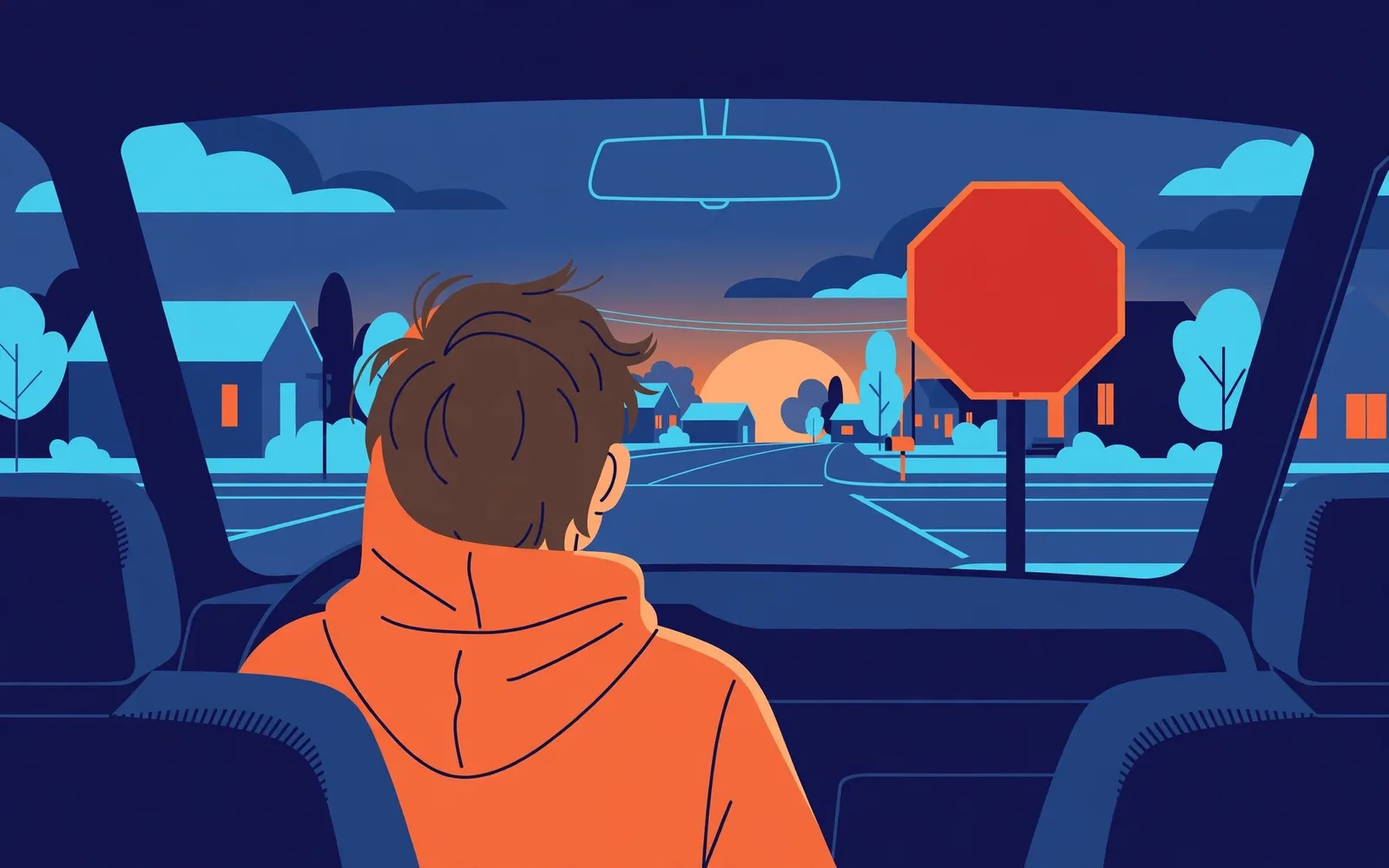
The 'Stop Sign Challenge' — also called 'Beat the Sign' and 'No Cop, No Stop' — is a social media dare in which teen drivers deliberately run stop signs, film it, and compete to beat the highest count. Ohio police warn it can mean criminal charges, not just a ticket, and a serious crash in Medina may already be linked to a driver who kept a 'Beat the Sign' log.
Somewhere in Ohio this month, a teenager sat behind the wheel, phone propped up on the dashboard, and drove straight through a stop sign on purpose. Then another. Then another. The point was the count. How many intersections could you clear without stopping, and could you beat the last kid who tried?
That is the "Stop Sign Challenge" — also called "Beat the Sign" and "No Cop, No Stop" — and it is not a rumour from three years ago. It is in the Ohio School Safety Center's November 2026 security bulletin. It has drawn warnings from the Ohio State Highway Patrol, the Ohio Department of Transportation, county sheriffs and local police departments, and it has reached school newsletters that are now landing in parents' inboxes. A serious crash in Medina, Ohio, may already be connected to it: a school superintendent told the safety centre that the driver at fault had allegedly been keeping a "Beat the Sign" log. Motoring Chronicle's full report on the warnings lays out the official advice in one place.
If your teenager drives, or rides with friends who drive, this is one of those weeks when a ten-minute conversation at the kitchen table is worth more than any lecture later. Here is what the challenge is, what police actually know and do not know, why a stop sign is the worst possible thing to turn into a game, and exactly what to say tonight.
What exactly is the "Beat the Sign" challenge?
The rules are brutally simple, which is part of why they spread. A driver — usually a teenager, according to the police warnings — deliberately ignores stop signs and counts how many intersections they can cross without stopping. Attempts often involve speeding. Participants film themselves and post the footage, competing to beat earlier tallies. The Ohio School Safety Center's bulletin describes it under three names: "Beat the Sign", "No Cop, No Stop" and the "Stop Sign Challenge". Similar behaviour has been documented among teenagers before under the older names, which tells you something important: this is not a brand-new idea. It is an old, dangerous habit that social media keeps dressing up as a fresh dare.
That matters for how parents should think about it. A challenge does not need to be new to be dangerous, and it does not need to be everywhere to hurt someone in your town. The safety centre says it has received more than one report about the trend. At the same time, officials have been careful — and parents should be too — about how big this is. The Ohio State Highway Patrol lieutenant who commands the Dayton Post, Lt. Dallas Root, told reporters he had seen no reports yet of the challenge catching on around Dayton. The Medina County Sheriff's Office and the Medina Police Department said they had not heard of the trend in their area. And at least one local report noted that the specific name "Beat the Sign" and how widespread the activity may be have not been independently verified online.
So the honest picture is this: police and school safety officials are treating it as a real, reported danger, not a confirmed nationwide craze. That is the right level of alarm. You do not wait for a body count in your own county before talking to your child about running stop signs on camera.
How the warnings spread across Ohio
The paper trail is short and fast, which is how you can tell this is a live story rather than a recycled scare.
The Ohio School Safety Center put the warning in its November 2026 security bulletin, after a school superintendent reported the serious crash in Medina involving a driver who allegedly kept a "Beat the Sign" log. On 9 November 2026, the Wayne County Sheriff's Office shared the safety centre's warning on social media, urging drivers to obey all traffic laws. On 11 November, Fox 8 Cleveland reported on the warning after the Medina crash. On 12 November, WOIO in Cleveland published its account of the safety centre's report. Around the same week, Brookville Police Department, near Dayton, relayed the warning to residents after the Ohio School Safety Center alerted law enforcement, and WHIO-TV reported it. School newsletters followed: Warren G. Harding High School in Warren, Ohio, sent families a notice describing the trend by all three names and asking parents to talk with their driving-age children.
The Ohio Department of Transportation added its own statement, and it is worth quoting in full because it captures the frustration of every road engineer in America: "ODOT can include lots of safety measures at intersections, but we can't make drivers pay attention to those safety measures. It goes without saying that intentionally ignoring stop signs is an incredibly dangerous behavior." You can rebuild an intersection, add flashing beacons, paint the road red, and still lose to a teenager who has decided the sign is optional.
The Wayne County Sheriff's Office put it more plainly on social media: "The Wayne County Sheriff's Office encourages everyone to obey all traffic laws to help keep everyone safe on the roadways." Brookville Police asked residents to stay alert at every intersection and never assume another driver will stop — advice that applies whether or not the challenge ever reaches your street.
The Medina crash: what we actually know, and what we do not
The Medina crash is the detail that turned a bulletin item into a news story, so it deserves care. Here is what has actually been reported, and where the reporting stops.
According to the Ohio School Safety Center's November bulletin, as reported by WOIO and WAKR, a school superintendent reported a serious crash in Medina in which the driver at fault allegedly kept a "Beat the Sign" log to track their attempts. The safety centre said it was not the only report it had received about the trend. No charges or court dates were reported in connection with that crash, and the investigative status of the Medina crash was not detailed in the coverage. The driver's identity, age and the exact circumstances of the crash were not published.
That is a thin factual base, and responsible coverage should say so. The log, if it exists, is alleged. The connection between the crash and the challenge is reported by a superintendent to a safety centre, not established by a police investigation in public record. And as noted above, local agencies in the Medina area itself said they had not heard of the trend.
None of that makes the story false. It makes it early. Police bulletins about emerging youth trends almost always start this way: a couple of reports, a worrying detail, a warning issued before the pattern is fully measured. The Ohio School Safety Center chose to warn schools rather than wait for a cleaner dataset, and given what is at stake at an intersection, that is the right call. Parents should treat the Medina crash the same way the safety centre did — as a credible warning sign, not as a proven fact — and act on the warning, not the uncertainty.
There is a useful parallel here. Our own reporting on the viral door kick challenge followed the same pattern: police warnings first, then a trail of real incidents — vandalism reports, arrests, a teenager shot in Boise after a door-kick prank — that confirmed the danger was not theoretical. Challenges that reward filming risky behaviour do not stay hypothetical for long.
Why a stop sign is the worst thing to turn into a game
Run a red light and you might get lucky. Run a stop sign at speed, on purpose, over and over, and the maths catches up with you fast. This is the part of the conversation that teenagers need to hear in plain language, because "don't do it" is not an argument. Physics is.
A stop sign exists at the intersections where drivers cannot see each other in time. The cross street may be hidden by a hedge, a parked truck, a hill. The whole point of the sign is that you stop, look, and only then go. A driver who blows through at 30 or 40 miles an hour has removed the only safety margin the intersection has.
Lt. Root explained what happens next in the blunt language of a trooper who has worked the wrecks: "That's where that T-bone type of crash or collisions are going to occur." A T-bone is when one car strikes the side of another at a right angle. He went on: "Our most vulnerable crumple zones are always gonna be on the sides of the vehicle, especially where your doors are at. And where does everybody sit? Typically right next to a door."
Read that again. The front of a car is built to absorb a crash. The side is not. The door is inches from the person sitting next to it. At intersection speeds, a side impact is the crash most likely to kill or maim, and it is the crash a stop-sign runner is most likely to cause — to themselves, to their passengers, to the driver crossing legally on the other road, and to anyone on foot nearby.
Then there is the legal side, and here Lt. Root's words should be read by every parent of a new driver. Running a stop sign is normally a traffic violation: a ticket, points, a fine. Doing it deliberately, on camera, as part of a filmed competition changes the conversation. "That is a level of intent where I don't think we're no longer talking about a traffic violation. We're talking about a criminal offense," Root said. "Especially if somebody is seriously injured or killed. It is not a vehicular manslaughter case. We're talking about an aggravated circumstance, which is going to place an individual in the elements of a felony."
He did not cite a statute, and the exact charge would depend on the state, the circumstances and a prosecutor. But the message is clear and it is one teenagers almost never hear: a filmed pattern of deliberate stop-sign running is evidence. It shows intent. It shows planning. It shows the driver knew the risk and chose it anyway. If someone is hurt, that footage does not disappear. It becomes the case against them.
Add the consequences that follow even without a crash: a moving violation on a new driver's record, higher insurance for years, a suspended licence under graduated licensing rules, and school discipline if the behaviour is linked to a school community. A ten-second clip can cost a teenager their licence, their insurance affordability and, in the worst case, their freedom. No number of views is worth that trade, and teenagers need to hear someone say it out loud before the algorithm does.
The numbers behind teen driving risk
To understand why police take a driving challenge seriously in a way they might not take a dance trend, you have to look at the numbers. Teen driving is already the most dangerous thing most American teenagers do.
The National Highway Traffic Safety Administration's most recent data, published in July 2026, shows that 2,162 young drivers aged 15 to 20 died in traffic crashes in the United States in 2024, and an estimated 184,129 were injured. Those young drivers made up only 5.2 percent of all licensed drivers, yet they accounted for 9 percent of all drivers involved in fatal crashes. In total, 5,247 people died in 2024 in crashes involving a young driver — not just the young drivers themselves, but their passengers, the occupants of other vehicles, and people on foot. That total was down 7 percent from 2023, which is real progress, but it is still more than fourteen deaths a day.
The Centers for Disease Control and Prevention puts it in the starkest possible terms: motor vehicle crashes are a leading cause of death for teenagers in the United States. Its figures show about 2,800 teens aged 13 to 19 killed and about 227,000 injured in motor vehicle crashes in 2020. Teen drivers aged 16 to 19 have a fatal crash rate almost three times as high as drivers aged 20 and older, per mile driven. The Insurance Institute for Highway Safety reports that 2,899 teenagers aged 13 to 19 died in motor vehicle crashes in 2024 — a figure that is 67 percent lower than in 1975, which shows how much safer cars and graduated licensing have made things, and still far too high. The Insurance Information Institute's teen driver statistics compile the same NHTSA figures in one place, including the year-by-year table from 2015 to 2024.
Speed is the thread that runs through the worst of these numbers. According to NHTSA, 37 percent of male drivers and 18 percent of female drivers aged 15 to 20 involved in fatal traffic crashes in 2023 were speeding — the highest rates of any age group. The "Beat the Sign" bulletin specifically describes attempts as involving speeding, which means participants are combining the two most dangerous behaviours a young driver can choose: speed and ignoring the sign that exists to prevent the collision speed makes unsurvivable.
Distraction is the other thread. NHTSA reports that 264 people were killed in 2024 in distraction-affected crashes involving teen drivers aged 15 to 19, and 241 teen drivers involved in fatal crashes that year were distracted. Seven percent of all teen fatalities in motor vehicle crashes in 2024 were in distraction-affected crashes. A challenge that requires a driver to film themselves while driving is, by definition, a distracted-driving challenge as well as a stop-sign challenge. The phone that records the stunt is also the phone that takes the driver's eyes off the road at the exact moment they need them most.
Put those numbers together and the picture is not "teenagers are bad drivers". It is more specific and more useful: teenagers are new drivers, and new drivers are at their most dangerous when they are fast, distracted, and surrounded by friends. The challenge manufactures all three conditions at once.
Why teenagers fall for it
If you want to stop a challenge, you have to understand what it offers the teenager who tries it. It is never just stupidity. It is usually three things at once: friends, a phone, and a brain that is still under construction.
Start with friends. The most robust finding in teen driving research is that passengers change everything. A study by the AAA Foundation for Traffic Safety found that a 16- or 17-year-old driver's risk of dying in a crash, per mile driven, increases 44 percent with one passenger younger than 21 in the car, doubles with two, and quadruples with three or more — compared with driving alone. Flip it around and the protective effect is just as dramatic: carrying at least one passenger aged 35 or older cuts a teen driver's risk of death by 62 percent. Friends in the car are not just company. They are a measurable risk factor.
That is not only about distraction. It is about what psychologists call injunctive norms — what a teenager believes their friends approve of. In a study published in the journal Health Psychology, researchers from the National Institute of Child Health and Human Development, the University of Michigan and the University of Sherbrooke put 66 recently licensed male teenagers in a driving simulator with a peer passenger. The study, summarised by the Association for Psychological Science, found the teens took significantly more risks — running more red lights — when they had a passenger with them, and they were far more reckless when the passenger seemed to approve of risky driving. The passenger in the study was a stranger who never pressured anyone. The researchers concluded that the real-world effect, with actual friends egging a driver on, is probably larger.
Now add the filming. A challenge video does two things a private dare cannot. First, it turns a momentary impulse into a performance with an audience, which raises the stakes of backing down. Second, it creates a permanent record that can be replayed, shared and compared — a leaderboard that never closes. Teenagers have always competed over who is bravest. Social media has given that competition a scoreboard, a distribution network and an archive.
Then add the brain. The part of the brain that weighs long-term consequences — the prefrontal cortex — is still developing through the teenage years and into the mid-twenties. The part that responds to social reward is fully switched on much earlier. That mismatch is why a teenager can know, in the abstract, that running a stop sign is dangerous, and still do it when three friends are filming and laughing. It is not that they do not know. It is that knowing loses to belonging in the moment.
This is also why the challenge format matters more than the specific stunt. Teen culture moves fast — one week a word like delulu is everywhere, the next it is a dance, the next it is a dare. The slang changes; the mechanism does not. A behaviour gets filmed, the film gets likes, the likes prove it was worth doing, and the next person tries to top it. Parents who only learn the name of the current challenge will always be one challenge behind. Parents who teach their teenager to recognise the mechanism — "someone is filming a risky thing for likes, and the likes are the trap" — give them a defence that works against the next challenge too, whatever it is called.
There is one more thing worth saying plainly: most teenagers will not do this. The challenge is newsworthy precisely because it is unusual. The teenagers who do try it are usually not the "bad kids". They are often ordinary kids who drive, who have friends, who have a phone, and who made a bad decision in a car full of people whose approval mattered more than a red octagon. That is why the conversation needs to happen before the moment, not after it.
What the law can actually do
Parents often ask what would happen, legally, if their teenager were caught doing this. The honest answer is that it depends on the state, the circumstances and whether anyone is hurt — but the range is much wider than most families realise.
At the low end, running a stop sign is a moving violation. The driver gets a ticket, a fine and points on their licence. For a new driver under a graduated licensing system, points can mean a suspended licence, mandatory driver education, or a longer probationary period. The Insurance Institute for Highway Safety is the most up-to-date source for graduated licensing rules in the US, and its data underpins the state-by-state restrictions on night driving and teen passengers that exist in nearly every state. Insurance follows: a moving violation on a teenager's record can raise a family's premiums for years, and some insurers will not cover a teen with a serious violation at all.
In the middle, there is reckless driving, which in most states is a more serious offence than a simple traffic infraction. Deliberately running stop signs at speed, while filming, is the kind of conduct a prosecutor can frame as reckless — a conscious disregard for the safety of others. Penalties can include larger fines, licence suspension, community service and, in some states, jail time.
At the high end, if someone is seriously injured or killed, the charges escalate sharply. That is the point Lt. Root was making with his felony language: deliberate, filmed, repeated stop-sign running shows intent and planning, and prosecutors treat intent as the difference between an accident and a crime. The specific charge would vary — reckless homicide, aggravated vehicular assault, and similar offences exist in different forms across states — but the direction of travel is the same. A teenager who films themselves running stop signs is filming evidence that could be used against them.
There is also the civil side, which families forget until it arrives. If a teenager causes a crash, the injured party can sue the driver — and, in many states, the parents who own the car or signed for the licence. A family's assets, including their home, can be at stake in a serious injury case. Teenagers do not think about civil liability. Parents should.
None of this is meant to terrify. It is meant to correct a specific misunderstanding teenagers have: that the worst outcome of a driving challenge is a ticket. The worst outcome is a funeral, someone else's or their own, followed by a courtroom. The second-worst is a criminal record before they are old enough to vote. Both are real. Both have happened to teenagers who thought they were filming a joke.
What to do tonight: a parent's checklist
You do not need a family meeting. You need ten honest minutes, ideally before the next time your teenager takes the keys. Here is how to use them.
Start with the news, not an accusation. "Have you heard about this stop sign challenge thing in Ohio? Police are warning about it." If your teenager has heard of it, ask what they have seen. If they have not, tell them the short version: kids film themselves running stop signs to beat a count, police in Ohio are warning about it, and a crash in Medina may be linked to it. Then ask the question that matters: "What would you do if a friend tried it while you were in the car?" Let them answer. The goal is not a confession. It is a plan, made in advance, for the moment when saying no is hard.
Name the specific risk, not just "be careful". Teenagers tune out "drive safely". They remember "the side of the car has almost no protection, and that's where the other car hits you when you run a stop sign". They remember "if someone gets hurt, the video is evidence". Use the trooper's words if they help: the most vulnerable crumple zones are on the sides, right where everybody sits. Concrete beats generic every time.
Make the passenger rule explicit. The AAA research gives you the number: a teen driver's risk of dying quadruples with three or more young passengers. Many graduated licensing systems already limit teen passengers for new drivers, and parents can set a stricter rule than the law. Tell your teenager plainly: no more than one friend in the car for the first six months, and no filming while driving — driver or passenger. Put it in writing. The Centers for Disease Control and Prevention offers a Parent-Teen Driving Agreement that families can use to agree on the rules of the road together, and putting rules in writing matters: a study of parent-teen pairs found that parents and teenagers often disagree about what the rules actually are, and writing them down closes that gap.
Check the phone, together. Ask your teenager to show you what driving content they watch — not as a search for guilt, but as a shared look at what the algorithm is feeding them. If stop-sign videos, street-racing clips or other driving dares are in their feed, that is information, not an accusation. Talk about how the algorithm works: the more you watch, the more it shows, and the more normal the dangerous thing starts to look. Then agree on a practical step, like reporting driving-challenge videos when they appear, rather than liking or sharing them. Platforms remove content that encourages dangerous driving when it is reported. Every report helps the next teenager's feed.
Give them an exit line. Teenagers who know the risk still freeze when the moment comes, because refusing in front of friends feels impossible. Rehearse the refusal the way you would rehearse a fire drill. "Nah, I'm not doing that, my parents track my driving and I'll lose the car." "I'm not filming that, my dad checks my phone." "Get out, I'm not riding with you if you're doing that." It does not matter whether the excuse is literally true. What matters is that your teenager has words ready that let them refuse without losing face. And make the deal explicit: if they ever feel unsafe in a car, they can call you, any time, no questions asked, and you will come and get them. The ride home is always free. The lecture can wait until morning.
If you see it happening, report it. Police in Ohio have been direct about this: if you believe you have witnessed the challenge, call 911. If your child's school has information, report it to the school and to the Safer Ohio School Tip Line at 844-723-3764, which is the number Ohio schools are giving families in their warning notices. If the behaviour involves a video on social media, report the video on the platform as dangerous content. Do not try to confront a stranger's teenager yourself. Let the police and the school handle it.
If your teenager is in a video, act fast and stay calm. Do not share the video, do not comment on it, and do not let your teenager delete it in a panic — deleting evidence after the fact can make a legal situation worse. Screenshot the post, save the link, note the date and time, and call a lawyer before talking to police or the school if there is any chance someone was hurt. Then have the conversation about why it happened, what the driver was thinking, and what changes now. The goal is a teenager who understands the gravity of it, not a teenager who is only afraid of being caught.
What schools and police are asking for
The warnings landing in school newsletters this week all ask for the same three things, and they are worth repeating because they are simple.
First, talk to your driving-age children about responsible driving, peer pressure and social media challenges — in that order, and in that combination. The schools are not asking parents to ban phones or ground teenagers. They are asking for a conversation that connects the three things: the car, the friends, and the feed.
Second, reinforce that online attention is never worth risking lives. That sentence appears, in almost those words, in the school notices going out in Ohio. It sounds obvious until you remember that it is competing with an algorithm that tells teenagers the opposite a hundred times a day.
Third, report what you see. Schools are asking families to notify the authorities, call 911, tell an adult, or use the Safer Ohio School Tip Line if they see, hear or are aware of the challenge happening. The Ohio School Safety Center's bulletin exists because people reported what they saw. The next warning will exist for the same reason.
Police, for their part, are asking drivers to do the simplest thing of all: stop at every sign, and never assume the other driver will. Brookville Police put it as a warning and a plea at the same time — a single bad decision can have lifelong consequences. That is not a slogan. It is a description of what happens at an intersection when someone decides the sign does not apply to them.
The bigger picture: challenges are the symptom, not the disease
It is tempting to treat each viral challenge as its own emergency and move on when the next one arrives. That is a mistake, because the pattern underneath them is the same and it is getting stronger.
Teenagers have always taken risks to impress each other. What has changed is the infrastructure around the risk: a phone in every pocket, a camera that is always on, an algorithm that rewards the most extreme version of everything, and a scoreboard that never closes. The "Beat the Sign" challenge is a driving challenge. Before it, there was the door kick challenge, which turned a prank into vandalism and, in one case in Boise, into a shooting. Before that, there were challenges involving spicy food that sent children to hospital, and challenges involving traffic that put teenagers in front of moving cars. The stunt changes. The machinery does not.
That is why the most useful thing a parent can do is not to memorise the name of this week's challenge. It is to teach their teenager to recognise the machinery: a video that rewards danger, an audience that rewards escalation, and a moment in a car where saying no feels harder than going along. A teenager who can name that pattern has a defence that works against every challenge, including the ones that have not been invented yet.
It is also why the adults around teenagers — parents, schools, police, platforms — need to keep doing the unglamorous work. Talk early. Set clear rules. Enforce them. Report dangerous content. Make sure the consequences of reckless driving are real and known. None of that is new. All of it works, slowly, the way seat belts and graduated licensing worked: not by eliminating risk, but by shrinking it year after year until the numbers, like the 67 percent fall in teen crash deaths since 1975, start to tell a different story.
The "Beat the Sign" challenge is a test of whether that work holds. A stop sign is a small red octagon on a pole. It only works if the person behind the wheel decides it matters. This week, in Ohio, police and schools are asking teenagers to make that decision — and asking parents to help them make it before they are sitting at an intersection with a camera running and friends counting.
Frequently asked questions
Is the "Stop Sign Challenge" real, or is it a hoax?
It is a real, reported trend, not a hoax — but it is also not a confirmed nationwide craze. The Ohio School Safety Center included it in its November 2026 security bulletin after receiving more than one report, and police departments and schools across Ohio have issued warnings. At the same time, officials have said the specific name "Beat the Sign" and how widespread the activity is have not been independently verified online, and some local agencies said they had not heard of it in their area. Treat it as a credible warning, not as an exaggeration — and talk to your teenager either way.
Has anyone actually been hurt doing it?
A serious crash in Medina, Ohio, may be linked: a school superintendent reported that the driver at fault allegedly kept a "Beat the Sign" log. That connection is alleged and has not been established by a public police investigation, and no charges were reported in connection with the crash. What is established is the underlying danger — running a stop sign at speed is one of the most reliable ways to cause a side-impact crash, and side impacts kill because the side of a car has almost no crumple zone.
What should I do if my teenager tells me their friend did it?
Thank them for telling you, and do not punish the messenger. Ask what happened, who was in the car, and whether anyone filmed it. Then report it: tell the school, and if the behaviour is ongoing or someone was put at risk, contact local police or the Safer Ohio School Tip Line at 844-723-3764. Use it as the opening for the passenger conversation — your teenager now has a real reason to refuse a ride with that driver.
Can my teenager get in trouble just for filming it, or for being a passenger?
Filming a driver who is deliberately running stop signs can make a passenger a participant in reckless behaviour, and the footage can be used as evidence. Passengers are also the people most likely to be hurt in a side-impact crash, since they sit right next to the door. The safest advice is simple: do not film it, do not share it, and do not stay in the car. Report the video to the platform as dangerous content.
How is this different from other viral driving challenges?
It is not very different, and that is the point. The door kick challenge, the "No Cop, No Stop" trend and now "Beat the Sign" all use the same formula: a risky act, a camera, and a competition. The difference is the setting. A door kick risks a confrontation with a homeowner. A stop-sign run risks a high-speed side-impact collision with a car full of strangers who did nothing wrong. That makes it one of the most dangerous challenge formats to appear this year, and the reason police are treating it as a criminal matter rather than a prank.
What is the single most effective thing a parent can do?
Put the rules in writing before the moment arrives. Agree, together, on passenger limits, a no-filming rule, and a promise that your teenager can call you for a ride home from any unsafe situation without punishment. The CDC's Parent-Teen Driving Agreement is a good place to start. Then keep the conversation going — not one big talk, but small check-ins about what they are seeing online and who they are riding with. The teenagers who survive these challenges are usually the ones who had a plan before they needed one.
Sources
- Motoring Chronicle: Offenders Risk Felony in Viral 'Stop Sign Challenge'
- WAKR: Wayne County Sheriff Warns of Dangerous 'Beat the Sign' Driving Challenge Following Reported Medina Crash
- WOIO Cleveland: Dangerous driving trend 'beat the sign' tied to alleged Medina crash
- WHIO-TV: Brookville Police warn community of dangerous stop sign trend
- Spot On Ohio / Fox 8 Cleveland: Dangerous driving challenge called 'Beat the Sign' sparks warning
- Warren G. Harding High School newsletter: November 2026 parent notice on the 'Beat the Sign' trend
- NHTSA: Young Drivers, 2024 Data (DOT HS 813 814), July 2026
- CDC: Teen Drivers
- Insurance Information Institute: Facts and Statistics, Teen Drivers
- AAA Foundation for Traffic Safety: Teen Driver Risk in Relation to Age and Number of Passengers (2012)
- Association for Psychological Science: Driving Under the Influence of Friends is Risky for Teens (Simons-Morton et al., Health Psychology, 2014)
- Journalist's Resource: Motor vehicle crash fatalities and injuries among young people
- Michigan Auto Law: Teen Car Accidents, Statistics, Causes and Prevention (NHTSA distraction data)