Why Kids Rewatch the Same Show Again and Again
Rewatching the same show helps children learn words, spot patterns, and feel safe. Child-development research explains why repetition is a feature, not a flaw.
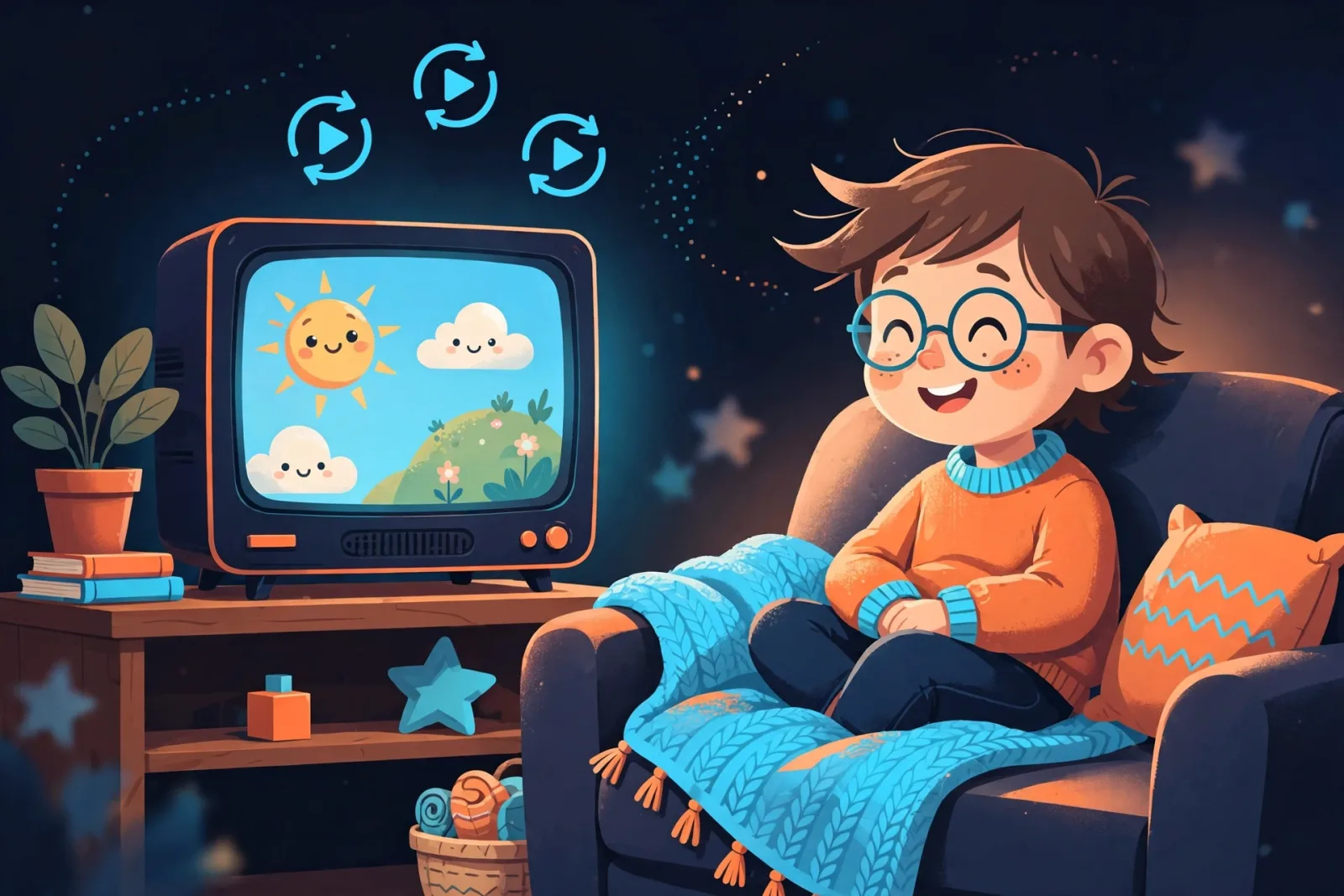
Children rewatch the same show because repetition helps their brains learn: it builds vocabulary, teaches story patterns, deepens understanding, and gives them comfort and a sense of control in a world that is still mostly new.
If your child has asked to watch the same episode for the tenth time this week, you are not alone. Almost every parent of a young child knows the feeling: the opening song starts, you already know every line, and your child is delighted all over again. It can feel strange, even a little worrying. Shouldn't children want something new?
Child-development researchers say the opposite. Rewatching the same show is not a sign that your child is stuck. It is one of the ways young brains learn. Repetition helps children spot patterns, build vocabulary, understand stories more deeply, and feel safe in a world that is still mostly new to them.
Why repetition feels so good to a young brain
A young child's world is full of new things: new faces, new words, new rules, new places. Processing all of that takes a lot of mental energy. A familiar show is different. Your child already knows the characters, the songs, and what happens next, so watching it feels easy and safe.
Researchers call part of this process statistical learning. Children's brains are very good at noticing regular patterns in what they see and hear, and a favorite show is packed with patterns: the same characters, repeated phrases, and predictable story shapes. Each rewatch gives the brain another chance to notice and lock in those patterns, which supports language and thinking skills.
There is also an emotional side. Familiar stories give children a sense of control. When life feels unpredictable, for example after starting school, moving house, or welcoming a new sibling, a known episode is a comfort. Your child knows exactly how it ends, and that predictability is calming.
What the research actually shows
Repetition is not just comforting. Studies show it changes what children take away from a story.
In a study at the University of Sussex, researchers read specially written storybooks to 3-year-old children three times over the course of one week. Some children heard the same story three times, while others heard three different stories containing the same new words. The children who heard the same stories repeatedly were accurate on both immediate recall and later retention tests, while the children who heard different stories failed to learn the new words at all. On retention tests, the repeated-story group performed 150% better than the different-story group. The researchers concluded that hearing the same story again and again dramatically helps vocabulary learning.
A review of this research explains the mechanism: on a first encounter, a child spends most of their attention on the plot, the setting, and the characters. On later encounters, those parts are already familiar, so attention is freed up for smaller details, including new words. Repetition lowers the mental effort of following the story, leaving room for learning.
The same pattern shows up with television. In two studies, 72 children aged 6 to 8 and 291 children aged 4 to 8 watched stories either once or four times. Repetition improved children's understanding of the content and reduced the gap between younger and older children. In other words, rewatching helped younger children catch up in comprehension.
Researchers writing about children's repetitive interests reach a similar conclusion: repetition builds familiarity, and familiarity builds mastery and a sense of control. Children are not passively zoning out. They are actively predicting what comes next, noticing details they missed before, and testing their understanding of how stories work.
First watch vs. rewatch: what changes
| What your child does | First watch | Rewatch |
|---|---|---|
| Follows the plot | Works hard to keep up with what is happening | Already knows the story, so attention is free |
| Learns new words | Hears new words once, in passing | Hears them again in a known context, which helps them stick |
| Understands feelings | Notices the big emotions | Notices why a character feels that way |
| Predicts what happens | Guesses and is surprised | Predicts correctly, which builds confidence |
| Feels emotionally | Excited but sometimes unsure | Calm, comforted, and in control |
This is why the tenth viewing can be more valuable than the first. The first watch is about discovery. Later watches are about depth.
Why older kids rewatch too
Rewatching does not stop at preschool. Older children and teenagers rewatch favorite shows and movies for many of the same reasons: comfort, humor they now understand better, and the pleasure of catching jokes or details they missed. A teenager rewatching a comfort show after a stressful day is using the same basic strategy as a preschooler: returning to something known when the world feels demanding.
When rewatching is healthy, and when to mix it up
Rewatching is healthy when it sits inside a balanced day. The concern is never really the repetition itself. It is what screen time might push out: sleep, active play, reading, homework, and time with family and friends.
The American Academy of Pediatrics recommends no screen time for children under 18 months except video chatting, and no more than 1 hour a day of high-quality programming for children ages 2 to 5, watched with a parent or caregiver when possible. Updated guidance from the Academy puts even more emphasis on quality, context, and conversation rather than only counting minutes, and it still recommends no screens before 18 months and one hour of high-quality content daily for ages 2 to 5.
It is worth varying things when you notice warning signs: your child gets very upset every time the show ends, refuses all other activities, or watches so much that sleep, play, or meals suffer. Repetition itself is not the problem, but rigidity around it can be. If a favorite show is the only thing that calms your child, or the only activity they want, gently widen the menu rather than banning the favorite outright.
What parents can do with a rewatch
You do not need to sit through every repeat in silence. A rewatch is a great chance to talk, because your child already knows the story and can focus on your questions.
You can also use the show as a bridge. If your child loves a show about animals, offer a picture book about animals. If they love the songs, sing them together away from the screen. The show becomes a starting point, not a dead end.
Most of all, relax about the repeat button. Your child is not being lazy, unimaginative, or behind. They are doing exactly what young brains are built to do: returning to something familiar until they have fully understood it, and enjoying the confidence that comes with knowing it by heart.
Frequently asked questions
Is it normal for my child to watch the same show every day?
Yes. Repeated viewing is very common in young children and is supported by child-development research. Children rewatch because repetition helps them learn words, understand stories, and feel secure. It is most common in preschoolers, but older children rewatch favorites too.
Does rewatching mean my child is not learning anything new?
No. Research shows the opposite. On later viewings, children notice details, words, and story connections they missed the first time. A study of 3-year-olds found that repeated stories produced far better word retention than different stories with the same words.
How many times is too many times?
There is no magic number. What matters more is the total screen time and whether other parts of the day are protected. For ages 2 to 5, the American Academy of Pediatrics recommends no more than 1 hour a day of high-quality programming. Within that limit, repeats are fine.
Should I force my child to watch something new instead?
Usually not. Forcing novelty can remove the comfort and learning benefits of repetition. A better approach is to keep the favorite available and gently offer new choices alongside it, for example a new episode after the favorite, or a book connected to the show.
What if my child only wants one show and nothing else?
That is worth watching. A single favorite is normal, but if your child refuses all other play, meals, or activities, or becomes very distressed when the show is unavailable, talk to your pediatrician. Expanding the range slowly, with your child's favorite as a safe base, usually works better than an abrupt ban.