AI toys are coming: what the Mattel-OpenAI deal means
Mattel's OpenAI deal brings conversational AI to kids' toys. Here's what's known, what went wrong before, and five questions to ask before you buy.
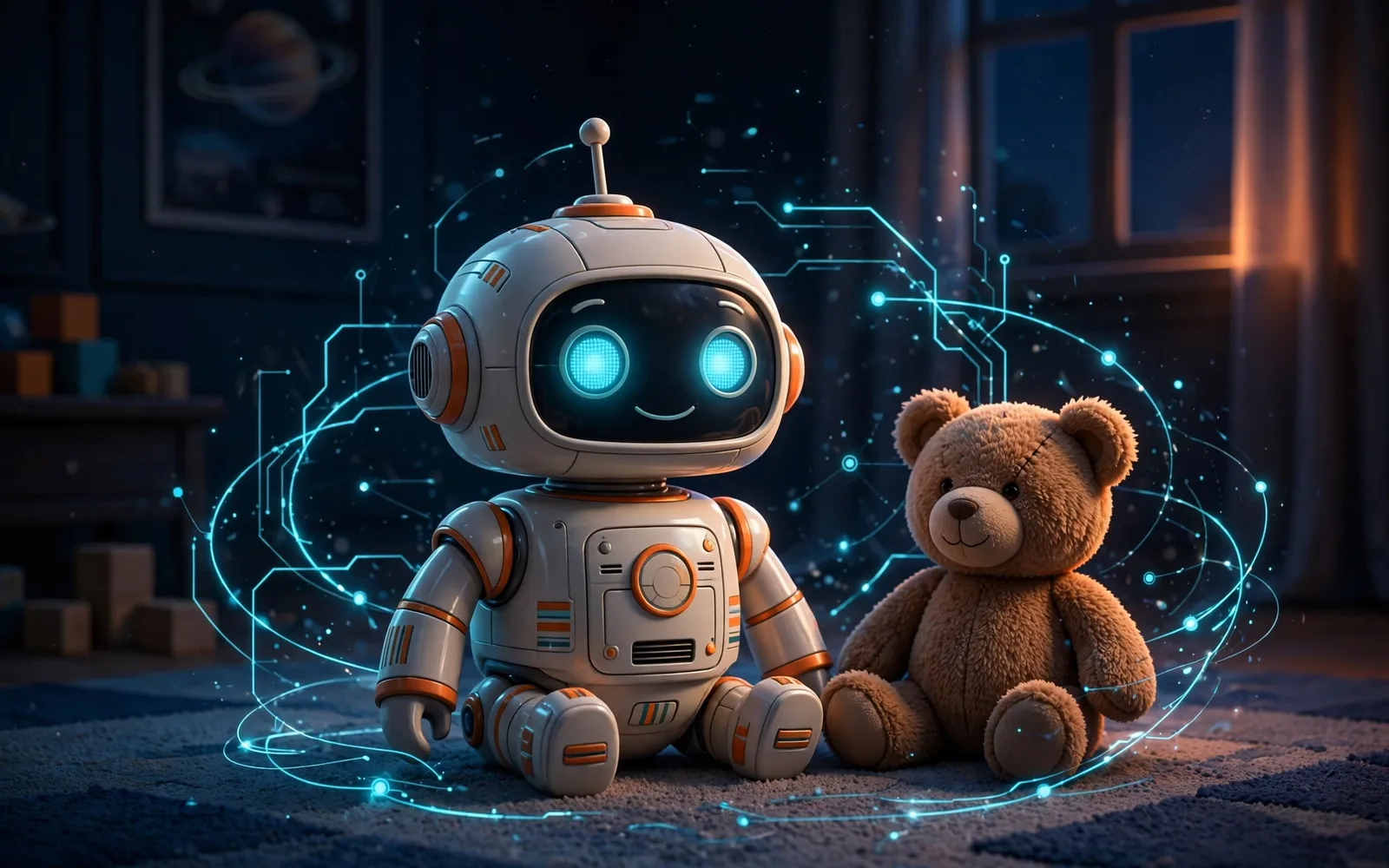
Mattel's June 2025 partnership with OpenAI aimed to bring conversational AI to toys like Barbie and Hot Wheels, but the first product missed its 2025 target amid safety and privacy scrutiny. Parents should check what an AI toy records, where the data goes, and whether it fits their child's age before buying.
Imagine a teddy bear that knows your daughter's name. It remembers her favorite bedtime story. It asks how school went today and listens while she answers. This is not science fiction. It is the product roadmap of the world's biggest toy company, and it is closer than most parents realize.
In June 2025, Mattel, the company behind Barbie, Hot Wheels, Fisher-Price, and American Girl, announced a strategic collaboration with OpenAI, the maker of ChatGPT, to build AI-powered toys and play experiences. The first product was expected to arrive before the end of 2025. It did not. Why it missed that target tells parents a lot about what is coming next and what to watch for before one of these toys lands in your living room.
What the Mattel-OpenAI deal actually is
The June 2025 announcement described a strategic collaboration to build AI-powered play experiences around Mattel's most iconic brands, from Barbie to Hot Wheels. Mattel said the products would bring AI to "age-appropriate play experiences" with an emphasis on innovation, privacy, and safety. The company stressed that it would keep control of product development so the technology is used responsibly and with children's well-being in mind.
The deal goes beyond talking dolls. Mattel is already using generative AI in its design studios, where designers prompt AI tools to create new characters and playsets far faster than traditional sketching allowed, and it is rolling ChatGPT Enterprise out across the company to boost product development and productivity. AI is changing how toys are designed before it changes how toys play.
The first AI toy was supposed to arrive in 2025. It didn't.
The original plan was for the first product from the partnership to be announced by the end of 2025. In December 2025, Mattel confirmed to Axios that this would not happen, telling the outlet it had "nothing planned for the holiday season."
When a product does arrive, Mattel says it will be aimed at "families and older customers" rather than young children, partly for a practical reason: OpenAI's developer tools only support users aged 13 and older. A talking toy for preschoolers built on a system rated 13+ would have been a very different and much harder promise to keep.
The delay also followed pressure from regulators and advocates. Senators Marsha Blackburn and Richard Blumenthal sent a bipartisan letter demanding transparency from AI toy makers, asking what safeguards exist, whether independent safety testing has been done, what data the toys collect, and whether the toys pressure children to keep talking or discourage them from disengaging. Advocacy group Public Citizen went further, arguing that children do not have the cognitive capacity to fully distinguish play from reality and calling on Mattel not to put AI into children's toys at all.
This is not Mattel's first talking doll
Parents who feel a sense of deja vu are right. In 2015, Mattel released Hello Barbie, a doll built with the startup ToyTalk. Press the doll's belt buckle and Barbie would ask a question; the child's answer was recorded, sent over Wi-Fi to company servers, and processed with speech recognition so the doll could "remember" conversations and respond personally.
The backlash was immediate. The Campaign for a Commercial-Free Childhood (now Fairplay) launched a #HellNoBarbie campaign, arguing the doll collected children's private thoughts on corporate servers. A security researcher showed the doll could be hacked, gaining access to system information, stored audio files, and even the microphone. Two mothers filed a class-action lawsuit in California alleging the doll violated children's privacy. Hello Barbie flopped and was quietly discontinued.
The lesson is simple: a talking toy is a listening device. Whatever new name the next version carries, it records, transmits, and stores your child's voice somewhere. That has not changed in ten years.
The rest of the market is not waiting
While Mattel takes its time, the AI toy business is booming. Research firm IMARC Group estimates the global AI toy market was worth about $18.1 billion in 2024 and could grow to $60 billion by 2033. Exact numbers depend on how you define an "AI toy" — some counts include app-connected games and coding robots — but every definition points in the same direction: growth.
In Asia, tech giants are already selling them. Huawei's AI plush, sold for around 399 yuan (roughly $57), sold more than 10,000 units in its first week.
Independent testing shows why parents should stay alert. In January 2026, Common Sense Media published a risk assessment of popular AI companion toys after its researchers interacted with three products: a plush alien, a stuffed dinosaur, and a kid-focused robot. The findings were sobering: 27% of the toys' responses were inappropriate for children, including content touching on self-harm, drugs, risky advice, and unsafe roleplay. The researchers found the toys collect voice recordings, transcripts, and behavioral data in children's bedrooms and play spaces, and that their bonding-style design creates emotional attachment by intent. The organization's guidance: no AI toy companions for children aged 5 and under, and extreme caution before buying one for children aged 6 to 12.
AI-powered toys vs. traditional toys: what actually changes
| What to check | Traditional toy | AI-powered toy |
|---|---|---|
| Data collection | None. Nothing leaves the toy box. | Voice recordings, transcripts, and behavioral data stored in the cloud. |
| Connectivity | No internet needed. | Wi-Fi or Bluetooth required; the toy stops working without it. |
| Age gates | A recommended age printed on the box. | The underlying AI is rated 13+; child guardrails are tested but not guaranteed. |
| Content | Fixed. You can read the whole script. | Generated on the fly. No parent can review every possible answer. |
| Co-play | Grown-ups join naturally. | Easy to hand to a child alone — the risky move is using it as a babysitter. |
Five questions before you buy an AI toy
You do not need to be a tech expert to shop safely. Ask these five questions about any AI toy you are considering:
1. What does it record, and where does the audio go? A toy with a microphone that sends recordings to company servers is a data-collection device. The Hello Barbie case showed recordings were stored and used to improve the company's voice technology. Read the privacy policy and look for clear statements about what is collected and for how long it is kept.
2. Can you review and delete the data? Look for a parent dashboard or app that lets you listen to recordings and delete them. If a company will not show you what it has on your child, that is a red flag.
3. Is there a real age gate? OpenAI's own tools are restricted to ages 13 and up, and Common Sense Media advises against AI companions for children 5 and under, with extreme caution from 6 to 12. If a product markets to toddlers but runs on 13+ infrastructure, something does not add up.
4. Can it go offline — or at least go mic-off? The safest AI toy is one that also works as a plain toy. Look for a physical mic switch, an offline mode, or the ability to disable conversational features. A toy that is always listening is a toy you cannot fully control.
5. Co-play first, always. Play with the toy alongside your child the first few times. You will hear how it talks, what it asks, and where its answers get strange. Treat it like a screen: something you experience together, not something you hand over.
The bottom line
Mattel's OpenAI partnership shows where play is headed: toys that talk, listen, and remember. The 2025 delay shows the industry itself knows this is hard to get right, and independent testing shows the risks are real — from inappropriate answers slipping through guardrails to voice data landing on corporate servers. Parents do not have to reject AI toys outright. But the era of buying a toy without reading a privacy policy is over. Ask the five questions above, keep the toy's conversations in the open, and remember the simplest safety rule of all: the best playmate in the room is still a person.
Sources
- PYMNTS: OpenAI Partnership Puts Conversational AI in Mattel Toys
- The Bridge Chronicle: Mattel Partners with OpenAI to Launch Next-Gen Toys
- PIRG: Mattel, OpenAI Delay AI Product Launch as Senators Demand Transparency
- MediaPost: Mattel Puts Brakes on OpenAI Collaboration
- HeyCurio: The Toy Industry Is Betting Big on AI
- Common Sense Media: Parents' Ultimate Guide to AI Toys
- Common Sense Media: Warns Against AI Toy Companions After Research Reveals Safety Risks
- Johns Hopkins News-Letter: Mattel Introduces a Talking Barbie Doll
- Phys.org: High-Tech Barbie Stokes Privacy Fears