Italian brainrot explained: what parents need to know about "Tung Tung Sahur"
Your kid chants "Tung Tung Tung Sahur" and you have no idea what it means. A parent's guide to the Gen Alpha meme universe: characters, games, risks, and what to do.
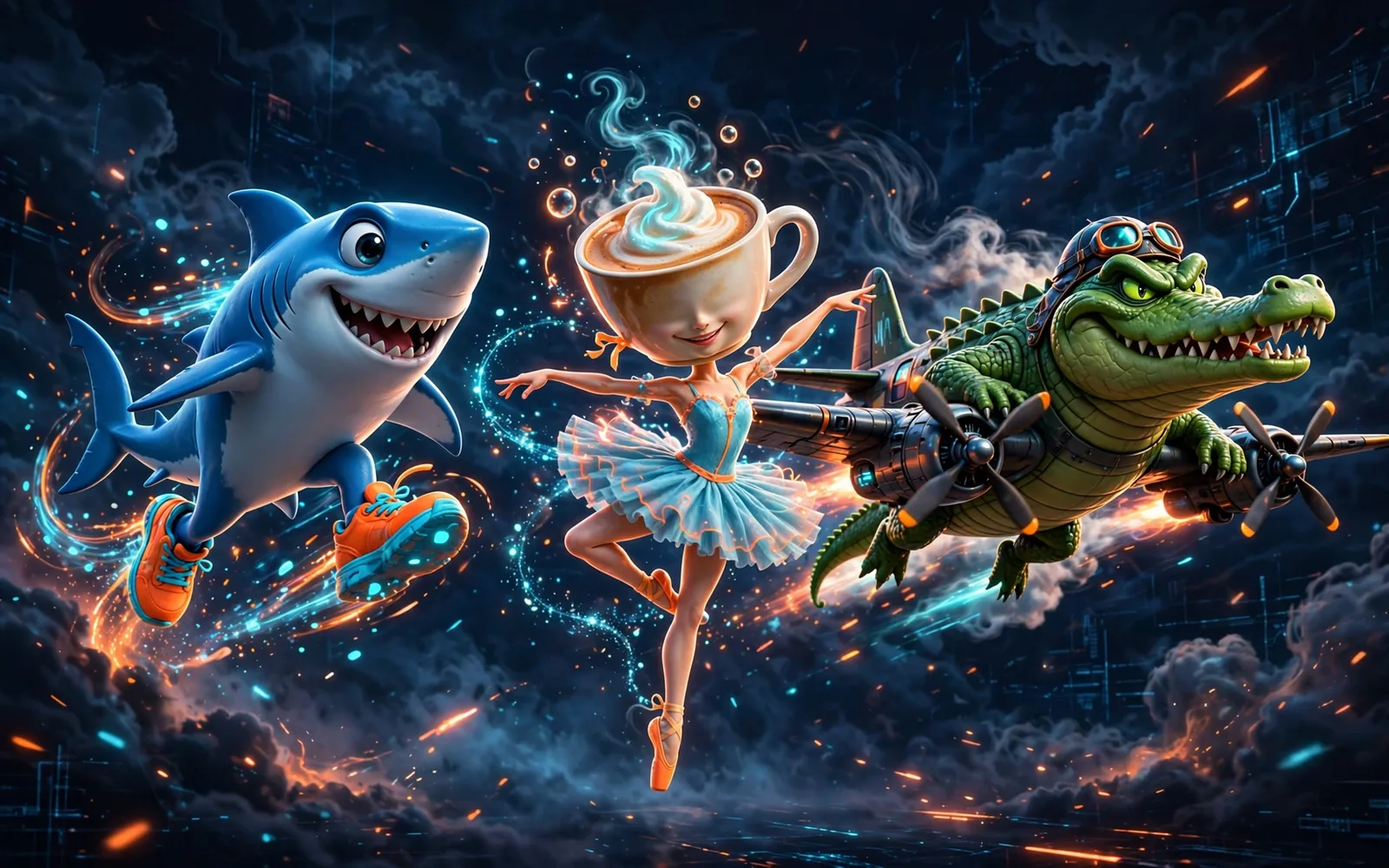
"Italian brainrot" is a Gen Alpha meme universe of AI-generated absurd creatures - a three-legged shark in sneakers, a ballerina with a cappuccino-cup head, a wooden plank carrying a bat - paired with mock-Italian chants, that exploded on TikTok in early 2025 and now powers one of the biggest Roblox games in the world.
If you have a child between roughly 8 and 14, you have heard it. A chant in nonsense Italian bursting out of a phone, a friend's mouth, or the back seat of your car: tung tung tung sahur. Or tralalero tralala. It sounds like nothing, means almost nothing, and yet an entire generation is fluent in it.
This is "Italian brainrot" - the defining internet phenomenon of Gen Alpha's year. It is not a show, not a game, and not exactly a meme. It is a whole homemade universe of characters, and your kid almost certainly knows the cast better than you know the cast of whatever they were supposed to be watching.
What "Italian brainrot" actually is
Start with the pieces. In early 2025, TikTok filled up with surreal, AI-generated creatures: animals fused with objects, food, vehicles, and weapons, each paired with an exaggerated, operatic pseudo-Italian voiceover chanting its name. Think of it as folklore made by robots and remixed by millions of children.
The core cast, as documented in a comprehensive guide to the phenomenon:
- Tralalero Tralala - a three-legged blue shark wearing Nike sneakers. He arrived first, in January 2025, and became the mascot of the whole trend.
- Ballerina Cappuccina - a ballerina in a tutu with a cappuccino mug for a head, star of melodramatic mini soap operas called "brainrot weddings."
- Bombardiro Crocodilo - a crocodile fused with a WWII-era bomber plane, usually cast as the villain.
- Tung Tung Tung Sahur - an anthropomorphic wooden plank or drum carrying a baseball bat. Despite the Italian dressing, he is Indonesian in origin: the name references the pre-dawn Ramadan drumming tradition called sahur, reimagined by the TikTok creator @noxaasht, according to Perfect Corp's breakdown of the meme.
- Chimpanzini Bananini, Lirili Larila, Cappuccino Assassino, Frigo Camelo - a monkey emerging from a banana, a cactus-elephant in sandals, a coffee-cup ninja, a camel fused with a refrigerator. Dozens more exist, and new ones appear daily.
Here is the part parents miss: anyone can make a new character. Free AI image tools plus text-to-speech voices mean a kid can generate a hybrid, give it a musical name, and see if the internet accepts it as canon. Italian brainrot is the first truly open-source mythology - a meme-culture roundup describes the format as attention-driven AI content that the audience knowingly treats as a joke while consuming it by the ton.
The "brain rot" label is not an insult the kids invented. In 2024, Oxford University Press named "brain rot" its Word of the Year after more than 37,000 people voted, and the term's usage had spiked roughly 230 percent, as Smithsonian reported. The first recorded use goes back to Thoreau's Walden in 1854. The younger generations reclaimed the word with cheeky self-awareness - and then built a universe out of it.
The cast at a glance
| Character | What it is | Why kids quote it |
|---|---|---|
| Tralalero Tralala | Three-legged shark in sneakers | The original; the chant everyone knows |
| Ballerina Cappuccina | Ballerina with a cappuccino-cup head | The melodrama - weddings, betrayals, lore |
| Bombardiro Crocodilo | Crocodile crossed with a bomber plane | The villain energy; dramatic entrances |
| Tung Tung Tung Sahur | Wooden plank with a baseball bat | The catchiest chant; the crossover star |
| Chimpanzini Bananini | Monkey inside a banana peel | Pure reaction-meme material |
| Lirili Larila | Cactus-elephant wearing sandals | Calm, "wise" contrast to the chaos |
From TikTok joke to a record-breaking Roblox game
Memes used to die in a week. This one got a second life as a game. Steal a Brainrot, a Roblox experience built around collecting the characters, became one of the most-played games on the platform in 2025. Players capture brainrots, level them up, and - the twist - sneak into rivals' bases to steal rare ones from each other.
The numbers are startling. In October 2025, the game hit a concurrent-player peak of about 25.4 million players at once, a single-title record on Roblox; one tracker recorded 25,868,678 concurrent players on October 11, 2025. That peak passed Fortnite's all-time record. A meme your kid quotes in the kitchen out-drew one of the biggest games on Earth.
The game's loop also raises a flag worth noticing: the core mechanic is stealing from other players. That makes it a digital-citizenship conversation, not just a screen-time one - more on that below.
Monetization moved fast, as it always does. Meme coins launched on crypto exchanges, plushies and sticker albums appeared, and newsstands in Italy started selling official "Italian Brainrot" trading card games aimed at children. Your kid's nonsense chant is somebody's product line.
Why kids fixate on it
This did not happen by accident. Five forces make Italian brainrot unusually sticky:
- Rapid dopamine cycles. Each clip delivers fast visual payoff and loud sound with almost no cognitive effort. Brains trained on this pattern start expecting constant novelty for free.
- Sensory-overload editing. Quick cuts, zooms, subtitles, bright colors, layered audio - it feels more intense than a cartoon, which makes calmer content feel boring by comparison.
- A near-zero barrier to making your own. A child can generate a new character in minutes. Creating and remixing is participation and identity in these communities.
- A secret language. The pseudo-Italian chants and nonsense lore form an in-group code that adults do not understand. The opacity is the appeal.
- Rebellion through nonsense. The whole thing is deliberately meaningless - digital Dada. Rejecting coherent storytelling fits the adolescent urge to build a world adults cannot enter.
Honest concerns - no panic, no dismissal
The attention question. Researchers are connecting formats like this to a broader pattern of attention fragmentation in young people. A 2025 systematic review and meta-analysis in Psychological Bulletin (Nguyen et al.), available via the APA, linked heavier short-form video use with poorer cognition, especially attention and impulse control. The honest version: this is behavioral conditioning, not brain damage. A developing brain repeatedly rewarded by chaotic ultra-short clips grows less comfortable with slow, sustained-focus tasks like reading and homework. The content does not literally rot anything - but the pattern of consumption trains impatience.
The content inside the chants. Some viral Tralalero Tralala audios contain Italian religious profanity and blasphemy that drew accusations of disrespect once the chants reached children's content. Italian speakers note this kind of language appears as common filler in some dialects - but intent does not travel well across cultures, and your child chanting it has no idea what they are saying. This is worth one calm conversation, not a lecture.
The stealing loop in the game. A game whose core verb is "steal from your friends" deserves a conversation about sportsmanship and consent in digital spaces - especially since the victims are often real classmates.
The spending. Trading cards, plushies, and in-game items add up fast. Set the merch budget conversation early, before the collection instinct kicks in.
The parent-action playbook
Forget banning the shark. The meme is not the problem; the binge pattern and the blind spots are. Here is what actually works:
- Ask your kid to explain the lore. This is the single best move. It is a media-literacy moment disguised as bonding: which characters are "good," who made them, how the game works. Kids who explain their media start thinking about their media.
- Co-watch a few clips together. You will find it unbearable. That is fine. Watching together lets you ask the useful question: "What makes this one funny to you?" Their answer reveals whether it is the creativity, the community, or just the dopamine.
- Set boundaries around the binge, not the meme. "No 45-minute short-form sessions" works better than "no more Tung Tung." Target the endless-scroll design: timers, app limits, and phone-free homework zones.
- Talk about the stealing mechanic directly. Ask: "How would you feel if someone stole your rarest brainrot?" Kids grasp fairness instantly when it is personal.
- Translate one chant together. Look up what the Italian actually says. Kids are usually horrified or delighted - either way, they stop chanting blindly.
- Watch the spending. Trading cards and game items get their own small budget, decided together, before the collection grows teeth.
Italian brainrot looks like nonsense because it is nonsense - on purpose. But underneath the shark in sneakers is something real: a generation building its own shared language out of the cheapest creative tools ever invented, in a game that briefly out-drew Fortnite. You do not need to love it. You do need to understand enough of it to guide the parts that matter: the attention, the fairness, and the wallet.