Underconsumption Core: Why Gen Z Teens Buy Less
Gen Z teens are proudly buying less — empty shelves, repaired clothes, no-buy months. What is driving underconsumption core, and what should parents know?
Drafted with an AI writing assistant and checked against its sources by the editor before publishing. How we use AI.
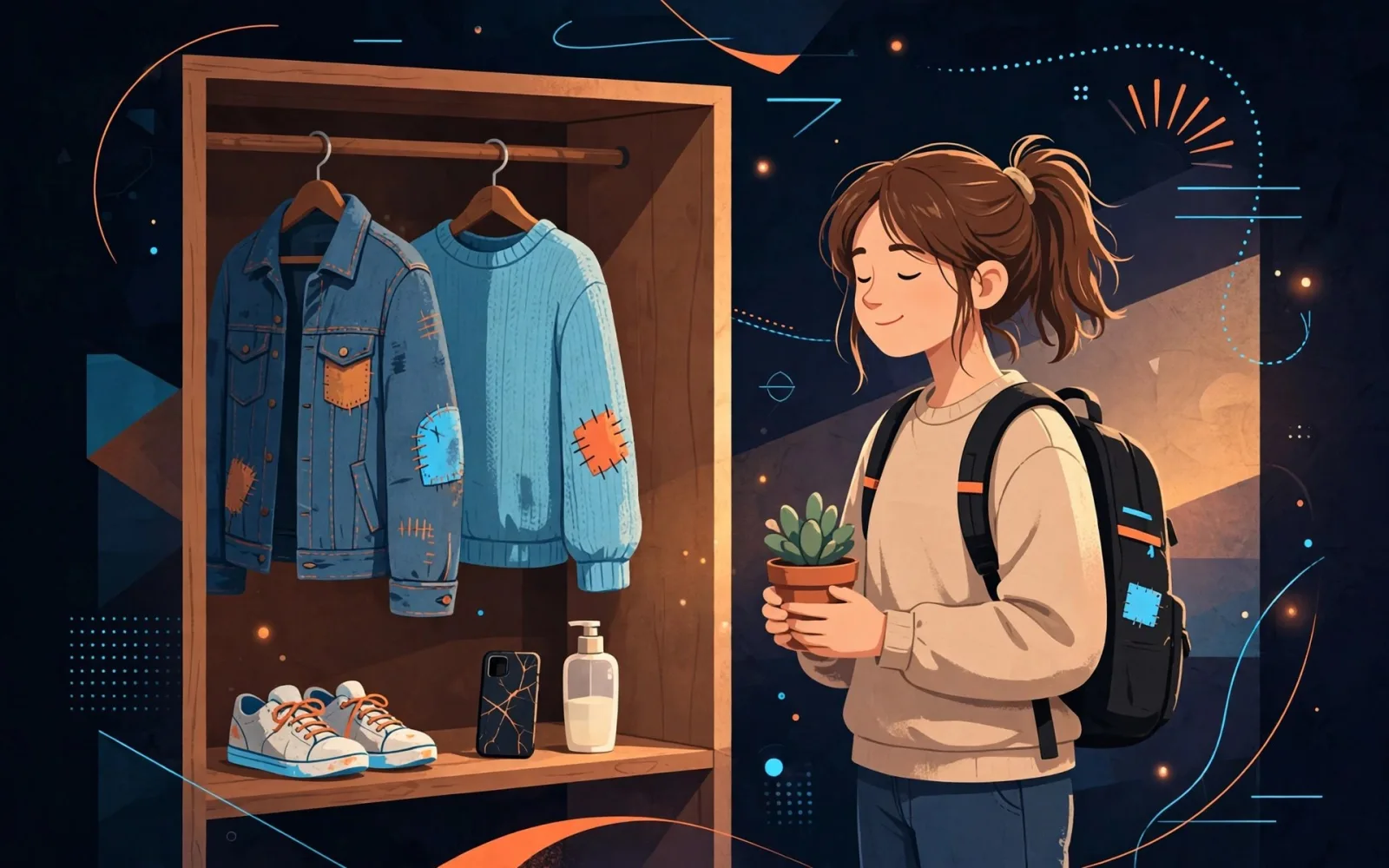
Gen Z teens are buying less on purpose because of cost-of-living pressure, climate worry and exhaustion with influencer marketing — a trend called underconsumption core. The attitude is real and secondhand shopping is booming, though purchase data shows spending often shifts to cheaper brands rather than falling overall.
Scroll through a teenager's feed in late 2026 and you will see something that would have looked absurd five years ago: a girl filming her nearly empty bathroom shelf and bragging about it. One tube of moisturiser, used down to the last squeeze. A pair of jeans with a stitched knee, worn for a third year. A hair dryer older than she is. The caption reads like a victory lap. This is underconsumption core, the TikTok trend where buying less is the flex — and it is one of the most interesting things happening in teen culture right now.
The short version is this: underconsumption core is a social media movement, mostly on TikTok, in which young people proudly show off using, repairing and reusing what they already own instead of buying new things. It grew out of the anti-haul and deinfluencing movements, it is driven by the cost of living, climate worry and sheer exhaustion with influencer marketing, and the data suggests it is a real shift in attitude even if the spending numbers are more complicated than the videos suggest. For parents, it is mostly good news — with a few warning signs worth knowing.
What is underconsumption core?
Underconsumption core is the name for a wave of TikTok content in which creators film the opposite of a haul. Instead of unboxing a pile of new purchases, they show the things they have owned for years and still use: worn shoes, a single bottle of shampoo used to the last drop, a phone with a cracked case that still works, a grandmother's glassware reused as storage. The trend first appeared on TikTok in the summer of 2024, and Wikipedia's summary of the trend describes it as content that "emphasizes using, reusing, repairing, and repurposing existing possessions instead of buying new items."
One of the early viral moments came from 18-year-old Maya "Liu" Feldman from Germany, who posted a video in July 2024 talking about how she still used an old hair dryer and wore clothes from seventh grade. The clip drew more than 446,000 likes and 2.3 million views, according to Katie Couric Media's explainer. From there the format spread fast. By June 2025 the hashtag had passed two billion views on TikTok, according to a 2026 look back at the movement, and it surged again in early 2026 when Gen Z finance creators launched 100-day no-buy challenges in January that peaked in visibility in March.
The look of it matters less than the message. A typical underconsumption video is deliberately unglamorous: a drawer with three pairs of shoes, a makeup bag with five products, a closet where every item gets worn. Some creators call the more polished version "luxury minimalism" — the same idea, but with a small number of expensive, long-lasting pieces instead of a large number of cheap ones. The German influencer Diana Blaum, for example, built a following showing a wardrobe built around just three pairs of shoes and a small collection of bags, as Katie Couric Media reported.
It is worth saying plainly what this is not. It is not a boycott of any one brand. It is not a formal movement with leaders or a manifesto. And it is not, for most teens, a vow of poverty. It is a public attitude: a teenager deciding, and then announcing to the internet, that the smart move is to stop buying things they do not need.
From hauls to anti-hauls: how we got here
To understand why this landed so hard with teenagers, it helps to remember what came before it. For a decade, the dominant shopping format on social media was the haul: a creator opening bag after bag of fast-fashion clothes, beauty products and gadgets, each one linked so viewers could buy the same thing in two taps. "TikTok made me buy it" became a running joke and a real sales engine at the same time. The algorithm rewarded volume — more products, more links, more purchases — and teenagers, who spend hours a day on these platforms, absorbed the message that a full closet was a normal closet.
Then, in early 2023, the backlash arrived. Deinfluencing — creators telling their audiences what NOT to buy — exploded on TikTok. The hashtag was virtually nonexistent before December 2022; by February 2023 videos under the tag had been viewed more than 200 million times, and the trend was being covered by the New York Times, the BBC, Vox and Vogue Business. Creators filmed themselves walking through a Sephora pointing out overhyped products they would never buy again, or listing the viral gadgets that had failed to live up to the promise.
Deinfluencing and underconsumption core are cousins, not twins. Deinfluencing is mostly about specific products: do not buy this cream, that gadget is a waste of money. Underconsumption core is broader: it is a whole posture toward owning things. As one analysis of the two trends puts it, the genuine version of underconsumption is not a content format at all — it is the person who has used the same water bottle for seven years and has not thought about it once. The TikTok version is the performance of that idea, which is where parents should keep a healthy scepticism. A teenager can film a video about not buying things while still buying plenty of things off camera. The trend is real, but the videos are still content, and content rewards exaggeration.
The growth has nonetheless been striking. Fashion-specific deinfluencing content surged 158% year over year, according to a 2025 analysis of the trend, spilling beyond beauty into fashion, home goods and lifestyle. Anti-haul videos now routinely outperform traditional shopping content in saves and shares. Audiences are not just watching restraint; they are bookmarking it.
The money reason: Gen Z is squeezed
The first driver is the simplest, and the one parents will recognise immediately: money is tight. Teenagers are not economists, but they are living inside an economy that feels very different from the one their parents grew up in. Prices rose sharply after the pandemic, housing costs climbed, and the part-time jobs available to teenagers and young adults pay wages that do not stretch the way they used to.
The numbers behind that feeling are stark. Deloitte's 2025 Gen Z and Millennial Survey, which polled more than 23,000 people across 44 countries, found that 48% of Gen Z respondents did not feel financially secure in 2025 — up from 30% just a year earlier. More than half of Gen Z respondents, 52%, said they were living paycheck to paycheck, and more than one in three said they struggled to pay their living expenses each month. Cost of living was the single biggest societal concern for the generation, ahead of climate change, mental health and political instability.
For teenagers specifically, the squeeze shows up differently. Most teens do not pay rent, but they do pay for their own clothes, their phone, their streaming subscriptions, their snacks and their social life — and they watch their parents worry about the grocery bill. A Bank of America Institute report from March 2025 found that Gen Z's spending on both necessities and discretionary items was growing faster than the overall population's, while the average young Gen Z worker did not have enough in savings to cover even one month of spending. Their spending-to-savings ratio was 1.93, meaning they were spending nearly twice what they held in savings. A later Bank of America "Gen Z reality check" from August 2026 found Gen Z had the lowest savings-to-spending ratio of any generation — and yet their spending growth had stayed resilient, with discretionary spending strengthening across beauty, jewellery, coffee and travel.
That contradiction is the key to the whole trend. Gen Z is not, as a generation, suddenly frugal in the traditional sense. They are anxious about money and spending at the same time. Underconsumption core gives that tension a shape: it lets a teenager feel in control of money without giving up the small pleasures — the coffee, the lip balm, the concert ticket — that make life feel worth living. The "little treat economy," as Bank of America calls it, runs right alongside the no-buy challenge. Both can be true of the same person in the same week.
There is a psychological relief in that framing, and the AllPrisma analysis names it well: if you cannot afford to buy new things constantly, underconsumption core gives you a framework in which not buying new things is evidence of taste rather than constraint. For a teenager, that reframe matters enormously. Nobody wants to be the kid who cannot afford the new thing. Everybody wants to be the kid who chose not to buy it.
The climate reason: the waste is visible
The second driver is the environment, and here the facts are genuinely alarming. Every year, 92 million tonnes of textile waste is produced globally, according to the United Nations Environment Programme — the equivalent of a garbage truck full of clothing being sent to landfill or incinerated every second. Between 2000 and 2015, clothing production doubled while the amount of time each garment was actually worn fell by 36%, according to the Ellen MacArthur Foundation's research cited by UNEP. Less than 1% of discarded clothing is recycled into new garments.
Teenagers have grown up with these images: mountains of discarded clothes in the Atacama desert in Chile, rivers of textile waste, documentaries about the human cost of fast fashion. They are also the generation most likely to have been taught about climate change in school from a young age. Deloitte's survey consistently finds climate among Gen Z's top concerns, and the secondhand boom reflects it: 56% of younger shoppers say brands are not doing enough to address fashion's impact on the planet, according to ThredUp's 2025 Resale Report.
That report, one of the most comprehensive measures of the secondhand market, found that the US secondhand apparel market grew 14% in 2024 — its strongest growth since 2021, and five times faster than the broader retail clothing market. Online resale grew 23% in the same year. The global secondhand apparel market is expected to reach $367 billion by 2029. And younger shoppers are driving it: they plan to spend 46% of their apparel budget on secondhand in the next year, and 39% of younger-generation shoppers have bought secondhand apparel on a social commerce platform in the last 12 months.
Thrifting, in other words, has become the practical half of underconsumption core. A teenager who will not buy a new fast-fashion top for £5 will happily spend an afternoon hunting for a vintage one for the same price. The money is the same. The story is different. One purchase is a copy of what everyone else is wearing; the other is a find, a one-off, a small act of taste. For parents, this is the easiest part of the trend to support: a thrifted wardrobe is cheaper, more individual, and vastly less wasteful than a fast-fashion one.
The algorithm backlash: tired of being sold to
The third driver is the one adults most often miss, because it is about the feed itself. Teenagers have spent their entire adolescence inside an advertising machine that is more sophisticated than anything previous generations faced. Every scroll brings a sponsored post, a creator's affiliate link, a "limited drop" with a countdown timer. The pressure is constant, personalised and relentless — and teenagers are tired of it.
This is the deeper meaning of deinfluencing. When a creator with a million followers says "do not buy this," they are doing something the platform was not designed for: breaking the sales funnel in public. The appeal is partly honesty. Teenagers are remarkably good at spotting a sponsored recommendation, and they have watched too many "must-have" products turn out to be ordinary. The trust in influencer recommendations has frayed, and the creators who admit it are the ones who gain credibility.
There is also a status shift underneath. In haul culture, status came from having more: more bags, more shoes, more products. In underconsumption core, status comes from needing less. The curated ten-item capsule wardrobe started looking smarter than the overflowing closet. Proportion and texture replaced volume as markers of taste, as the Riiven analysis notes. A teenager who can make three outfits from five pieces is showing skill. A teenager who buys thirty pieces is showing a credit card.
Parents should take this seriously, because it is a genuinely healthy instinct. A teenager who questions whether an advertisement is telling the truth, who waits before buying, who asks "do I actually want this or did the algorithm want me to want it" — that teenager is developing the critical thinking schools try to teach and advertising tries to prevent. It is worth praising out loud when you see it.
What the data actually says: the honest complication
Here is where a responsible article has to slow down, because the story is messier than the TikTok version. The trend is real as a cultural attitude. Whether teenagers are actually buying less is a different question — and the early evidence says: not really, not yet.
The most interesting data comes from Measure Protocol, a behavioural research firm that linked TikTok viewing data to receipt-level purchase data for a US and UK panel between June 2024 and May 2026. Their finding is blunt: people who watched underconsumption content did not buy less. Their purchase volume was statistically flat compared with the TikTok baseline — about 218 purchases per user versus 224 — and a higher share of them made purchases at all (64.6% versus 50.6%). What changed was what they bought: spending shifted toward value brands, Amazon and delivery apps, and away from prestige brands. The restraint was, at the aggregate level, performative. The substitution was real.
That does not make the trend meaningless. Attitudes often change before behaviour does, and the substitution pattern — value over prestige, secondhand over new — is itself a behavioural change with real consequences for brands and for the planet. But parents should know the gap between the video and the receipt, because it protects teenagers from a particular trap: believing that because they watched the right videos, they have already solved the problem. Watching anti-haul content is not the same as spending less. The algorithm does not care whether you buy the product or the critique of the product. It cares that you keep watching.
The Bank of America data tells a similar story from the other side. Gen Z's discretionary spending on beauty, jewellery, coffee and travel actually strengthened through 2025 and into 2026, according to the bank's August 2026 reality check. The generation is cutting back in some categories and spending freely in others — the "little treat" alongside the no-buy month. That is not hypocrisy. It is how real people behave. But it is a useful corrective to the idea that a whole generation has sworn off shopping.
The honest summary is this: underconsumption core is a real change in what teenagers value and talk about, a real growth market in secondhand, and a real shift in which brands get their money — but it is not yet a measurable collapse in how much they buy. The attitude may yet become the behaviour. That is a story still being written, and parents should watch it with interest rather than either celebration or cynicism.
Underconsumption vs the cousins: a quick comparison
The words around this trend get tangled, so here is a plain comparison of the four ideas teenagers are most likely to mention.
| Idea | What it means | Typical teen version | The catch |
|---|---|---|---|
| Underconsumption core | Use, repair and reuse what you already own; buy less on purpose | Filming an almost-empty shelf, wearing repaired clothes, a no-buy month | Can become a performance — filming restraint is still content, and the spending often just moves elsewhere |
| Deinfluencing | Creators telling audiences what NOT to buy | "Do not buy this viral cream, it is overhyped" videos | Deinfluencers still earn from attention, and many quietly recommend cheaper "dupes" instead |
| Minimalism | Owning fewer things by design, for calm and focus | A capsule wardrobe, a clear desk, a phone with five apps | Can become its own expensive aesthetic — buying new "minimal" things to look like you own nothing |
| Overconsumption / haul culture | Buying lots of new things, often because the feed said so | Unboxing ten fast-fashion parcels in one video | The default the other three are reacting against: debt, waste and a closet full of unworn clothes |
The table makes the family resemblance clear. All four are answers to the same question — how much stuff does a person need? — and teenagers are trying out different answers in public, which is exactly what adolescence is for.
When it is healthy — and when parents should worry
Most of the time, a teenager's interest in buying less is something to welcome. It builds patience, it builds taste, it saves money, and it connects a teenager to a real-world problem — waste — in a way that feels like their own choice rather than a lecture. A no-buy month that a teenager chooses is a genuinely useful exercise in self-control, and the skills it teaches — waiting, repairing, making do — are the same skills that keep adults out of debt.
But there are lines where a healthy habit tips into something a parent should notice. The first is anxiety. If "I should not buy this" turns into "I am a bad person for wanting this," the trend has stopped being about money and started being about self-punishment. Watch for a teenager who feels guilty about every purchase, including necessary ones — new shoes when the old ones have holes, a birthday present for a friend, lunch with friends. Frugality that makes a teenager skip meals, refuse social outings because they cost money, or hide normal spending from you is not a virtue. It is anxiety wearing a fashionable outfit.
The second is shame. Underconsumption core reframes not buying as taste, which is liberating for the teenager who cannot afford the new thing. But it can also flip into a new kind of judgement: the teenager who does buy something gets mocked for it, or the teenager whose family genuinely cannot afford much feels exposed rather than empowered. If your teenager starts policing other people's spending — siblings, friends, you — that is a sign the trend has become a purity test, and purity tests are rarely kind.
The third is the mirror image of haul culture: comparison. A no-buy challenge shared publicly is still a public performance, and teenagers compare their performance with everyone else's. The girl with the genuinely empty shelf gets fewer likes than the girl with the artfully arranged empty shelf. The pressure to perform restraint can be as stressful as the pressure to perform consumption, and parents should not assume that a teenager who posts about buying less is free of the feed's pressure. They have just swapped one scoreboard for another.
The fourth, and the one most parents will recognise, is the aesthetic trap. The "aestheticised version" of underconsumption, as the AllPrisma analysis calls it, often involves buying new things in order to photograph the old ones: a new linen basket for the old clothes, a new ceramic jar for the nearly empty cream, a new "vintage" piece to complete the thrifted look. If your teenager's no-buy month somehow includes three new purchases "for the aesthetic," it is worth a gentle, amused conversation about what just happened. No lecture. Just noticing.
None of this means the trend is dangerous. It means, like every teen trend, it is a tool that can be used well or badly, and teenagers need an adult nearby who can tell the difference without mocking the whole thing.
How to talk about money without lectures
The fastest way to kill a teenager's interest in buying less is to turn it into a lecture about your generation's frugality. Teenagers can smell a lecture from the first sentence, and the surest way to make them buy more is to tell them they should buy less. The trend is useful to parents precisely because it does the persuading for you. Your job is to make the conversation easy, not to win it.
Start with curiosity, not approval. "I saw a video about a girl who only owns three pairs of shoes — what do you think of that?" is a better opening than "You should watch this, it is very sensible." The first invites an opinion. The second invites an eye roll. Teenagers who feel interrogated about money shut down; teenagers who feel consulted about money open up.
Separate the wants from the needs out loud, together, without judgement. A practical exercise that works well: once a month, sit with your teenager and look at what they actually spent — not to audit them, but to sort it together into three piles: things that made life better, things that were fine, things they regret. Most teenagers are startled by how much falls into the third pile, and that discovery is far more persuasive coming from their own bank statement than from a parent's speech. This is also the moment to connect the trend to the bigger money picture — and if your teenager is curious about how their generation thinks about money more broadly, our guide to Gen Z buying crypto before a 401(k) is a useful next read, because it shows the same generation making very different money choices at the same time.
Give them a real budget, not a veto. A teenager with £20 or $30 a month of genuinely their own money — no approval needed, no questions asked — learns more about spending than a teenager whose every purchase is debated. The no-buy challenge works best as a game they choose, not a rule you impose. Offer to do one with them: a family low-buy month, where everyone picks one category to skip and the savings go toward something shared, like a day out. Shared sacrifice is fun. Imposed sacrifice is resentment.
Talk about the algorithm as a fact, not a moral failing. "The feed is designed to make you want things" is a neutral statement a teenager can agree with, because it is true and it does not blame them for wanting things. Once that is established, the practical question follows naturally: what do you do about it? Some teenagers delete shopping apps from their phone. Some use a 72-hour rule — wait three days before buying anything that is not a necessity, and most of the time the urge passes. Some keep a "want list" on their phone and only buy from it once a month. All of these are versions of what underconsumption creators are already preaching, which is why the trend is such a useful ally: your teenager heard it from a creator they trust, and you are simply agreeing.
Finally, model it — lightly. Teenagers notice what their parents buy far more than what their parents say. If you mend a jacket, use a product until it is empty, or wait before replacing a working phone, say so out loud, once, without making a speech of it. "This jacket is five years old and I still like it" is a complete lesson. You do not need to add the moral.
A simple starter: the 30-day low-buy experiment
If your teenager is curious, here is a low-pressure way to try the idea without turning it into a vow. It takes thirty days, costs nothing, and works best if the whole family does it together.
First, pick one category to skip, not everything. Clothes are the easiest, because the trend is mostly about clothes. Beauty products are a close second. One category keeps the experiment winnable, and winning matters more than the category.
Second, write down the rules together and stick them on the fridge. The usual version: no new purchases in the chosen category for thirty days; replacements only if something genuinely breaks or runs out; gifts do not count; experiences do not count. Writing the rules down stops the daily renegotiation that kills most family challenges.
Third, keep a visible tally. Every time someone is tempted and does not buy, they write the item and its price on a shared note. At the end of the month, add it up. Teenagers are consistently surprised by the total, and the surprise is the lesson. Put the saved money toward something the teenager actually wants — a concert, a trip, a piece of kit for a hobby — so the experiment ends in a reward rather than a lecture about virtue.
Fourth, allow one deliberate exception. The teenager who is allowed one planned purchase at the end of the month — something they genuinely want, chosen slowly — learns the difference between an impulse and a choice. That difference is the whole point.
And if the month falls apart in week two, that is fine too. The point was never perfection. The point was noticing how often the urge to buy shows up, and where it comes from. A failed no-buy month that teaches a teenager something about their own habits is worth more than a perfect one that teaches them nothing.
Frequently asked questions
What is underconsumption core?
Underconsumption core is a TikTok trend in which young people proudly show off using, repairing and reusing what they already own instead of buying new things — nearly empty shelves, mended clothes, old products used to the last drop. It began in the summer of 2024 and is driven by cost-of-living pressure, climate concern and exhaustion with influencer marketing.
Is underconsumption core actually saving teenagers money?
Partly. Secondhand spending is genuinely growing — the US secondhand apparel market grew 14% in 2024, five times faster than regular retail — and many teenagers do spend less on new clothes. But purchase data shows that people who watch underconsumption content do not buy less overall; their spending often shifts to cheaper brands and delivery instead. The attitude is real; the savings depend on the teenager.
Is a no-buy challenge healthy for a teenager?
Usually, yes, when the teenager chooses it and it lasts a few weeks. It teaches waiting, budgeting and the difference between wanting and needing. It becomes unhealthy if it turns into guilt about every purchase, skipping meals or social plans to save money, or judging other people for buying things. If your teenager feels anxious rather than empowered, it is time to talk.
How is underconsumption core different from minimalism?
Minimalism is a long-term philosophy of owning fewer things for a calmer life. Underconsumption core is a social media trend with a similar spirit but a shorter horizon — it is often a month-long challenge or a style of video rather than a life philosophy. The two overlap, but underconsumption is more about the public performance of restraint, while minimalism is usually quieter and more permanent.
What should I do if my teenager wants to do a no-buy month?
Say yes, and offer to join them. Help them pick one category, write the rules down together, and agree on what the saved money goes toward at the end. Do not turn it into a test of character, and do not police every exception. If they last a week, that is a win. If they last a month, celebrate it. And if they quit, ask what they learned — that is the real prize.
The bottom line
Underconsumption core is not a revolution, and it is not a fraud. It is a generation of teenagers looking at a world of rising prices, visible waste and a feed that never stops selling, and deciding — in public, with jokes, with an aesthetic, with all the contradictions of adolescence — that buying less is worth trying. The data says their spending has not collapsed. The resale market says their habits are genuinely shifting. The videos say they would rather be seen as someone who needs little than someone who owns much.
For parents, that is a good place to start a conversation. Not a lecture about the old days. Not a warning about a trend that will pass. Just a recognition that your teenager has noticed something real — that wanting less can feel like freedom — and an offer to try a little of it together. The empty shelf is not the point. The teenager who chose it is.
If money is on your teenager's mind more broadly, it is worth knowing how common that is: recent research found that a large share of teens have already spent money online, and the amounts add up fast. Our daily look at the study on kids spending money online breaks down what the numbers actually show. And if your teenager is the one doing the influencing — filming their own anti-haul, building an audience around restraint — the same rules apply: honesty about what is sponsored, honesty about what is bought, and a parent nearby who can tell the difference between a trend and a trap.