Gen Z Is Hooked on Fishing: Why Teens Are Trading Screens
Teen anglers in the US rose to 5.4 million and #FishTok passed 20 billion views. What is pulling Gen Z to the water — and what parents should know.
Drafted with an AI writing assistant and checked against its sources by the editor before publishing. How we use AI.
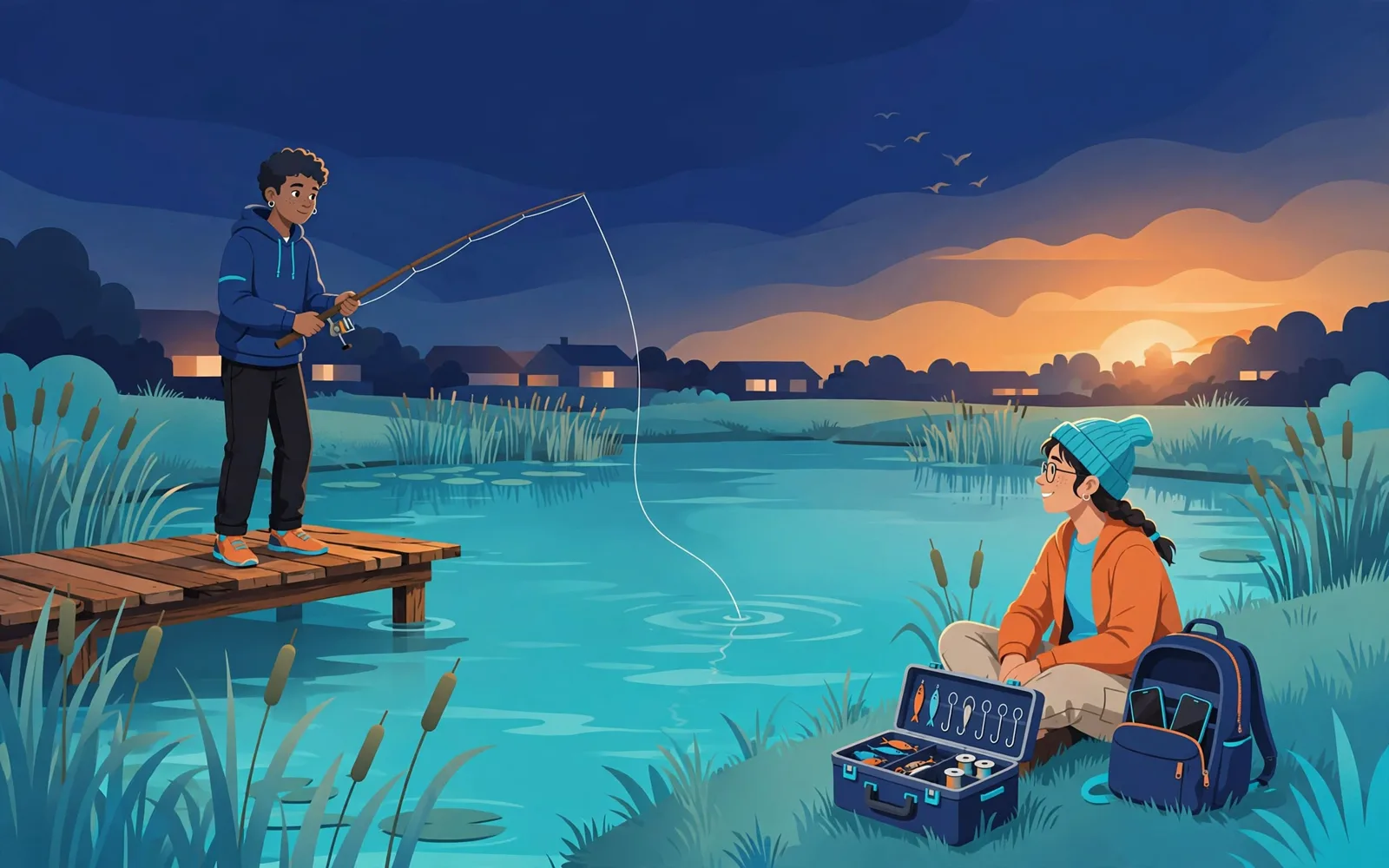
Gen Z teenagers are taking up fishing in growing numbers — US anglers aged 13 to 17 rose to 5.4 million in 2025, under-18 licences in British Columbia jumped by a third since 2019, and #FishTok passed 20 billion views — driven by viral fishing videos, cheap entry costs, and a hunger for slow, unranked time outdoors with friends.
The most surprising youth trend of November 2026 is happening a long way from any screen. Teenagers are picking up fishing rods. Not ironically, not for a single TikTok, but in numbers big enough to show up in national data. In the United States, the number of anglers aged 13 to 17 rose from 5.2 million to 5.4 million in 2025, and their participation rate ticked up from 24 per cent to 25 per cent, according to the 2026 Special Report on Fishing, the industry's annual participation survey. In British Columbia, fishing licences issued to people under 18 climbed from 48,000 in 2019 to 64,000 in 2025, according to Fisheries and Oceans Canada figures cited in a viral breakdown of the trend. And on TikTok, where the whole thing arguably started, #FishTok has passed 20 billion views.
It is a strange headline to write about a generation that has been described, for most of its life, as permanently glued to a phone. Pew Research Center's latest survey found that 36 per cent of US teens use at least one social platform almost constantly, and nearly all of them are online every day. Yet the same teenagers are now standing quietly beside ponds at dawn, waiting for a bite, phones in their pockets. Something is going on, and it is worth understanding properly — not as a cute curiosity, but as a real shift in how some young people are choosing to spend their free time.
This is not a story about fishing suddenly becoming cool in the old sense. Nobody is pretending that a rod and reel compete with a smartphone for excitement. The appeal is almost the opposite. Fishing is slow, undramatic, frequently boring, and it asks nothing of you except patience. For a generation raised on feeds engineered to never let a spare second pass unfilled, that emptiness turns out to be the point.
What the numbers actually say
Start with the hard data, because the trend is easy to overstate and the numbers keep it honest. The 2026 Special Report on Fishing, published in July 2026 by the American Sportfishing Association and the Outdoor Foundation, is the most comprehensive annual count of who fishes in America. Its headline figure is not a record: 57 million Americans aged six and older went fishing in 2025, down slightly from the all-time high of 57.9 million in 2024. Overall participation slipped from 19 per cent to 18 per cent of the population. The report also records the highest churn on record — 19 million people dropped out of the sport in 2025.
But inside that cooling total, the teenage numbers moved the other way. Anglers aged 13 to 17 grew from 5.2 million to 5.4 million, and their participation rate rose a point to 25 per cent. Total fishing outings grew 3 per cent to 918 million. And 6.3 million Americans tried fishing for the first time in 2025 — 11 per cent of all participants, up from 9 per cent the year before. The report's authors are blunt about why the teenage years matter: 86 per cent of current fishing participants first fished before the age of 12, and the teenage window is where a casual childhood trip either becomes a lifelong habit or quietly dies. As Anglers Journal's summary of the data put it, participation "fell sharply after a child turned 18" — so the growth among 13- to 17-year-olds is exactly the age band the sport most needs to hold.
The Canadian picture points the same way. CBC's technology desk reported on 18 November 2026 that fishing "is having a moment with young people, thanks in part to social media and a growing community of online anglers", in a piece headlined "Gen Z is hooked on fishing. Could that be good for the fish?". The British Columbia licence figures are the cleanest evidence in the story: a one-third rise in under-18 licences in six years, from 48,000 to 64,000, in a period when most youth activities were fighting for attention against phones. The same CBC report was picked up across Canadian outlets within days, which is usually a fair sign that editors think a trend has legs rather than being a one-day wonder.
Then there is the social layer, which is where the trend becomes visible to anyone who is not counting licences. Good Housekeeping reported on 21 November 2026 that Gen Z and Gen Alpha are "rediscovering fishing", describing preteens and teenagers trading screen time for sessions at the local pond, and quoting clinical psychologist Caroline Adelman on why it works: outdoor daylight exposure, interaction with natural spaces, and risk-balanced activities support positive development — particularly, she noted, when pursued without external pressure to perform. A separate round-up of the trend published on 23 November asked directly why fishing is "suddenly so popular with Gen Z", and the fly-fishing world has noticed too: Trout Unlimited's recent essay on the state of fly-fishing culture observes that on rivers in Pennsylvania, Michigan, Colorado, Montana and beyond, "I see a lot of young faces. I see diversity as well. I see a lot of women anglers."
Search behaviour backs the anecdotes up. Research from Clawford Lakes, cited in coverage of #FishTok, found fishing-related keyword searches up 26 per cent since January 2022, and the hashtag #CarpFishingUK alone has passed 166 million views on TikTok. The broader #FishTok tag sits above 20 billion views. For scale, that is a number more commonly associated with dance crazes and celebrity gossip than with a hobby that mostly involves sitting still.
One honest caveat before the excitement runs away with itself: the youngest age band is not growing. Children aged 6 to 12 who fished fell to 7.4 million in 2025, down 600,000 from the 2020 peak, and their participation rate has flatlined at 26 per cent. The 2026 Special Report is explicit that youth fishing overall "is losing ground" at the younger end. So the accurate story is narrower and more interesting than "kids love fishing now": teenagers, specifically, are picking it up — or picking it back up — at the exact age when the data says most young anglers are usually lost.
Why now? Five forces behind the rod
Trends with a single cause are usually PR inventions. This one has at least five forces pushing in the same direction, and they reinforce each other in ways that make the boom feel less random than it first looks.
1. The feed discovered fishing first. The irony is the engine. #FishTok did not emerge in 2020 as a niche corner of TikTok and stay there; it grew through lockdown, when fishing was one of the few legal outdoor escapes, and then kept growing as creators got better at filming it. The format suits short video strangely well: a cast, a strike, a splash, a fish held up to the camera, all inside thirty seconds, with the long boring wait edited out. Fishing influencers such as Bev Clifford have built large followings by leaning into the social side of the sport rather than the technical side, and the algorithm rewards exactly that. As one explainer of the #FishTok phenomenon puts it, the question is whether TikTok alone can "inspire a new generation of keen fishermen" — and the licence numbers suggest the answer is increasingly yes. The pipeline runs in one direction: a teenager sees a catch on their feed, wants to try it, goes to a pond, films their own first catch, and feeds the loop.
2. Doing nothing, on purpose. The second force is the one psychologists keep coming back to. Fishing is one of the few leisure activities a teenager can do that is socially acceptable to do badly, slowly, and without an audience scoring it. There is no leaderboard at the pond. Nobody is counting likes on a cast. Good Housekeeping's piece makes this explicit: parents report their children shifting "from constant online chatter to a shared focus on catching largemouth bass", and Adelman's point about "no pressure to perform" is the key line in the whole story. This fits a wider pattern we have been tracking all year — the same instinct behind Gen Alpha's scroll-to-store shopping habit, where teenagers who discover things online then insist on experiencing them in person, with friends, in a real place. Fishing is the outdoor version of the same move: the discovery happens on a screen, the experience pointedly does not.
3. It is cheap, and teenagers are broke. A basic rod-and-reel combo costs less than a pair of trainers, a day licence in most US states costs less than a cinema ticket, and many states and provinces run free fishing days and youth licences at token prices. In a year when teenagers are acutely aware of money — Gen Z's financial anxiety is one of the most consistent findings in youth research — a hobby with almost no entry cost and no subscription has an obvious advantage over the alternatives. Tackle can be borrowed, ponds are free, and the fish, famously, do not charge admission. The economics also explain why the trend is showing up in working-class and suburban areas as much as in the countryside: you do not need a boat, a lake house, or a car full of gear. A bus ride to a municipal pond will do.
4. The pandemic cohort grew up. The teenagers now discovering fishing were around 10 to 13 when the pandemic hit. They spent the most screen-saturated years of their lives indoors, and they remember it. The 2026 Special Report data hints at this: 6.3 million first-timers in 2025 is the highest share of newcomers in years, and 15 per cent of young Americans aged 6 to 17 who have never fished say they are interested in trying. That is a large pool of latent demand — 5.7 million young people, by the report's count — and it suggests the trend is less a fad than a delayed reaction. The kids who were locked inside at 12 are choosing, at 16 and 17, to spend their free time outside.
5. Adults are finally inviting them. The least glamorous force is probably the most important. Fishing is a mentored sport: almost nobody teaches themselves to tie a knot from a YouTube video alone, and the data proves it, with 86 per cent of current anglers having started before 12. What has changed is that the adults around teenagers — parents, grandparents, uncles, youth workers, teachers — have started treating a fishing trip as a credible way to spend time with a teenager rather than a chore. A study of private pond owners found that about 90 per cent had at least one child fish their pond in the past year, most of them the children of friends and neighbours, and that 75 per cent of the children who fished those ponds kept fishing on their own afterwards. The researchers' conclusion is worth quoting to any parent wondering whether one afternoon matters: mentoring and repeated exposure, not a single spectacular day, is what turns a first cast into a habit. The UK's Angling Times made the same point in its November 2026 issue, arguing that "the up-coming generation needs us" — adults who will take young people fishing and, crucially, let them learn rather than lecturing them.
What the research says about teenagers and the outdoors
It is tempting to turn this into a simple story — screens bad, nature good — and it would be a dishonest one. Fishing is not a cure for anything, and the research does not say it is. What the research does say, with unusual consistency, is that time in nature is associated with better wellbeing, and that teenagers are getting very little of it.
The most cited study in this area comes from the University of Exeter, where researchers analysed survey data from nearly 20,000 people in England and found that those who spent at least 120 minutes a week in natural settings — parks, woodlands, beaches, riversides — were significantly more likely to report good health and high psychological wellbeing than those who spent no time in nature at all. People below the 120-minute threshold showed no significant benefit, and the benefits levelled off at around 200 to 300 minutes a week. As one summary of the Exeter research explains, it did not matter whether the two hours came in a single visit or several shorter ones, and the pattern held across age groups, incomes and health conditions. The study's lead author, Dr Mathew White, put it plainly: "It's well known that getting outdoors in nature can be good for people's health and wellbeing but until now we've not been able to say how much is enough." Two hours a week, it turns out, is the dose.
The caveats matter and should be stated clearly. The Exeter study is cross-sectional: it shows an association, not proof that nature time causes better wellbeing. Healthier people may simply go outside more. A second account of the same study makes the same point, and responsible coverage should not pretend otherwise. But the finding has held up across later work, including research finding that children with a stronger connection to nature show less distress and hyperactivity and fewer behavioural and emotional difficulties.
Set that against what teenagers' weeks actually look like. Pew's Teens, Social Media and AI Chatbots 2025 survey, based on 1,458 US teens, found that 36 per cent use at least one of the five major platforms almost constantly, and that roughly one in five describe their TikTok and YouTube use as almost constant. Our own daily fact this week put the same picture in a single line: 1 in 3 teens are on social media almost constantly. Add school, homework and sleep, and the hours left for being outside are thin. That context is what makes the fishing numbers interesting: they describe teenagers actively carving out two or three unhurried hours a week for something that happens outdoors, with other people, and without a screen mediating it.
There is also a quieter psychological thread that deserves a mention. Fishing is, by design, an exercise in tolerating uncertainty: you cast, you wait, and most of the time nothing happens. Teenagers who have grown up with instant answers and instant feedback are, by several recent measures, unusually uncomfortable with not knowing — a theme we explored in our recent piece on Gen Z and uncertainty. A pond is a low-stakes place to practise the opposite skill. Nothing bad happens when the fish do not bite. The wait itself is the activity. For a generation that reports high levels of anxiety, that is not a trivial thing to learn, and it is a plausible reason why the teenagers who try fishing describe it, again and again, as relaxing rather than exciting.
The conservation question: is this good for the fish?
CBC's headline asks the question in its second half — "Could that be good for the fish?" — and it is the right question, because a surge of new anglers is not automatically good news for rivers and lakes. More people fishing means more pressure on fish stocks, more litter, more trampled banks, and more beginners who do not yet know how to handle a fish safely. The honest answer is that it depends entirely on what the new generation does next.
There are reasons for optimism. Anglers are, historically, the constituency that pays for conservation: fishing licence fees and tackle taxes fund habitat restoration and fisheries management in the US and Canada, so every new licence holder is, in a literal sense, paying into the system that keeps fish alive. The 2026 Special Report notes that Black American participation hit a record high of nearly 6 million and Hispanic participation doubled over a decade to 6.9 million — a broader, more diverse base of people with a direct stake in clean water. And the young anglers showing up now are arriving with an environmental ethos that older generations of anglers often had to learn late. Trout Unlimited's essay notes that "the environmental ethos in the sport is stronger than ever, particularly among those younger anglers", and the fly-fishing world's new crowd cares, in the author's words, less about "how big" and "how many" and more about "the how, the where and with whom they share the experiences".
The risk is the churn. The same report that celebrates teenage growth records 19 million people leaving the sport in a single year — the highest churn on record. If the new teenage anglers are a TikTok-fuelled wave that washes out after one summer, their conservation value is close to zero, and the litter and pressure remain. Retention is the whole ballgame, and retention is where fishing has always struggled: participation falls sharply after 18, and female youth quit at an 11 per cent higher rate than male youth, according to the 2025 report's data. The difference between a trend and a movement is whether the teenagers still fishing in 2028 are the same ones holding rods in 2026.
Parents can tilt that balance without much effort. The research is consistent that what keeps a young angler fishing is not better gear but company: friends to go with, an adult who makes time, and early success. A child who catches something on their first trip is far more likely to come back than one who sits for three hours and catches nothing, which is why experienced anglers advise beginners to start at stocked ponds and bluegill-rich waters rather than wild trout streams. Catch-and-release, taught properly — wet hands, quick photos, barbless hooks — is the single most useful conservation habit a new angler can learn, and it costs nothing.
A parent's practical guide to the first cast
If your teenager has mentioned fishing — or if you have noticed the rod-shaped hole in their Christmas list — the barrier to entry is genuinely low. Here is what actually matters, stripped of the tackle-shop upsell.
Start at a pond, not a river. Still water is forgiving. A neighbourhood pond, a park lake or a stocked community fishery will have bluegill, perch or stocked trout that bite readily, and your teenager will catch something on day one. Rivers demand casting skill, reading water, and wading; save them for trip three or four.
Borrow before you buy. A basic spinning rod-and-reel combo, a small box of hooks, bobbers and sinkers, and a tub of worms is enough for the first month. Many parks departments, libraries and community groups lend tackle, and several US states run free fishing days when no licence is needed. Spending £30 or $40 well beats spending £200 on gear that gathers dust.
Check the licence rules where you live. Rules vary sharply by place and by age. In most US states, under-16s fish free or on a cheap youth licence; adults need a licence, and the money funds conservation. In the UK, anyone aged 13 to 16 needs a free junior rod licence from the Environment Agency, and under-13s do not need one. In Canada, rules are provincial, and the British Columbia numbers above show the youth licence system working. Check before you go; fines for fishing without a licence are real and famously unamusing.
Teach the unglamorous parts first. How to hold a fish with wet hands. How to remove a hook without tearing a mouth. How to put the fish back quickly. How to take rubbish home, including tangled line, which strangles birds. Teenagers who learn this on day one become the anglers other anglers want beside them.
Let them bring a friend, and let them film it. The social pull is the point, not a corruption of it. Fishing with a friend is the single best predictor of whether a teenager returns, and filming the catch is how the trend spreads. The phone can stay in a pocket during the wait and come out for the catch. That is not failure; that is how a 2026 teenager does a hobby.
Watch the water, not just the fish. Rivers and lakes demand respect: slippery banks, deep water, changing weather, and in some regions ticks, sun exposure and, rarely, blue-green algae warnings. Check local advisories, wear a life jacket near deep or fast water, and treat a fishing trip like any other outdoor trip with a teenager — sun cream, water, a charged phone, and someone who knows where you are.
Do not make it a lesson. The fastest way to kill a teenager's interest in anything is to turn it into a curriculum. The adults in the private ponds study who succeeded were the ones who fished alongside children, not the ones who lectured them. Trout Unlimited's essay makes the same point from the riverbank: "people absolutely love to be taught how to fish and they despise being told how to fish." Go, sit, wait, and let the pond do the teaching.
What to watch next
Three things will decide whether this is a footnote or a real shift. First, the 2027 Special Report: if the 13-to-17 cohort grows again, the trend has survived its first winter, which is the hardest test for any outdoor hobby discovered on a phone. Second, the licence data from Canada and US states through 2026 — the British Columbia numbers will be updated, and other provinces and states will show whether the growth is continental or local. Third, and most interestingly, whether the platforms that created the trend start shaping it: TikTok's fishing creators are already organising meet-ups and clean-up days, and the step from "I saw a catch online" to "I helped clean the river" is the step that turns a viral hobby into a conservation constituency.
There is also a wider question hanging over all of this, and it is the one that makes the fishing story worth more than a single article. Teenagers are not logging off. Pew's data is unambiguous: they are online more than ever. But they are also, in growing numbers, choosing to spend some of their free hours in places where the internet cannot follow them — in real shops with friends, on real ponds with rods, in activities that are slow, analogue and unranked. The scroll-to-store story and the fishing story are the same story told twice: a generation that grew up inside the feed is learning to use it as a map, not a destination. They discover things online and then go and do them in the world, with people, in person.
That is a healthier relationship with technology than the one their parents were warned about, and it is one teenagers are building for themselves, without being told to. The least adults can do is notice it, hand them a rod, and go with them.
Frequently asked questions
Why are Gen Z teenagers suddenly interested in fishing?
Several forces coincide: fishing content went viral on TikTok under #FishTok, which has passed 20 billion views; the hobby is cheap and needs no subscription; teenagers are actively seeking slow, unranked outdoor time away from constant connectivity; and adults are inviting them. The data confirms it: US anglers aged 13 to 17 rose from 5.2 million to 5.4 million in 2025, and under-18 fishing licences in British Columbia rose from 48,000 in 2019 to 64,000 in 2025.
How many teenagers fish in the US?
According to the 2026 Special Report on Fishing, 5.4 million Americans aged 13 to 17 went fishing in 2025 — a participation rate of 25 per cent, up from 24 per cent the year before. A further 7.4 million children aged 6 to 12 fished, and 15 per cent of young Americans aged 6 to 17 who have never fished say they want to try.
Is fishing good for teenagers' mental health?
Time in nature is associated with better wellbeing: University of Exeter research on nearly 20,000 people found that at least 120 minutes a week in natural settings was linked to significantly better self-reported health and wellbeing. Fishing adds daylight, gentle physical activity, patience practice and face-to-face social time. It is not a treatment for anxiety or depression, and the Exeter study shows association rather than proof of cause — but as a regular outdoor habit, it ticks most of the boxes clinicians recommend.
What does #FishTok mean?
#FishTok is the fishing community on TikTok, where creators post catches, techniques, fails and river clean-ups. The hashtag has passed 20 billion views, and fishing-related searches have risen 26 per cent since January 2022. It is the main route by which teenagers who have never fished first encounter the sport.
How much does it cost for a teenager to start fishing?
Very little. A basic rod-and-reel combo, hooks, bobbers and bait can cost under $40 or £30, and many states and provinces offer free or cheap youth licences plus free fishing days. Borrowed tackle from a park scheme or a relative brings the cost to nearly zero. The expensive version of fishing exists, but it is optional, and beginners do not need it.
Do teenagers need a fishing licence?
It depends on where you live and how old they are. In most US states, under-16s fish free or on a low-cost youth licence. In England and Wales, 13- to 16-year-olds need a free junior rod licence and under-13s need none. In Canada, rules are set by province. Always check the local rules before the first trip.
Is catch-and-release better for the environment?
Yes, when done properly. Wet your hands before handling a fish, use barbless hooks where possible, keep the fish out of the water for seconds rather than minutes, and release it gently. Licence fees and tackle taxes also fund habitat restoration, so licensed anglers directly pay for conservation. Taking litter home — especially discarded fishing line — matters as much as anything else.
Why do teenagers quit fishing after 18?
The data shows participation falls sharply after 18, and the 2026 Special Report records the highest churn on record. Common reasons are familiar: leaving home, losing fishing companions, competing demands from work and study, and the cost and hassle of licences and gear as an adult. The teenagers most likely to keep going are the ones who fish with friends and who started young — 86 per cent of current anglers first fished before 12.
Sources
- CBC — Gen Z is hooked on fishing. Could that be good for the fish? (18 Nov 2026)
- Good Housekeeping — Gen Z and Gen Alpha are rediscovering fishing (21 Nov 2026)
- American Sportfishing Association — 2026 Special Report on Fishing (July 2026)
- 2026 Special Report on Fishing — full PDF
- Anglers Journal — Fishing participation hits record high
- Threads — BC youth fishing licences 2019–2025, via David J. Doherty
- Flake Food — Why fishing is suddenly so popular with Gen Z (23 Nov 2026)
- Trout Unlimited — The state of fly-fishing culture
- WriteUpCafe — Could fishing be TikTok's new viral sport?
- Pew Research Center — Teens, Social Media and AI Chatbots 2025
- Good News Network — Two hours a week in nature and the Exeter study
- Sustainability Times — The Exeter 120-minute nature study
- Burger et al. — The role of private ponds in recruiting the next generation of anglers (SEAFWA)
- Today in Canada — Gen Z is hooked on fishing (CBC syndication)