The Drawbridge Generation: Gen Z's New Trust Rules
Pacsun and GlobalData asked 6,126 Americans who they trust. The answer — family and friends, not influencers or AI — names a new shift: the Drawbridge Generation.
Drafted with an AI writing assistant and checked against its sources by the editor before publishing. How we use AI.
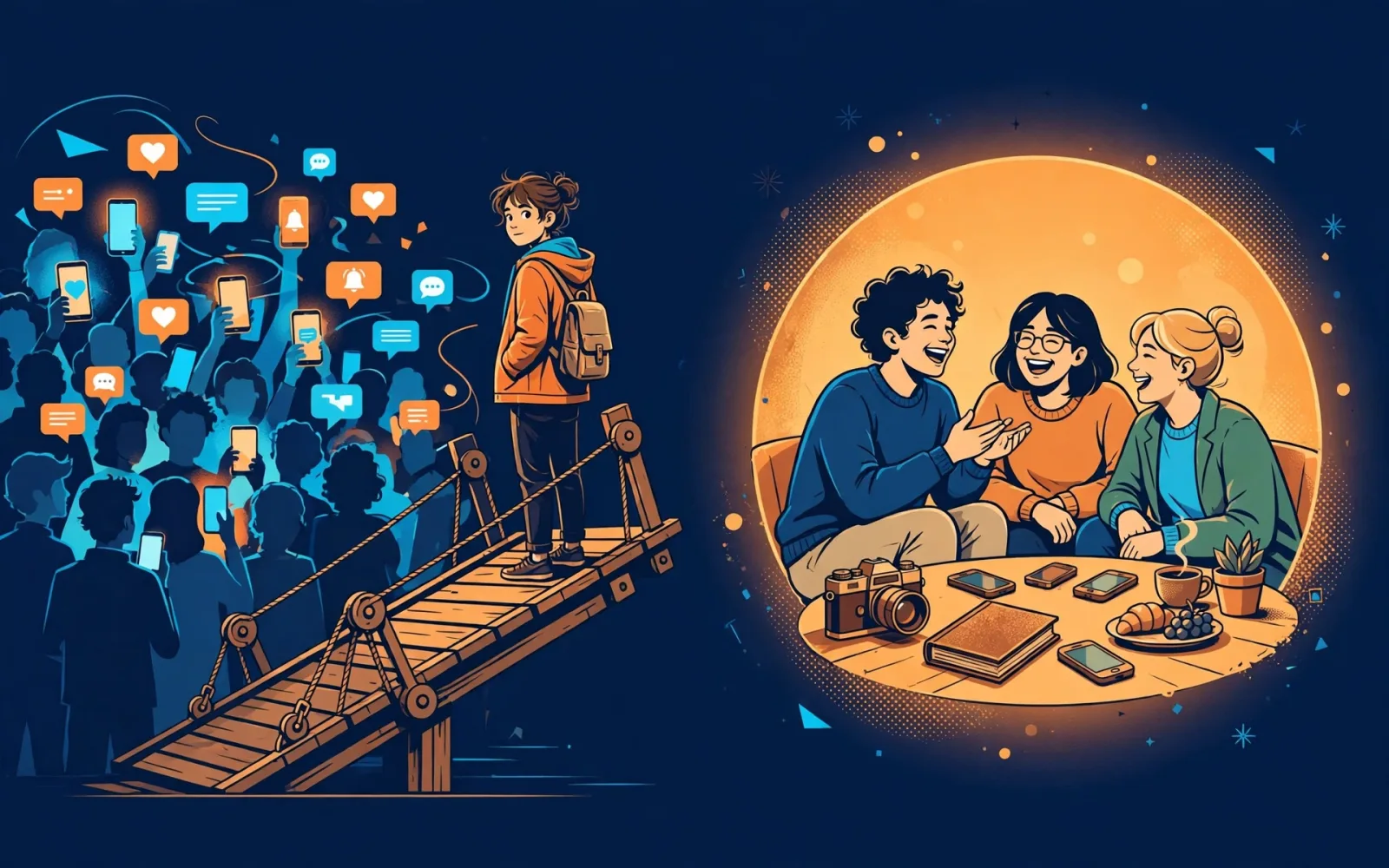
Gen Z and Gen Alpha are pulling up the drawbridge on the noisy public internet: trusting family and friends over influencers and AI, admitting social media addiction is rising, and choosing smaller, real circles over the endless feed.
There is a new name for what Gen Z and Gen Alpha are doing with their attention, and it did not come from a think tank or a university. It came from a survey of 6,126 young Americans, and the name is the Drawbridge Generation. Pacsun and the research firm GlobalData asked young people aged 11 to 24 who they trust, what they think of social media, how they feel about AI, and what they want from the future. The answers describe a generation that is not logging off and not tuning out. It is doing something more deliberate: pulling up the drawbridge on a noisy public world and deciding, person by person and app by app, who gets across.
That image matters because it corrects a lazy story adults keep telling about young people. The lazy story says teenagers are passive — swept along by algorithms, fooled by influencers, helpless in front of screens. The Drawbridge Generation says the opposite. These young people know exactly what the feed does to them. Nearly three in ten now describe themselves as "definitely addicted" to social media, up sharply from a year ago, and they are responding by building boundaries around the people who matter most. Family and friends win their trust in every category the survey measured. Influencers never win more than 11 percent of it in any category at all. AI is used by 85 percent of them and trusted by almost none of them for the decisions that count.
For parents, teachers and anyone trying to understand a teenager's online life, this is genuinely useful news. It means the conversation can move past "phones are bad" and into something more honest: young people are already negotiating with the internet, and they are better at it than adults give them credit for. The job for the adults around them is not to win the argument about screens. It is to notice the boundaries young people are already drawing, and to help them hold the line.
What the Drawbridge Generation actually is
The phrase comes from Pacsun's second annual Youth Report, produced with GlobalData and released in September 2026. The survey behind it was conducted in June 2026 with 6,126 people aged 11 to 24 across the United States, sampled to be representative by age, gender, region and household income. Because it is the second year of the research, the report can show not just what young people think, but how their attitudes are moving — and several of the shifts are large. Pacsun's Youth Report announcement
Pacsun's chief executive, Brieane Olson, explained the thinking behind the name in her own account of the findings. Gen Z and Gen Alpha, she wrote, are growing up in "an extraordinarily noisy public world — algorithms, endless content, news cycles, advertising, creators, AI and constant access." But rather than letting all of that noise have equal influence, they are pulling some things closer and keeping others at a distance. "The drawbridge isn't permanently up or down," she wrote. "They decide who gets access." Brieane Olson on the Drawbridge Generation
That is the whole idea in one sentence, and it is worth sitting with. A drawbridge is not a wall. It opens and closes. It lets the people you trust through and keeps the crowd out. It is controlled by the person inside the castle, not by the people outside it. The report's central claim is that young people are taking control of the gate — not by abandoning the internet, but by getting far more selective about what crosses from the public world into their private one.
The idea was important enough to headline Pacsun's second annual Purpose Summit in Malibu in September 2026, where the trust finding ran through a day of conversations involving creators, executives and young voices — including Snapchat's chief marketing officer Grace Kao, the designer Sami Miró and Rare Beauty's impact chief Elyse Cohen. GlobalData's Neil Saunders, who led the research, put it plainly: across more than 6,000 respondents, "financial independence is declining, digital engagement is intensifying, and trust is concentrating around family and friends." Pacsun's Purpose Summit on Gen Z trust
Trust is moving closer to home
The single clearest finding in the report is about trust, and it is worth stating without softening. Family and friends dominate every measure of trust the survey tested — from financial advice to purchase decisions. Influencers, despite their enormous visibility in youth culture, never account for more than 11 percent of trust in any category. Not one. The entire influencer economy, with its billions of dollars of sponsored content, speaks to an audience that trusts it less than its own group chat.
That distinction — between attention and trust — is the most important one in the whole report. Young people may live in a world of seemingly unlimited access to content, creators, information, brands and AI. But access does not automatically translate into influence. They watch influencers. They follow them, laugh at them, buy the occasional thing they recommend. What they do not do is believe them. As Olson put it, "They are becoming more selective about what they let in." Brieane Olson on the Drawbridge Generation
This is not a small correction to the conventional wisdom. It is a reversal of it. For a decade, the marketing world has behaved as if reach equals persuasion — as if the creator with the biggest audience automatically has the most influence over what young people think and buy. The Drawbridge Generation suggests that the young audience has quietly worked out the difference between someone who is entertaining and someone who is credible, and that the two groups barely overlap. One recent commentary on the findings put it bluntly: influencer trust has a ceiling, and it sits lower than the industry admits. Influencer trust has hit rock bottom with Gen Z
The pattern shows up in other research too. Mastercard's recent study of Gen Z and Gen Alpha, "The Next Growth Generation," surveyed roughly 3,500 Gen Z respondents aged 17 to 29 and about 1,800 parents of Gen Alpha children aged 11 to 16 across 18 markets. Its big takeaway was agency: young people are moving from being consumers of digital media to co-creators of it, and the culture around them is fragmenting into hyper-niche micro-communities rather than one shared mainstream. Most of Gen Z now say a single pop culture mainstream — with broadly shared shows, movies and songs of the summer — no longer exists. Mastercard on Gen Z and Gen Alpha
Put the two studies together and the picture sharpens. Young people are not retreating from culture. They are retreating from the public, performative version of it — the feed, the sponsored post, the stranger's opinion — and towards smaller circles where trust is earned face to face. The group chat beats the feed. The friend's recommendation beats the influencer's. The drawbridge stays down for people they know and up for people they don't.
The influencer economy's credibility problem
It is worth asking why influencer trust is so low, because the answer tells you something about how young people actually experience the internet. They have grown up inside the creator economy. They have watched creators promote products they clearly do not use, apologise for controversies they clearly do not regret, and pivot from one brand deal to the next without missing a beat. They have seen the same faces sell skincare on Monday and crypto on Tuesday. They are not naive about any of this. They are, if anything, more literate about persuasion than any generation before them, because they have been its target since childhood.
The report's numbers give that literacy a shape. Eleven percent is not a low score. It is a ceiling. In no category — not fashion, not money, not relationships, not buying decisions — does influencer trust rise above it. And the number is consistent with what young people say when they are asked directly. The researchers call the pattern the Drawbridge Generation precisely because it is a pattern of behaviour, not a mood: young people are actively managing who influences them, and influencers keep failing the test. Why Gen Z and Gen Alpha don't trust brands yet
There is a lesson in this for brands and for parents alike, and it is the same lesson. Trust cannot be assumed because you have reach. Being present in someone's feed does not mean you have earned a place in their life. Olson's own conclusion was that connection has to come before the transaction — and that listening should not happen only when you want to sell something. For parents, the parallel is obvious. The lecture about screen time lands better when it comes from inside the circle of trust than when it arrives as another voice from the noisy public world.
None of this means influencers are finished. It means their role has changed. They are entertainment now, closer to television presenters than to trusted advisers. Young people will watch them, enjoy them and occasionally buy what they sell — but they will check with a friend first. That is a healthier relationship with influence than the one adults feared they were forming, and it is worth saying so out loud.
AI is everywhere. Trust in it is not.
If the trust numbers are the report's clearest finding, the AI numbers are its strangest — and maybe its most revealing. Eighty-five percent of respondents used AI in the past year. Seventy-four percent are open to using it for shopping discovery. Young people are not afraid of AI, and they are not avoiding it. They are using it constantly, for homework, for ideas, for entertainment, for shopping.
But ask them to trust it with something personal, and the numbers collapse. Only 5 percent trust AI for financial advice. Only 4 percent trust it for relationship advice. Just 2 percent trust it for fashion advice. The gap between use and trust is enormous: 85 percent use it, 2 percent would let it dress them.
That gap is the drawbridge in action. AI gets access to the practical, low-stakes parts of life — the homework help, the brainstorming, the product search. It does not get access to the decisions that shape identity, relationships and money. Young people have worked out, faster than most adults, that a tool can be useful without being wise, and that a chatbot's confidence is not the same thing as judgement. Pacsun's Youth Report announcement
This fits with what other recent research has found. A Gallup study this year found that around a third of Gen Z now turn to AI for friendship and companionship — a finding that worried plenty of adults when it landed, and that we covered in detail at the time. Read alongside the Drawbridge numbers, the Gallup finding looks less alarming and more complicated. Young people are talking to AI, yes — but they are also keeping it at arm's length on the questions that matter most. They will hand the machine their homework and their sneaker picks, then draw the line at dating advice and wardrobe choices. The generation that grew up inside the algorithm is the first one to know exactly where its edges are. A third of Gen Z turns to AI for friendship
The Mastercard research points the same way. Gen Alpha, it found, has become the first genuinely AI-native generation — but even so, 59 percent of Gen Z say they are comfortable using AI tools for career advice, which is a practical, information-heavy task, not an intimate one. The pattern is consistent across every study that asks the question properly: young people trust AI with information and distrust it with judgement. Mastercard on Gen Z and Gen Alpha
For parents, this is a much better starting point for the AI conversation than panic. The child who uses a chatbot for homework is not the same as the child who believes the chatbot. The useful question is not "are you using AI?" but "what are you trusting it with?" — and the evidence suggests most young people already have a decent answer.
"Definitely addicted" — and they know it
Then there is the number that stops you. Twenty-nine percent of young people now describe themselves as "definitely addicted" to social media. Last year, that number was 18.8 percent. That is a jump of more than ten percentage points in twelve months, and it is the single biggest year-on-year move in the whole report.
Olson herself singled it out. "There is another number I haven't been able to stop thinking about," she wrote. "Young people clearly understand the role technology plays in their lives — and, increasingly, some of the tension that comes with it." Brieane Olson on the Drawbridge Generation
The instinct is to read that number as despair. Read it instead as the other side of the drawbridge. The addiction admission is self-awareness, and self-awareness is what makes the boundary-drawing possible. A generation that did not understand what the apps were doing to it would not be pulling up the drawbridge at all. The fact that 29 percent can name the problem in those words — "definitely addicted" — suggests they are further along in dealing with it than the adults who still treat the phone as a simple matter of willpower.
And they are acting on it. Market research firm GWI found that 40 percent of 12- to 15-year-olds worldwide now take breaks from screen time in the interest of digital self-care. Mastercard's researchers found the same pushback from the other direction: school phone restrictions, the influence of books like "The Anxious Generation," and a conscious turn towards micro-communities instead of every network at once. The drawbridge is not just an attitude. It is a set of behaviours. Mastercard on Gen Z and Gen Alpha
The most visible version of that behaviour is the analog turn. Youth research firm YPulse polled 1,500 people aged 13 to 39 and found roughly two-thirds turning to analog options — flip phones, film cameras, record players, crocheting — to escape addictive apps. Purchases of flip phones among buyers aged 18 to 24 rose 148 percent between 2021 and 2024. A phone that calls, texts and runs Snake has become a feature, not a bug. Even the products built to enforce the boundary are booming: Brick, a small fob that locks your phone on a schedule, saw downloads climb nearly 600 percent year over year this January, according to Sensor Tower estimates. Gen Z is trading smartphones for flip phones
The analog wave is not nostalgia. It is regulation. A film roll with a limited number of exposures forces intention. A flip phone with no social apps forces presence. A locked phone forces a pause before the scroll begins — a moment to ask whether the scroll is even worth starting. Young people are not rejecting technology. They are adding friction to it, because friction is the one thing the apps were designed to remove. The return of analog
That same impulse is visible in schools. California's Phone-Free Schools Act required every district to adopt a policy limiting or prohibiting student smartphone use by July 2026, and the results on the ground are striking. EdSource reporters interviewed more than 40 people across seven districts and found teachers reporting higher engagement, fewer fights and less bullying — and, in the words of one middle school principal, students who are "actually communicating." The drawbridge, it turns out, works in classrooms too. How California school phone bans are changing classrooms
Money is tighter, and they know it
The report's financial findings are the sobering counterweight to the trust story. Only 34.9 percent of respondents describe themselves as financially independent, down from 41.3 percent in 2025. The share reporting full reliance on their parents climbed from 23.8 percent to 29.1 percent. In a single year, the generation got noticeably less independent — and noticeably more aware of it.
You can see the pressure in how they shop. Sixty-five percent say low prices make trend-driven purchases worthwhile today, while 61 percent say they would cut back on those purchases if money were no object. Sixty-seven percent have purchased secondhand or are open to it. Their choices are not necessarily a rejection of values. They are the economic trade-offs of young people navigating a cost of living that keeps outrunning their earnings. Pacsun's Youth Report announcement
This is the same pressure behind loud budgeting, the Gen Z anti-spending trend we covered recently, in which young people say their financial limits out loud instead of quietly overspending to keep up. The Drawbridge Generation and loud budgeting are the same instinct in different clothes: honesty about money, spoken in public, as a form of self-protection. When a teenager tells their friends they cannot afford something, they are doing what the survey describes — drawing a boundary and letting the trusted circle in. Loud Budgeting: Gen Z's anti-spending trend
Parents should hear the financial numbers as context, not as failure. A 19-year-old who still relies on their parents is not behind. They are typical — nearly three in ten of their peers are in exactly the same position, up from fewer than one in four a year ago. The useful conversation is not "why aren't you independent yet?" but "what would independence look like, and what is actually in the way?" The survey suggests young people are ready for that conversation. They are already having it with each other.
The American Dream is evolving, not disappearing
For all the talk about younger generations rejecting traditional definitions of success, the report's findings on aspiration are strikingly familiar. By age 35, 62 percent want a stable job. Sixty percent want a car. Fifty-nine percent want a home. Those are not the goals of a generation that has given up on the future. They are the goals of a generation that still wants the same things their parents wanted — and knows how hard they have become to reach.
What has changed is what sits alongside those goals. Fifty-nine percent also say being mentally healthy is a priority by age 35 — carrying exactly equal weight with owning a home. That combination is the most quietly radical number in the report. Young people have not stopped aspiring. They have broadened the definition of what a successful life looks like, and they have put their own wellbeing inside that definition rather than treating it as a luxury to be dealt with later.
It is worth pausing on that, because it reframes so much of the generational argument. The young person who says they want a stable job and good mental health is not being soft or unrealistic. They are being precise about what a good life requires, and they are refusing to accept a version of success that costs them their health. The drawbridge, again: some things get let in, and some things — the hustle-at-all-costs version of ambition, the always-on version of work — get kept outside.
The Mastercard study found the same redefinition from a different angle. Gen Z's earning potential is estimated to reach 33 trillion dollars by 2030, and Gen Alpha is expected to command 5.5 trillion dollars of global economic influence by 2029. These are not generations without economic power. They are generations whose power is arriving later, more unevenly, and with more conditions attached than their parents' did. The American Dream has not disappeared. It has been renegotiated — and mental health is now part of the contract. Mastercard on Gen Z and Gen Alpha
The wider pattern: agency, not retreat
It would be easy to misread the Drawbridge Generation as a story about withdrawal — young people giving up on the public world, hiding from it, going quiet. The evidence points the other way. What the report describes is agency: young people taking an active role in deciding how technology, influence and culture reach them.
Mastercard's researchers used exactly that word. The big takeaway from their six trends, they said, "could be summed up in one word: agency." Gen Z and Gen Alpha are moving from being consumers of digital media to co-creators of it — making videos, remixing culture, building their own micro-communities, using AI as a co-pilot for practical decisions. Sixty-five percent of Gen Z already identify as creators. A 26-year-old TikTok creator's 11-second jingle suggestion for Dr Pepper ended up in a national television commercial during the 2026 College Football Playoff National Championship — and she was paid handsomely for it. That is not retreat. That is participation on their own terms. Mastercard on Gen Z and Gen Alpha
UCLA's 2026 Teens and Screens report, which we covered when it was released, tells a similar story from the entertainment side. Nearly four in five young respondents now consider short-form video a legitimate form of storytelling, YouTube outranks television and film as a storytelling medium, and 55 percent want to see more neurodivergent characters on screen. Young people are not abandoning stories. They are demanding better ones, on platforms they control, from creators who look like them. The drawbridge does not keep culture out. It filters it. Gen Z and Gen Alpha are redefining storytelling
Even the commentary around the report has picked up on this. One analysis noted that the drawbridge generation "will hand the machine their homework and their sneaker picks, then draw the line at dating advice and wardrobe choices" — and that the collapse of influencer trust fits a wider pullback from the public internet that includes flip phones, film cameras and screen-free evenings. The common thread is control: young people deciding who gets access to their attention and on what terms. The Drawbridge Generation has a point
What parents should actually do
So what does any of this mean at home, on a Tuesday evening, when your teenager is on their phone and you are wondering whether to say something? The report suggests a few things that are more useful than another argument about screen time.
First, trust the group chat. The survey says your child's friends and family are their most trusted sources of information — more trusted than any influencer, any brand, any algorithm. That means your voice still carries weight, and so does the voice of the friends you actually know. The influence that worries parents most — the stranger on the feed — is the influence young people trust least. That is worth remembering before the next argument about who they follow.
Second, ask about the drawbridge, not the screen. Instead of "how long have you been on your phone?" try "what did you let in today, and what did you keep out?" The first question invites a defensive answer. The second invites a real conversation about judgement — and the survey suggests your child has more judgement to share than you might expect. They know the apps are designed to hold their attention. Ask them how they fight back, and listen to the answer.
Third, respect the boundaries they are already building. If your teenager has a screen-free evening, a locked-phone routine, a small group chat they actually talk in, or a film camera they are proud of, that is the drawbridge working. Encourage it. The analog turn is not a phase to be mocked. It is a coping strategy, and a good one. The cheapest version of it costs nothing: a charging spot outside the bedroom, one screen-free evening a week, a grayscale mode on the phone. Small friction beats big lectures. Gen Z is trading smartphones for flip phones
Fourth, talk about AI in terms of trust, not fear. The question is not whether your child uses AI — 85 percent of their peers do. The question is what they trust it with. Ask them what they would never ask a chatbot, and why. Their answer will tell you more about their judgement than any parental control setting will. And if they are turning to AI for companionship, take that seriously without panicking: it usually means the human connections around them need attention, not that the technology has won. A third of Gen Z turns to AI for friendship
Fifth, talk about money honestly. Nearly a third of young people now rely fully on their parents, and more than six in ten say low prices decide their purchases. If your teenager is stressed about money, they are not alone and they are not failing. The loud budgeting trend shows they are already learning to say the limits out loud. Meet them there: talk about what things cost, what you can and cannot afford as a family, and what independence actually looks like step by step. Loud Budgeting: Gen Z's anti-spending trend
Finally, remember what the phone-free week story taught us. In our Saturday story about a phone-free week at a summer treehouse, the children who gave up their phones for seven days did not miss the feed. They missed each other less — because they were actually together. The Drawbridge Generation is the same lesson, learned at scale: the best parts of young people's lives happen inside the circle, not on the feed. The adults who understand that will be the ones invited across the bridge. The Treehouse Summer: a story about a phone-free week
Why this matters now
The Drawbridge Generation is not a prediction. It is a description of something already happening, measured across 6,126 young people and confirmed by study after study from other researchers. Trust is narrowing to the people young people actually know. Social media dependence is rising — and so is the self-awareness about it. AI is used everywhere and trusted almost nowhere that matters. Money is tighter, independence is later, and the definition of a good life now includes mental health as a non-negotiable.
None of that is a crisis. It is an adjustment, and a fairly sensible one. A generation raised inside the feed has looked at the deal on offer — your attention for free, in exchange for convenience — and decided the price was too high. They are renegotiating, person by person, app by app, boundary by boundary. The drawbridge is their instrument for doing it.
The adults who do best by this generation will be the ones who stop trying to lower the drawbridge by force and start asking to be let across. Listen first, as Pacsun's chief executive put it. Connection before transaction. The young people in this survey are telling us a lot — about trust, about addiction, about AI, about money, about what they want from the future. The least we can do is hear them, and the most useful thing we can do is help them hold the line they are already drawing.
Frequently asked questions
What is the Drawbridge Generation?
The Drawbridge Generation is the name Pacsun and GlobalData gave to Gen Z and Gen Alpha in their 2026 Youth Report, based on a survey of 6,126 Americans aged 11 to 24. It describes young people who are pulling up the drawbridge on a noisy public world — algorithms, influencers, news cycles and AI — and retreating towards a smaller, more trusted circle of family, friends and unfiltered connection, while deciding for themselves who gets access.
Who do Gen Z and Gen Alpha trust most?
Family and friends, by a wide margin. In Pacsun's 2026 Youth Report, family and friends dominate every measure of trust, from financial advice to purchase decisions, while influencers never exceed an 11 percent share of trust in any category. Only 2 percent trust AI for fashion advice, 4 percent for relationships and 5 percent for finance.
How many young people say they are addicted to social media?
Twenty-nine percent of respondents in the 2026 Youth Report describe themselves as "definitely addicted" to social media, up from 18.8 percent in 2025. At the same time, 40 percent of 12- to 15-year-olds worldwide take breaks from screen time for digital self-care, according to market research firm GWI.
Is the Drawbridge Generation anti-technology?
No. Eighty-five percent of the young people surveyed used AI in the past year, and most are enthusiastic creators and co-creators of online culture. The pattern is selective, not rejectionist: they use technology heavily for practical things and keep it away from personal decisions about identity, relationships and money.
What do Gen Z and Gen Alpha want by age 35?
A stable job (62 percent), a car (60 percent) and a home (59 percent) — but alongside those traditional milestones, 59 percent also say being mentally healthy is a priority. The American Dream, in their version, includes wellbeing as a goal in its own right.
Sources
- Pacsun and GlobalData unveil the second annual Youth Report — PR Newswire, 10 September 2026
- Brieane Olson: The Drawbridge Generation — Pacsun CEO's account of the findings, 14 September 2026
- Who does Gen Z trust? Pacsun's Purpose Summit explains all — PR Newswire, September 2026
- Gen Z and Gen Alpha shift from scrolling to shaping culture — Mastercard, "The Next Growth Generation" study
- The Drawbridge Generation has a point — GenZ NewZ, September 2026
- Influencer trust just hit rock bottom with Gen Z — GenZ NewZ, September 2026
- Why Gen Z and Gen Alpha don't trust your brand yet — Conversate Labs
- Gen Z is trading smartphones for flip phones and film cameras — GenZ NewZ, on the YPulse analog study
- The return of analog: why Gen Z wants something real — Headcount Coffee, on YPulse's 2026 analog research
- YouTube beats TV as Gen Z and Gen Alpha redefine streaming, UCLA study finds — Cord Cutters News, on UCLA's 2026 Teens and Screens report
- How California school cellphone bans are changing classrooms — EdSource, November 2026
- The Drawbridge Generation: insights from Pacsun's 2026 Youth Report — Third News summary of the report