Gen Z Is Skipping Rent to Afford Christmas: The 46% Stat
Nearly half of Gen Z have delayed or skipped rent to pay for Christmas, a new survey finds. What is driving it, what it costs, and what parents can do.
Drafted with an AI writing assistant and checked against its sources by the editor before publishing. How we use AI.
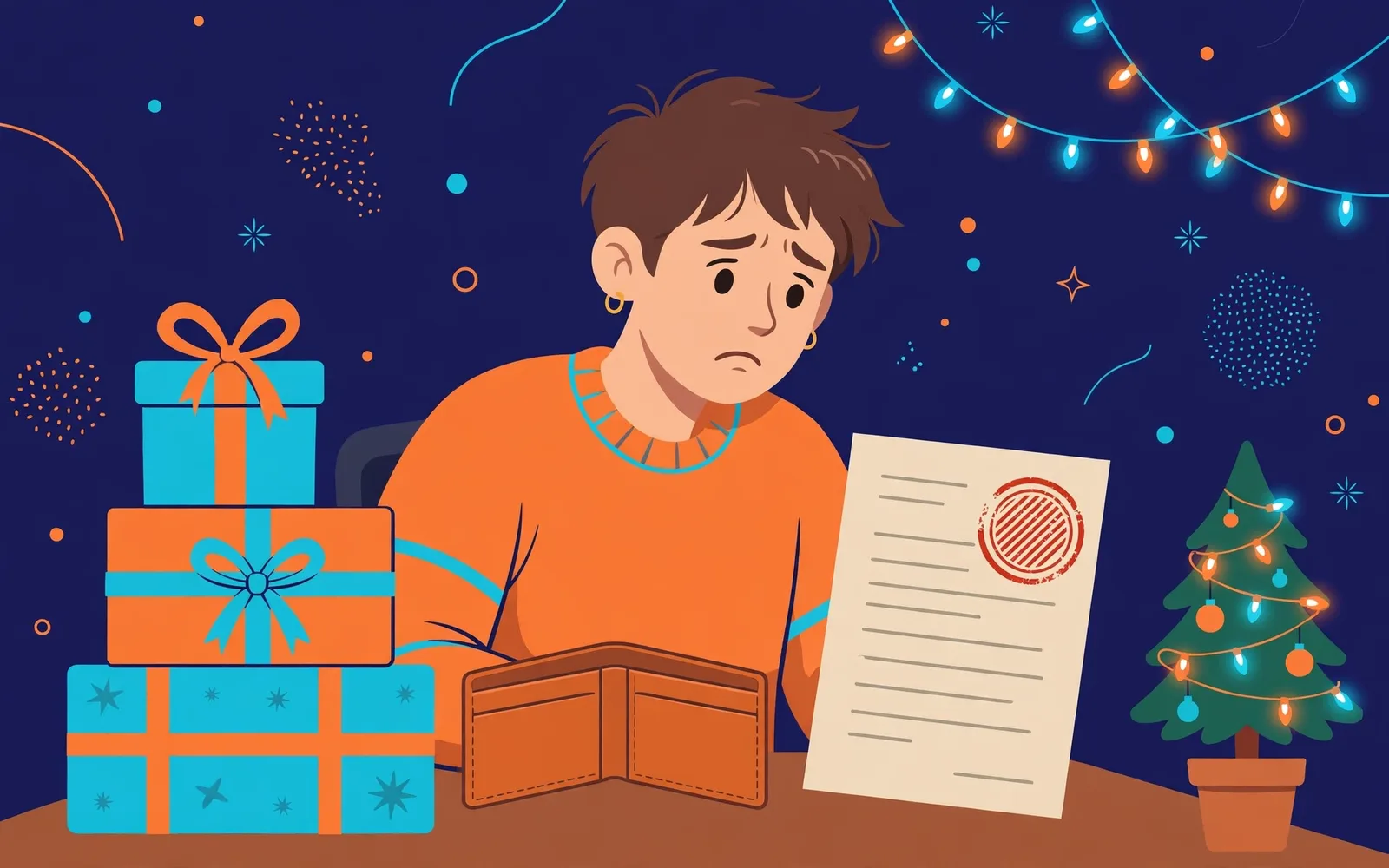
A November 2026 survey of 2,000 US adults found 46% of Gen Z respondents have delayed or skipped a rent or mortgage payment to afford holiday spending, the highest of any generation, driven by record rent burdens, holiday pressure and easy credit.
Nearly half of Gen Z have skipped the rent to pay for Christmas. Not trimmed the gift list, not shopped a sale — actually delayed or skipped a rent or mortgage payment so the holidays could happen. That is the headline finding of a new survey released this month, and it lands six days before Black Friday, at the exact moment the year's biggest spending season begins.
The number is 46%. That is the share of Gen Z respondents who told researchers they have delayed or skipped a housing payment to afford holiday spending. Millennials came in at 28%, Gen X at 14%, and baby boomers at 3%. No other generation is anywhere close. And this is not a survey about people who are struggling in general and happen to also buy presents. The question was specific: have you put off the rent or the mortgage so you could pay for the holidays? Almost one in two young adults said yes.
So what is going on? This is not a story about a generation that cannot do maths. It is a story about a generation caught between the most expensive housing market in modern memory, a holiday season that now costs more than $1,500 per person, and a social pressure machine that makes opting out feel like letting everyone down. The rent is the biggest bill most young adults pay. When the money runs out in December, it is the bill with the most room to move — and the most dangerous one to move.
What the survey actually found
The survey was commissioned by Accredited Debt Relief and carried out by Talker Research, which polled 2,000 US adults who celebrate a winter holiday between 16 and 20 October 2026. The results were released on 10 November. The headline number — 46% of Gen Z delaying or skipping a housing payment — sits inside a much wider picture of holiday financial strain, and the rest of the findings make it harder to dismiss as a quirk.
Two-thirds of Gen Z respondents, 67%, have taken on holiday debt this year or expect to before the season ends, Realtor.com's analysis of the survey notes — and the pattern holds across the wider data. Across all ages, 45% of Americans expect to take on some holiday debt, and nearly 15% are still paying off last year's holiday spending. Think about that for a second: one in seven adults is still paying for last Christmas while buying this one. The average American expects to give 15 gifts this year and spend $1,533 in total. Most of that — 56% — will be paid for with cash or a debit card, but almost a third, 32%, goes on a credit card, and 12% on buy now, pay later plans.
Then there is the part that should worry parents most. Almost two-thirds of respondents, 62%, said holiday spending expectations have got out of hand. And 46% said they would skip gift-giving altogether if they could do it without disappointing or offending anyone. People know the pressure is unreasonable. They feel it anyway. That gap — between what people believe and what they actually do — is where the rent money goes.
Bobbi Rebell, Accredited Debt Relief's chief financial education adviser, put it plainly when the survey was released: "Holiday spending should never come at the expense of someone's financial stability, but these findings show just how difficult it can be to balance financial responsibilities with the social expectations and pressure to create a memorable holiday." She is right, and the numbers back her up. The survey also found that 61% of people have at least one "hidden" holiday spending category — something they forget to budget for and spend on anyway, like wrapping, travel, food, or the work Secret Santa. The budget never stood a chance.
It is worth being honest about what a survey like this can and cannot prove. Two thousand people is a solid sample, and Talker Research used a random double opt-in panel, but the answers are self-reported, and "delayed or skipped" covers a wide range — from paying the rent five days late to missing it entirely. The survey was also commissioned by a debt-relief company, which has an interest in the problem looking big. None of that makes the finding disappear, though, because every other piece of independent data this autumn points in the same direction.
Why rent, of all things
To understand why the rent is the bill that gets skipped, you have to start with what rent costs now. Harvard's Joint Center for Housing Studies released its State of the Nation's Housing 2026 report in June, and the numbers are stark: 22.7 million renter households — 49% of all renters in America — now spend more than 30% of their income on housing. That is a record high, the fourth consecutive year the figure has set one. Worse, 12.1 million households spend more than half their income on rent. When half your pay goes to the landlord before you have eaten, there is no slack anywhere in the budget. A $1,500 Christmas is not a luxury splurge. It is a second rent payment, due in the same month as the first.
Harvard's researchers also found something that explains why this hits the young hardest. Household formation among young adults has slowed sharply — the country added just 1.1 million households in 2025, down from an average of 2 million a year in 2021 — because, in the words of senior research associate Daniel McCue, "many young adults simply cannot afford to form their own households and are instead doubling up or living with family." Home prices have risen 54% nationwide since 2020, and the median existing single-family home now costs nearly five times the median household income. The generation that is supposed to be buying its first homes mostly cannot, and the generation renting instead is paying record shares of its income to do it.
Deloitte's 2026 Gen Z and Millennial Survey — 22,595 respondents across 44 countries — found the same squeeze from the other side. Cost of living has been the top concern for Gen Z for five consecutive years. Nearly half of Gen Z respondents, 47%, live paycheck to paycheck. More than half, 55%, have delayed a major life decision — marriage, a family, further education — because of their financial situation. And 51% say they simply cannot afford to buy a house, while 69% say housing availability and affordability directly shape their career decisions and where they can work. When your housing already dictates where you can live and work, skipping one payment to fund Christmas stops looking reckless and starts looking like the only lever left to pull.
There is a telling detail in a separate renter survey reported this month: 81% of Gen Z renters now say renting is the smarter financial decision for their household right now, up from 72% a year earlier. That is not enthusiasm for renting. That is a generation making peace with a door that has closed. And when the rent is both your biggest cost and the one you have already decided you cannot escape, the psychology shifts. The rent feels fixed and immovable — until December, when it suddenly feels like the one bill that can wait a week.
The debt underneath the tinsel
Skipping the rent does not happen in isolation. It sits on top of a whole architecture of holiday debt that has been building for years, and Gen Z is at the sharp end of every part of it.
Start with the credit card. The Federal Reserve's data shows commercial banks charged an average of 22.36% on credit card accounts assessed interest in the third quarter of 2026. At that rate, a single month of interest on $1,223 — the average holiday debt in LendingTree's survey of people who borrowed for last year's holidays — comes to roughly $23. That does not sound catastrophic until you hear the rest of LendingTree's findings: 63% of people who took on holiday debt expected to need three months or longer to pay it off, and 41% were still paying off debt from the holidays before that. Interest compounds quietly. A $1,200 Christmas paid off over six months at 22% costs about $1,270. Paid off over a year, it costs more than $1,350. And that is before the next Christmas arrives.
Then there is buy now, pay later, the payment method that has quietly become the holiday season's default for young shoppers. LendingTree's 2026 buy now, pay later research found that 47% of BNPL users paid late on at least one loan in the past year, up from 41% in 2025 and 34% in 2024. Almost two-thirds, 63%, have held multiple BNPL loans at once. More than two-thirds, 68%, say BNPL makes them overspend, and 54% say they need it to make ends meet. Among Gen Z, the numbers are sharper still: 64% have used BNPL, 71% have held multiple loans simultaneously, and 38% have used it to buy groceries — up from 14% two years ago. When a payment method designed for splitting a jacket into four instalments is being used to buy food, it has stopped being a convenience and become a coping mechanism.
Adobe Analytics expects Americans to put a record $21.3 billion on buy now, pay later plans this November and December, up 6.6% on last year. A Harris Poll survey for NerdWallet taken in early October found 38% of adults will need to rely on credit for at least some holiday expenses. And the pattern starts earlier than Christmas: LendingTree's Halloween survey found 43% of Gen Z celebrators expected to go into debt for Halloween this year, against 35% of millennials, 14% of Gen X and 2% of boomers. Halloween cost an average of $162 per celebrator. If a generation is borrowing for the pumpkins, the presents were never going to be paid for in cash.
None of this is because young people are uniquely bad with money. It is because the system is built to make borrowing feel effortless and saving feel impossible. A BNPL button at checkout takes one tap. A rent payment takes a bank transfer, a due date and a late fee if you miss it. The friction is all on the responsible side.
The paradox: the generation that cannot afford Christmas is paying for it
Here is the part that makes this story stranger than a simple tale of hardship. Gen Z is not just struggling with holiday spending. Gen Z is driving it.
Deloitte's 2026 Holiday Retail Survey — based on 4,000 US adults polled between 26 August and 10 September — expects the average household to spend $1,654 this holiday season, up 4% on last year. And for the first time in the survey's history, Gen Z and millennials are expected to account for 50% of all holiday spending. Gen Z alone now represents 16% of holiday spending, up from 10% last year. Both generations plan to increase their spending by double digits year over year. Three-quarters of Gen Z shoppers plan to gift clothing and accessories. Almost three-quarters, 72%, now consider luxury goods a worthy investment, up from 57% last year.
The National Retail Federation expects the same boom from the other direction: holiday sales of $1.013 trillion across November and December, up 4.2% on 2025, the first time the season has ever crossed a trillion dollars. Retailers are not worried about demand. They are counting on it.
So how do you square those two pictures — a generation that is half skipping the rent, and a generation that is half the holiday economy? The answer is that both are true at the same time, and that is exactly the problem. Gen Z is spending more than it can afford, on purpose, in public, because the holidays have become the one time of year when not spending is socially visible.
This is where the generational difference actually lives. A boomer who skips a gift can say the family agreed to keep it small. A 23-year-old whose entire social life runs through group chats, gift guides, unboxing videos and "what I got for Christmas" posts cannot hide a thin year. The spending is the signal. Deloitte found that 49% of Gen Z shoppers use generative AI for holiday shopping tasks — gift inspiration, deal discovery, price comparison — and those who use search, social media and AI together plan to spend $2,893 on average, more than double those who use none of them. The tools that are supposed to make shopping smarter are, in practice, making it bigger.
It is also worth saying plainly that some of this spending is not frivolous. For a generation that rents, moves often, and lives far from family, Christmas is frequently the only time the whole family is in one room. The presents are not the point. Being there, and being seen to have made an effort, is the point. That is why 46% of people in the Accredited Debt Relief survey said they would skip gift-giving if nobody would be disappointed — and why they do not skip it. The disappointment is the thing they are buying their way out of.
There is a counter-movement, and it is worth naming because it shows the pressure is not invisible. Loud budgeting — saying out loud that you are not spending, and why — has become one of Gen Z's defining money trends of 2026. It is the opposite of the old rule that you never talk about money. Young people are posting their budgets, declining the expensive dinner, and telling friends the gift budget is $25 and that is final. It works precisely because the default is so punishing. But loud budgeting is still a minority sport, and it takes a kind of confidence that is hard to summon when you are 22, newly out on your own, and trying to impress a partner's family for the first time.
Parents should also know that this is not the same story as the one we have told before about Gen Z and money. Our guide to Gen Z buying crypto before a 401(k) showed a generation trying to build wealth through the only doors that seem open to it. This is the other side of that same coin: a generation improvising its way through a financial system that was not designed for its wages, its rents, or its timeline. The crypto and the skipped rent are not contradictory. They are both symptoms of the same calculation: the traditional path is closed, so you find another one, whatever it costs.
What skipping the rent actually costs
It is tempting to treat a skipped rent payment as a victimless bit of juggling — the money goes out a week late, the landlord never notices, Christmas is saved. Sometimes that is what happens. Often it is not, and parents need to understand the real downside before they reassure a young person that it will be fine.
A late rent payment usually triggers a late fee, and in many US states that fee can be 5% to 10% of the monthly rent. On a $1,500 apartment, that is $75 to $150 — roughly what the average person spends on one or two gifts. Some landlords report late payments to credit bureaus, and a single reported late payment can sit on a credit file for years, raising the cost of every loan, card and car lease that follows. Repeat it, and the landlord can begin eviction proceedings; in many states, a tenant who is behind on rent has very little protection once the process starts, and an eviction on your record makes the next apartment far harder to get. The cruel arithmetic is that skipping the rent to afford Christmas can make next Christmas harder, because the next landlord will charge more, demand a bigger deposit, or simply say no.
The mortgage version is worse. A mortgage payment more than 30 days late is reported to the credit bureaus, and a single 30-day late mark can knock 60 to 100 points off a credit score. It stays on the report for seven years. For the small number of Gen Z homeowners — the 51% who say they cannot afford a house are the majority, but some have bought — that one skipped payment can undo years of careful credit building. It can also trigger late fees, and if it becomes a pattern, the lender can start foreclosure. No pile of presents is worth that.
There is also a cost that does not show up on any statement: the stress. The Accredited Debt Relief survey found that 15% of Americans are still paying off last year's holiday debt, and LendingTree found that 41% of people who borrowed for the holidays were still paying off debt from the holidays before that. That means January arrives with the credit card bill, the BNPL instalments, and the rent that was pushed into January too — all at once, in the coldest, darkest month of the year, when the heating bill is at its highest. It is a predictable pile-up, and it is the reason financial advisers dread January more than any other month.
And there is one more cost, specific to this year. The holiday season's biggest shopping days are still ahead — Black Friday falls on 27 November — and the deals will keep coming until Christmas Eve. Every "limited time" offer is another reason to put the rent off for one more day. The pressure does not end when the presents are bought. It ends when the bills arrive.
What parents can actually do
If your son or daughter is in this position, the worst response is a lecture about budgeting. They already know the numbers do not add up — they live inside them. What helps is practical, specific and non-judgmental, and it starts before the spending happens, not after.
First, say the quiet part out loud: the rent comes first, and the family will understand a smaller Christmas. This sounds obvious, and it is almost never said. The survey found that 46% of people would skip gift-giving if nobody would be disappointed. Your job as a parent is to be the person who removes the disappointment. Call the family group chat. Propose a gift cap — $25, or one gift per person, or homemade only — and say it first, so your child does not have to. The relief that follows is usually immediate, because you have just given everyone else permission to do the same thing.
Second, if the money is genuinely short, help them talk to the landlord early rather than after the payment is missed. Landlords would much rather hear "I will be five days late this month, here is the date I will pay" than discover it themselves. Many will waive a first late fee if they are told in advance, and a short, honest message preserves a relationship that a silent missed payment destroys. If your child has a mortgage, the same applies to the lender: most servicers have hardship options, including a one-month forbearance, that cost far less than a 30-day late mark on a credit report.
Third, tackle the BNPL pile-up directly. Sit down together — not as an audit, as a rescue — and list every active plan: the amounts, the dates, the providers. LendingTree found that most BNPL users hold several loans at once, and the danger is not any single $25 instalment. It is five of them landing in the same week. Pay the ones due soonest first, turn off the one-tap checkout options in the apps, and agree on a rule for the rest of the season: if it cannot be bought with money that is already in the account, it does not get bought. That one rule would have prevented most of the debt in the survey.
Fourth, give them an exit from the gift arms race. Offer to be the bad guy. "Mum and Dad said we're keeping it small this year" is a sentence a 23-year-old can hide behind in a way that "I can't afford it" is not. Help them pick one meaningful gift per person rather than five forgettable ones — Deloitte found that 47% of shoppers prefer one meaningful, higher-cost gift to several smaller ones, so the instinct is already there. And if you can afford it, quietly covering one bill — the electricity, the phone, a week of groceries — does more good than any present under the tree, because it is the money that lets them pay the rent on time.
Finally, keep the conversation going past Christmas. The survey's most important number might not be the 46% at all. It might be the 15% still paying off last year. If your child is in that group, the answer is not a better budget spreadsheet. It is a plan for January: list every debt, note the interest rates, pay the most expensive first, and consider a free session with a non-profit credit counsellor, who can negotiate lower rates and a single monthly payment. The help exists. Most young people just do not know it is free, and would rather quietly carry the debt than ask.
One more thing worth saying, because it gets lost in the money talk: the reason this story matters is not the money. It is that a generation is measuring its worth in December by what it can put in a bag. Screens make that pressure worse — the comparison never switches off, and the adverts never stop — and our daily look at the research on phones and teen wellbeing shows how early that pressure starts. The best gift a parent can give a young adult this Christmas is not a bigger present. It is permission to spend less, and mean it.
What this means, in short
A new survey says 46% of Gen Z have delayed or skipped a rent or mortgage payment to afford holiday spending. The average American will spend $1,533 on the holidays this year. Gen Z and millennials will drive half of all holiday spending, for the first time ever, while nearly half of Gen Z live paycheck to paycheck and record numbers of renters pay more than 30% of their income on housing. Buy now, pay later use is at a record high, late payments are rising, and one in seven Americans is still paying off last Christmas. The spending is real, the strain is real, and the two are feeding each other.
None of that is an excuse, and none of it is a judgement. It is a description of a squeeze that has been tightening for years and has now reached the point where the rent itself is negotiable. The fix is not a lecture, and it is not a budgeting app. It is a family conversation, held early, that takes the pressure off before the money runs out.
Frequently asked questions
How many Gen Z have skipped rent to pay for Christmas?
According to the Accredited Debt Relief survey of 2,000 US adults, 46% of Gen Z respondents have delayed or skipped a rent or mortgage payment to afford holiday spending — compared with 28% of millennials, 14% of Gen X and 3% of baby boomers. Across all ages, 18% said they had done it.
How much will Americans spend on the holidays in 2026?
The Accredited Debt Relief survey puts the average at $1,533 per person, across about 15 gifts. Deloitte's 2026 Holiday Retail Survey puts the average household spend at $1,654, up 4% on last year. The National Retail Federation forecasts total holiday sales of $1.013 trillion, the first time the season has passed a trillion dollars.
Why is Gen Z spending so much if money is tight?
Deloitte found Gen Z and millennials will account for 50% of holiday spending this year, the first time they have made up half. The drivers are social pressure, gift-giving expectations, and easy credit — especially buy now, pay later, which 64% of Gen Z have used. At the same time, 47% of Gen Z live paycheck to paycheck and 51% say they cannot afford a house, so much of the spending is borrowed rather than saved for.
What happens if you skip a rent payment?
It depends on the landlord and the lease, but common consequences are a late fee of 5% to 10% of the rent, a report to the credit bureaus, and — if it happens repeatedly — eviction proceedings and a record that makes the next apartment harder to get. A mortgage payment more than 30 days late is reported to credit bureaus and can cut 60 to 100 points from a credit score for up to seven years.
What is the safest way to handle holiday debt?
Pay the rent and the essential bills first, list every buy now, pay later plan and credit card balance with its interest rate, pay the most expensive debt first, and stop using BNPL for the rest of the season. If the debt is unmanageable, a free session with a non-profit credit counsellor can help negotiate lower rates and a single monthly payment. And agree a family gift cap early — it removes the pressure that caused the problem in the first place.