Gen Alpha Prefers Real Shops: The Scroll-to-Store Surprise
New UK research says Gen Alpha — the most digital generation ever — would rather shop in real stores. 76% were sent there by social media. What parents should know.
Drafted with an AI writing assistant and checked against its sources by the editor before publishing. How we use AI.
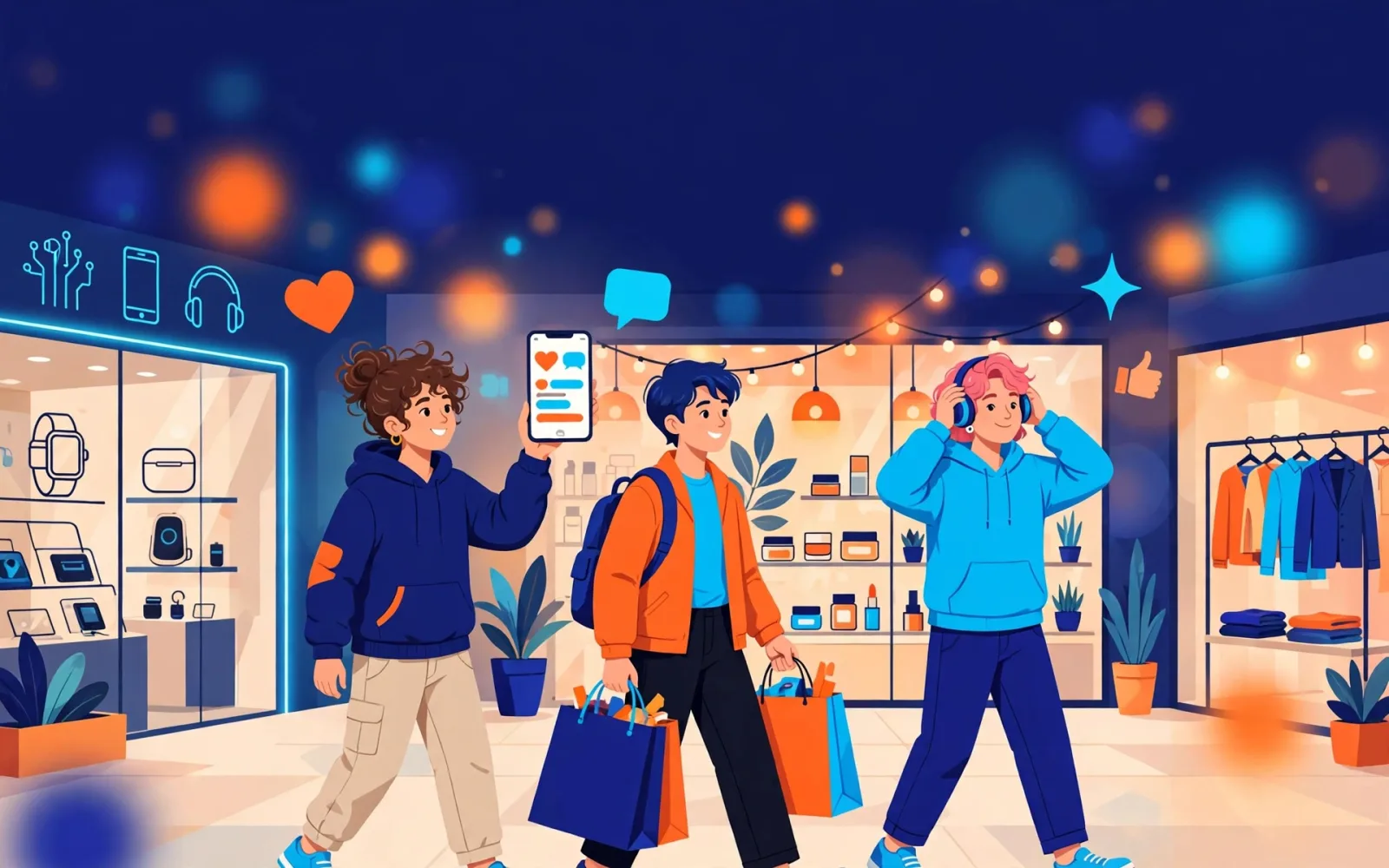
Yes — new Hammerson and Retail Economics research published 23 November 2026 finds Gen Alpha is more likely than Gen Z or Millennials to shop mostly or entirely in-store, with 76% saying social media prompted a shopping trip in the past year.
The most online generation in history would rather go to the shops. That is the blunt finding of new research published today, 23 November 2026, by the shopping-centre owner Hammerson and the consultancy Retail Economics — and it turns a decade of assumptions about young consumers upside down.
Gen Alpha — children born between 2010 and 2024 — grew up with a tablet in one hand and a streaming subscription in the other. They are the first generation to have never known a world without smartphones, and the received wisdom has always been that they would do everything online. The new study says the opposite. Two in five of the young consumers surveyed say they shop mostly or entirely in-store, a higher share than Gen Z or Millennials. More than three-quarters say something they saw on social media sent them to a physical shopping destination in the past year. Social media, in other words, is not replacing the shop. It is the shop window.
That matters for parents for a practical reason, not a theoretical one. Christmas is four weeks away, Black Friday week is under way, and the generation now doing much of the wanting is also doing much of the choosing — even when it is mum or dad who pays. Understanding how Gen Alpha actually shops, rather than how adults assume they shop, is the difference between a calm December and a month of impulse buys, returned trainers and arguments about skincare a nine-year-old saw on TikTok.
What the new research actually found
The study surveyed 1,500 UK consumers aged 12 to 20 and combined the results with Retail Economics' market sizing. Its headline number is striking: Gen Alpha is already worth £5.3 billion a year in physical non-food retail in the UK alone. That is money spent in real shops, on real shelves, by a generation whose oldest members are only 16.
The detail underneath is where it gets interesting. The young people surveyed make around 30 visits a year to shopping destinations — roughly one every twelve days. By the age of 20, average physical retail spending reaches £1,039 a year, about double the level recorded at age 12. Spending power, in other words, does not arrive in a sudden rush at 18. It builds steadily through the teenage years, trip by trip.
Two in five (40%) say they shop mostly or entirely in-store, compared with around a third of Gen Z and Millennials. And a visit is rarely just a purchase. More than half (54%) regularly combine at least three activities during a single trip — shopping, eating, entertainment and socialising. For this generation, the shopping centre is not a warehouse with a roof. It is where they meet their friends.
The social media connection is the part parents should read twice. Some 76% say something seen on social media prompted a shopping destination visit in the past year, and 29% say it happens at least monthly. These frequent social-media-led visitors are also among the highest spenders, estimated to spend over £1,600 a year in physical non-food retail — roughly double the average for their age group. The feed does not keep them at home. It gives them a reason to leave the house.
Asked what draws them to a destination, 68% say brands and experiences that match their interests, 68% say trying something new, 66% say browsing and shopping in person, and 56% say spending time with friends and family. More than half (56%) would travel at least 30 minutes for the right combination of shops, food and activities. That is a generation willing to make an effort for a good day out — not a generation that wants everything delivered to the door.
The surprise is real, but it is not just a UK story
It is tempting to dismiss one survey from one shopping-centre company. Hammerson, after all, owns Bullring in Birmingham, Cabot Circus in Bristol and Manchester Arndale, so it has an interest in the answer. But the pattern shows up in independent research on both sides of the Atlantic, and it shows up for Gen Z as well as Gen Alpha.
In the United States, the property firm Colliers published its 2026 retail report, "The Next Dollar", on 10 November. Its central forecast is that every generation — including the youngest — is expected to make the majority of its retail purchases in stores through 2030, and that Gen Z spending alone is projected to grow 85.6% to $1.61 trillion by 2030. The same report notes that Gen Alpha is already influencing household purchasing decisions, years before most of its members have their own income.
The in-store comeback is visible in the numbers Gen Z researchers keep producing. JPMorgan's research, cited in a 2026 round-up of Gen Z shopping statistics, found the share of Gen Z planning to shop in-store more this holiday season rose from 27% in 2024 to 37% in 2025, and that more than 55% of Gen Z spending during peak events is omnichannel — discovered on social, compared in-app, bought wherever is easiest. A separate Adyen survey found 73% of adults aged 18 to 27 shop in-store at least once a week, and 57% of Gen Z describe in-store shopping as an enjoyable experience. Deloitte's holiday research found 72% of Gen Z planned to shop in stores on Black Friday.
None of this means online shopping is dying. It means the story was never as simple as "young people shop online, old people shop in shops". The youngest shoppers use both, and they use each for different things: the phone for discovering, the shop for deciding.
Social media is the shop window, not the till
The Hammerson finding that 76% of young consumers were prompted into a store by social media fits a much bigger pattern. Social media has become the main way young people find out that a product exists at all.
The research firm Salsify found that 73% of Gen Z say social media is their main source for learning about new products, against 61% of Gen Xers who still discover products mainly by browsing physical stores. Sprout Social's 2026 survey found social media is now the top place Gen Z discovers products, named by 54%. And the scale of the commerce flowing through the feed is now enormous: eMarketer forecasts that US social commerce sales will pass $100 billion for the first time in 2026, with TikTok Shop alone reaching $23.41 billion in the US, up 48% in a year. More than half of US social buyers are expected to shop on TikTok in 2026.
But — and this is the part that matters for a parent standing in a shop with a teenager — discovery is not the same as purchase. Only 22% of shoppers buy mainly through social media shops, according to the same data, even though 63% of retailers now sell on social platforms. The feed creates the want. The shop, very often, closes the sale. That is exactly what Hammerson calls "scroll to store": a teenager sees a product on TikTok or Instagram, talks about it with friends, and then goes to a real shop to see it, try it, and buy it — often with a parent's card.
There is a useful honesty in this. The old fear was that social media would keep children glued to screens and out of the real world. The evidence now suggests something more complicated: the screen is often the reason they go out. The trip to the shops is a social event, planned on group chats, documented on phones, and remembered as a day out rather than a transaction. Parents who treat the phone and the shopping trip as opposites are fighting a battle their children have already resolved.
Who actually pays: the teenager is the household's chief marketing officer
Here is the finding that should change how parents think about Christmas lists. Gen Alpha may not have much of their own money, but they have an extraordinary amount of influence over other people's money.
A major US study published in August 2026 — the Gen Alpha Household Influence Study, conducted by HarrisX and Allison Worldwide among 750 Gen Alpha teenagers aged 13 to 16 and 750 of their parents — found that 91% of parents say their Gen Alpha teenager shapes the brands they like themselves. In the other direction, 73% of teenagers say their mum shapes what brands they like — more than any influencer, celebrity or social platform. The influence runs both ways, but the teenager's pull on the parent is the stronger current.
The study, announced by HarrisX and Allison Worldwide, has one number that matters most for parents: 62% of the purchases parents make for their Gen Alpha teenagers are driven by the teenager proactively asking for a specific brand. For girls, the figure is 67%; for boys, 59%. And in beauty — the category that has caused the most parental head-scratching in the last two years — nearly three-quarters of parent purchases from Sephora and e.l.f. Cosmetics were initiated by the teenager. Six in ten girls in the study said they would ask their parents for e.l.f. products specifically.
Salsify's 2026 consumer research reaches a similar conclusion from a different angle: 43% of parents say their Gen Alpha children, aged 1 to 15, already influence household spending — not just on toys and games, but on food and drink, fashion and electronics. The same research found that 41% of Gen Alpha children are on TikTok, 51% on Roblox and 78% on YouTube Kids. The platforms parents worry about are, for this generation, simply where they live.
The brands winning this household tug-of-war are familiar ones, according to Marketing Dive's report on the study. Amazon and Nike top the HarrisX ranking of brands among Gen Alpha households, with McDonald's third and Walmart fourth overall — and first among parents, largely because of mums. TikTok is the most important platform for teenage girls (42%), followed by Pinterest (19%); YouTube leads for teenage boys (35%) and for dads (32%); Facebook still leads for mums (24%). Different members of the same family discover brands in different places, which is why a product can feel like it is suddenly everywhere: it is reaching the teenager on TikTok, the mum on Facebook and the dad on YouTube at the same time.
None of this is new in kind — children have always pestered parents for things — but the scale and the speed are new. A trend that once took months to travel from a playground to a parent's wallet can now do it in a weekend, carried by an algorithm that shows the same product to millions of children simultaneously.
What they are actually buying
The Hammerson study found that fashion takes the largest share of a hypothetical £100 of Gen Alpha spending, but the generation allocates significantly more towards technology, beauty and entertainment than the wider population. Technology's share of the budget — phones, gaming and gadgets — is more than twice the UK average. Together, technology, entertainment and beauty account for over 40% of Gen Alpha's discretionary budget.
That mix is confirmed by the biggest survey of American teenagers, Piper Sandler's Taking Stock With Teens, published in October 2026. Its 26th annual survey of almost 9,000 teenagers aged 13 to 19 found teen spending rebounded 6% year on year in autumn 2026, with spending among higher-income teens up 11%. Total teen spending is now estimated at about $65 billion, with teenagers self-reporting about $2,350 each per year. Apparel spending was up 7%, girls' apparel up 10%, and Amazon accounted for about half of upper-income teens' online shopping.
Beauty is the category where the generation gap is widest — and where parents most often feel blindsided. Piper Sandler's beauty data, reported by BeautyMatter, shows teen girls' beauty spending grew 7% year on year and now accounts for a survey-high 23% of their wallet share, led by hair care, up 10%. Sephora remains the number one beauty destination for teen girls at 39%, followed by Ulta Beauty at 25%. And here is the number that connects directly to Hammerson's findings: 85% of teen girls still prefer to shop for beauty in person. They want to swatch the lipstick, smell the perfume and try the serum. They discover it on TikTok and buy it in Sephora — which is why Sephora's arrival at Hammerson's Bullring centre in Birmingham drove more than a million extra customer visits in its first year.
The beauty story also explains why the household influence numbers are so high for girls. When 87% of teen girls say influencers and friends shape their purchases, against only 37% who cite beauty retailers, the shop assistant is not the authority any more. The authority is the creator on the phone — and the parent is the person who has to decide whether a £28 serum is appropriate for a 12-year-old's skin. That decision is easier when the parent knows where the request came from.
The money behind the trend is enormous
It is easy to treat Gen Alpha as a curiosity — a generation too young to matter economically. The forecasters disagree, and by a very large margin.
Mark McCrindle, the Australian social researcher who coined the term "Generation Alpha", estimates the generation already wielded $1 trillion of worldwide spending power by 2024, counting both their own money and their influence on their parents' spending. By 2029, he puts that figure at $1.7 trillion, within an overall economic footprint of almost $5.5 trillion. With almost two billion Alphas expected worldwide, they are set to become the largest generation in history. World Data Lab projects that global consumer spending by Gen Alpha will pass $1 trillion a year within the next decade.
For parents, the useful translation is simpler: the generation that is hardest to advertise to through traditional channels is the generation that will soon be the biggest spending force on the planet. Retailers know it, which is why shopping centres are being redesigned around them — more food, more entertainment, more reasons to stay. Hammerson says its destinations now have 1.5 million followers across social channels, growing at more than 10% a year. The shopping centre itself has become a social media account.
What this means for parents this Christmas
The research points to a handful of practical conclusions, and none of them involves banning anything.
First, accept that the phone is part of the shopping trip now, not a distraction from it. If your teenager's Christmas list came from TikTok, that does not make it less real than a list that came from a catalogue. The Hammerson data suggests the list is a starting point for a visit, not a demand for a delivery. Going to the shop together to look at the thing, try it on, and talk about whether it is worth the money is exactly how this generation already wants to shop. The trip is the point.
Second, use the in-store preference as leverage. Because 85% of teen girls prefer to buy beauty in person and most teenagers want to try things before buying, the shop is where you can have the conversation about whether a product is suitable — its ingredients, its price, whether a cheaper alternative does the same job. A "no" delivered in a shop, with the product in hand, lands very differently from a "no" delivered at home about something on a screen.
Third, set the budget before the trip, not during it. The Hammerson study found frequent social-media-led shoppers spend over £1,600 a year — and Piper Sandler found teenagers spending about $2,350 a year in the US. These are not small numbers, and they are driven by discovery: new products appear constantly, and the feed never stops. A clear budget, agreed before the shopping centre, protects both the parent's wallet and the teenager from the guilt of having overspent. Our own reporting on Gen Z's Black Friday plans this week found the same dynamic at the older end of the age range: 94% of Gen Z plan to shop the event, spending $752 on average, with 40% planning to use buy-now-pay-later. The habits being formed at 13 are the habits that will be expensive at 23.
Fourth, talk about who is selling to them. The HarrisX study found that 60% of dads say their Gen Alpha teenager recently introduced them to a new brand they would not otherwise have known — a finding HackerNoon's analysis calls the most important in the whole report. Influence in these households flows upwards as well as downwards. That is not a problem to solve; it is a conversation to have. Asking "where did you see that, and why do you want it?" is more useful than asking "why do you want that?" — and it teaches the media literacy that no school lesson quite delivers.
Fifth, remember that the shopping trip is social time. More than half of the young people in the Hammerson study combine three or more activities per visit, and 56% say spending time with friends and family is a draw. For a generation that spends so much of its social life on screens, the shopping centre is one of the few places where friendship happens in person, in public, without an adult organising it. That is worth protecting — and worth joining, occasionally, rather than just funding.
The caveats parents should know
Good research deserves honest caveats, and this study has a few.
The survey covers ages 12 to 20, which straddles two generations: the younger end is Gen Alpha, the older end is Gen Z. Hammerson's release talks about "Gen Alpha", but some of the spending power it describes belongs to 18- to 20-year-olds with part-time jobs and student loans. The direction of the findings is consistent with other research, but the label is broader than the generation.
The study is also UK-only and commissioned by a company that owns shopping centres. That does not make the numbers wrong — Retail Economics is a respected independent consultancy, and the sample of 1,500 is solid — but it does mean the research was designed to answer a question Hammerson cares about. The independent corroboration from Colliers in the US, from Piper Sandler's 9,000-teen survey and from HarrisX's household study is what turns a company press release into a genuine trend.
Finally, the numbers describe averages, and averages hide real differences. A 12-year-old's £500 a year and a 20-year-old's £1,039 a year are different worlds. A family on a tight budget will experience this Christmas very differently from the families in the survey's upper-income brackets. The trend is real; the individual experience varies enormously.
Frequently asked questions
Do Gen Alpha children really prefer shopping in stores?
According to the Hammerson and Retail Economics research published on 23 November 2026, yes — 40% of the 12- to 20-year-olds surveyed say they shop mostly or entirely in-store, a higher proportion than Gen Z or Millennials. Independent US research points the same way: Colliers' 2026 retail report expects every generation to keep making most purchases in stores through 2030.
How does social media fit in if they shop in person?
Social media is the discovery channel and the shop is the purchase channel. In the Hammerson study, 76% of young consumers said something they saw on social media prompted a visit to a shopping destination in the past year, and 29% said it happened at least monthly. Salsify's research found 73% of Gen Z say social media is their main source for learning about new products. The feed creates the want; the shop closes the sale.
How much influence do Gen Alpha children have on what parents buy?
A great deal. The HarrisX and Allison Worldwide study of 750 Gen Alpha teenagers and 750 parents found 91% of parents say their teenager shapes the brands they like, and 62% of purchases parents make for their teenagers are driven by the teenager asking for a specific brand. Salsify found 43% of parents say their Gen Alpha children influence household spending across food, fashion and electronics.
What are Gen Alpha children spending money on?
Fashion takes the largest share, but technology, beauty and entertainment together account for over 40% of their discretionary budget, according to Hammerson and Retail Economics. Technology's share is more than twice the UK average. Piper Sandler's survey of nearly 9,000 US teenagers found total teen spending of about $65 billion, with beauty spending by teen girls at a record share of their wallets.
Should parents worry about "Sephora kids" and skincare trends?
Worry less, engage more. The trend is real — 85% of teen girls prefer to buy beauty in person, and most beauty purchases for young teenagers are initiated by the teenager — but the shop is actually the best place to have the conversation about what is age-appropriate. A parent who goes along, asks questions and checks ingredients is doing more good than a parent who bans the trip and leaves the child to order online instead.
Is this just a Christmas story?
No. The Hammerson research was published in late November, but the pattern it describes — social discovery leading to in-store purchase, with teenagers driving household decisions — is structural, not seasonal. With Gen Alpha's spending power forecast to reach $1.7 trillion by 2029, according to McCrindle, retailers are redesigning their shops around this generation now, and the habits being formed in 2026 will shape how these children spend for the next decade.
The bottom line
The generation that was supposed to kill the high street is turning out to be the generation that might save it — on its own terms. It is a shift of the same kind we described in the Drawbridge Generation, where young people are getting far more selective about who and what gets their attention. Gen Alpha discovers on a screen and buys in a shop. They go for the experience as much as the product, they bring their friends, and they bring their parents' wallets with them.
For parents, that is oddly good news. The shopping trip your teenager wants is not a surrender to consumerism; it is one of the few parts of their social life that still happens in person, in daylight, with real people. Go with them sometimes. Set the budget first. Ask where they saw it and why they want it. And remember that the child asking for a specific brand is not being manipulated by an algorithm. They are doing what teenagers have always done — the words and wants travel through friendship groups first, as our guide to what "chopped" means showed — just faster, louder and with better Wi-Fi.
The shops are not dying. They are being reinvented by the youngest customers they have ever had.