Gen Z Is Reinventing Thanksgiving Around Friendship
Gen Z is choosing friends over the family table this Thanksgiving: 41% say Friendsgiving matters as much as the real thing, and half met someone new this autumn.
Drafted with an AI writing assistant and checked against its sources by the editor before publishing. How we use AI.
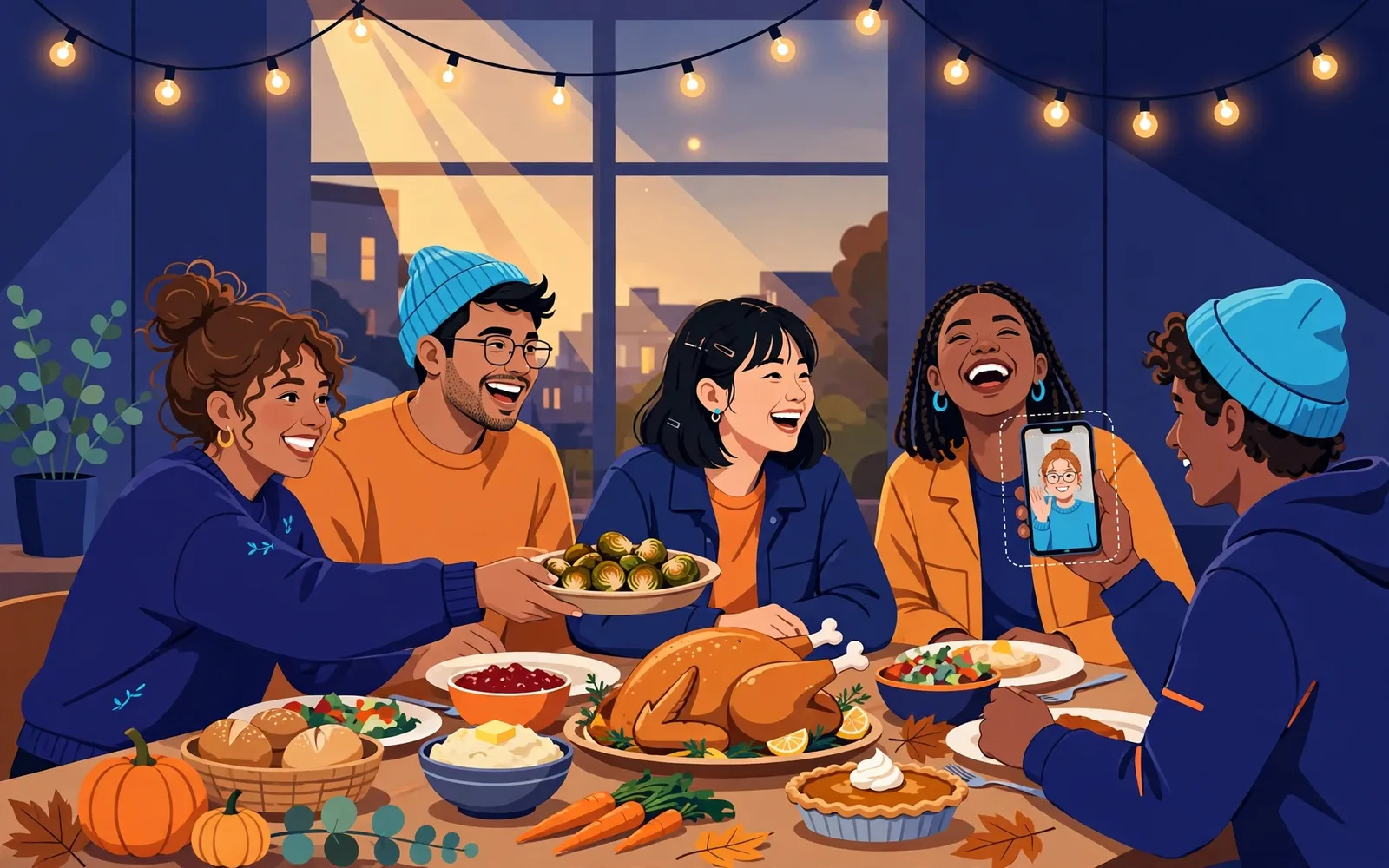
Gen Z is rebuilding Thanksgiving around friendship: 41% say Friendsgiving is as meaningful as the family meal, 38% of 18- to 29-year-olds are celebrating one this year, and nearly half met someone this autumn they want to keep talking to through the holidays, most of them through an app.
Somewhere in America today, a twenty-year-old is sitting at a Thanksgiving table, half-listening to an uncle, and thinking about someone who is not in the room. She met him — or her — six weeks ago, in a dorm, or on a campus, or in an app. They have talked every day since. And the strangest part, the part she will probably not say out loud over the turkey, is that the person she is thinking about feels more like her real life than the house she grew up in does.
That is not a small story about one young adult. Three separate surveys published in the last three days say it is the shape of Thanksgiving 2026 for an entire generation. Gen Z is not abandoning Thanksgiving. It is rebuilding it around friendship — and around friendships that, more often than not, started on a phone.
The headline numbers are hard to ignore. In a nationally representative survey of 1,198 American adults, conducted on 11 and 12 November by Ogilvy Consulting and the research firm Ideally, 41% of Gen Z said Friendsgiving — a meal with friends, on or near Thanksgiving — is equally or more meaningful to them than Thanksgiving with family or relatives. Gen Z respondents were almost twice as likely as the general population to name Friendsgiving outright as their most meaningful celebration of the season. A second, independent survey from the friend-making app Wizz, published on 25 November and based on 13,684 of its US users aged 18 and over, found that nearly half — 49% — met someone this autumn they want to keep talking to over the Thanksgiving break. And consumer data from CivicScience puts Friendsgiving participation at 21% of all American adults this year, up from 18% last October, jumping to 38% among 18- to 29-year-olds.
Put those together and the picture is clear enough: the friends' table is no longer the alternative to Thanksgiving. For a large share of the youngest adults in the country, it is the main event.
The numbers behind the new Thanksgiving
Start with the Wizz survey, because it is the most detailed picture of what is actually happening in young people's lives right now — and also the one that needs the most careful reading. Wizz surveyed its own users, in its own app, between 12 and 16 November. That matters. People who use a friend-making app are, by definition, people who are actively looking for new connections, so the numbers will run higher than they would in the general population. But the pattern inside the data is still revealing, and the nationally representative Ogilvy research points in the same direction.
Of the Wizz respondents, 49% said they met someone this fall they want to keep talking to over the Thanksgiving break. Among the 39% who are heading home for their first Thanksgiving since starting college or moving away, that figure rises to 60% — against 41% of those who have been home before. First-timers, in other words, are the ones forming the most new bonds, and they are the ones most determined to keep them alive through the holiday.
Two in three of the new connections started in an app. Of the 6,472 respondents who met someone this fall and named a place, 68% met that person through an app, and 43% met them only on Wizz itself. Three in ten met on campus. The phone, for this generation, is not a distraction from meeting people. It is where meeting people happens.
Nearly half — 48% — plan to tell their family about the people they met this fall. Among first-timers, that rises to 63%. That is a small detail that says a lot. Telling your parents about someone is what you do when a connection has crossed from casual to real. It is also, for a nineteen-year-old home for the first time since September, a quiet announcement: I have a life you have not seen yet, and it matters to me.
More than one in four — 28% — said they feel torn between being home with family and staying close to the people they met this fall. Among first-timers, 41% feel that pull. And more than half — 56% — said they feel like a different person from the one people at home still expect them to be. Among first-timers, that figure is 72%. Yet 78% said they feel no pressure to act like the person they were before they left. Read those two numbers together and you get something parents should hear clearly: young adults are changing fast, they know it, and most of them are not apologising for it.
The Ogilvy and Ideally research, reported by Fortune on 23 November, fills in the other half of the story — the money. Almost a third of Gen Z respondents, 31%, said they planned to skip Thanksgiving this year because of the cost. Two-thirds, 65%, said they would happily eat a Thanksgiving dinner made up entirely of side dishes. Friendsgiving, in this light, is not only an emotional choice. It is also a cheaper one. A potluck with friends splits the bill in a way a family feast does not, and for a generation that is still early in its earning life, that counts.
The commercial data backs the trend up. Partiful, the event-planning app popular with younger users, told The Guardian that Friendsgiving events on its platform have doubled year over year in 2026. Evite says 43% of its Thanksgiving-related invitations are now Friendsgivings, up from 37% in 2022. What began as a workaround for people who could not get home has become a planned, hosted, invited event in its own right — and the apps that organise young people's social lives are where the growth is showing up first.
Friendsgiving: a word that is barely old enough to vote
For something that now shapes how millions of young Americans spend their biggest family holiday, Friendsgiving is a remarkably young idea. The word itself first appeared in print on 4 December 2007, in a Usenet group called "Friends of the Friendless", where someone wrote: "Happy Friendsgiving Y'all!!!" Merriam-Webster, which added the word to its dictionary in January 2020, traced the earliest known uses to that post and to early Twitter. The concept, of course, is older — people have been eating Thanksgiving dinner with friends for as long as anyone can remember, and a 1973 episode of television, A Charlie Brown Thanksgiving, showed Snoopy cooking a chaotic meal of buttered toast, popcorn, pretzels and jelly beans for the gang. The sitcom Friends, which ran from 1994 to 2004, gave the idea a decade of Thanksgiving episodes. But the word itself did not exist until 2007, and it did not go mainstream until 2011, when Baileys Irish Cream built an advertising campaign around it and The Real Housewives of New Jersey aired an episode called "Gobblefellas" centred on a Friendsgiving dinner.
That timeline matters, because it tells you whose holiday this really is. Friendsgiving is not a tradition Gen Z inherited. It is one their older siblings and the millennials before them invented, online, in the same years that social media itself was being invented. Gen Z is the first generation to grow up with the word already in the dictionary — and the first to treat it as a real rival to the family table rather than a consolation prize for people who could not get home.
There is a second, quieter shift inside the numbers. Early Friendsgivings were mostly an alternative: something you did instead of family Thanksgiving, because you lived too far away or your family was difficult. The 2026 data describes something different. Friendsgiving is increasingly an addition — a second meal, a second table, a second set of people who count. Gen Z is not choosing friends instead of family. It is choosing friends as well as family, and in a growing number of cases, ranking the friends' table first.
Why friendship now carries the weight family used to carry
To understand why this is happening, you have to look at what friendship means to this generation — and how much of it now lives online. The most authoritative picture we have comes from a report published on 18 November 2026 by Gallup and the Digital Wellness Lab at Boston Children's Hospital, based on a survey of 15,925 young people aged 15 to 22 across 16 countries. The Digital Wellness Lab's own summary puts the same findings in plain language for parents. Its findings are more reassuring, and more complicated, than the headlines about lonely teenagers suggest.
The good news first. In-person friendship is still nearly universal: a median of 93% of young people across the countries surveyed said they have a close in-person friend. And 37% said they have a close friend they have only ever met online. Crucially, those two things almost always coexist. Only 4% of young people have a close digitally mediated friendship without an in-person friend as well. Online friendship, for the overwhelming majority, is an addition to real-world friendship, not a replacement for it. And the quality of in-person friendships matters more than anything else the researchers measured: young people with high-quality in-person friendships had about twice the adjusted odds of thriving as those without one.
But the report also draws a line that parents should know about. Loneliness was more common among young people who frequently communicate one-to-one online with strangers — 42% reported high loneliness — or with online-only friends, at 32%, than among those who frequently communicate with in-person friends or family, at 24% each. The online-only friendships that look healthiest are the ones wrapped around a real social life. The romantic end of that same shift — boys forming attachments to chatbots — is a separate story we examined this week, and it carries sharper risks. The ones that stand alone, with no in-person anchor, are where the risk gathers. And six in ten young people said they often or always scroll through short-form video when they feel lonely — the most common response to loneliness the researchers found, and the online habit most strongly linked to lower life ratings.
Pew Research Center's December 2025 survey of 1,458 American teenagers aged 13 to 17 fills in the daily texture. YouTube reaches 92% of teens. TikTok reaches 68%, Instagram 63%, Snapchat 55%. More than a third — 36% say they use at least one of the big platforms almost constantly. And nearly two-thirds, 64%, say they use AI chatbots, with about three in ten using them every day. The phone is not a separate place young people visit. It is the room where their social lives happen.
That is the context in which a Thanksgiving finding like "68% met new people through an app" stops sounding strange. For Gen Z, meeting someone in an app is not a lesser version of meeting someone. It is simply how meeting someone works now. The Wizz survey's most striking number may not be the 49% who met someone this fall. It may be the 56% who feel like a different person going home — and the 78% who feel no pressure to pretend otherwise. A generation that met its friends online, built its identity partly online, and now comes home to a family that knew an earlier version of them is negotiating something genuinely new: two selves, one holiday, and a phone that keeps both of them alive at once.
The app question parents cannot skip
There is one part of this story that deserves a harder look, and it is the app at the centre of the biggest survey. Wizz is a friend-making app built around meeting strangers: you swipe through profiles — a photo, a short bio, a few interests — and when two people connect, you can chat one-to-one. The company insists it is a friend-making app, not a dating app. The distinction is thinner than it sounds. Swiping through strangers and opening a private chat is the shape of a dating app, whatever you call the friendships it produces.
Wizz also has a history parents should know before their teenager downloads it. In January 2024, Apple and Google both removed Wizz from their app stores after the National Center on Sexual Exploitation raised concerns following NBC News reporting that linked the app to financial sextortion scams targeting minors. A January 2024 report from the Network Contagion Research Institute found the app had been used in sextortion schemes, with some victims reporting they were targeted within minutes of joining. Wizz returned to both stores within weeks, rebuilt around age verification from the identity firm Yoti, and it has been live and shipping updates ever since. Its own terms now say no one under 16 may use it, and Apple rates the app 18+, though Google Play rates the same app far lower, at Teen level. Whether the age gate actually holds is the question everything else depends on — and researchers who have tested it have found ways around it, including adults using a younger relative's face for the selfie check.
None of that makes the survey's findings false. But it does mean the survey should be read for what it is: a snapshot of the users of one particular app, taken by that app, about a behaviour the app exists to serve. The nationally representative Ogilvy research and the CivicScience data, which come from entirely different sources, point the same way — Friendsgiving is growing, and Gen Z is driving it. The direction of travel is real. The exact percentages belong to their samples.
The safety question is also bigger than any single app. An investigation published on 17 November 2026 by the Associated Press and the PBS series FRONTLINE found that financially motivated sextortion — scammers posing as teenagers, obtaining an intimate photo, then demanding money under threat of sharing it — surged by nearly 40% last year and now affects more than 160 children every day, according to the National Center for Missing & Exploited Children. By August 2026, the centre had received more than 40,000 reports involving the financial sextortion of minors, against roughly 50,000 across the whole of 2025. At least three dozen American teenage boys have died by suicide after being targeted since 2021. The investigation found that TikTok's share of reports to the Canadian hotline run by the Canadian Centre for Child Protection climbed from 2% in 2023 to 27% in 2025 and 33% so far in 2026, after the platform expanded direct messaging and image sharing — and that the Associated Press easily identified a dozen TikTok accounts promoting tips, tools and scripts for sextortionists.
That is the other side of "68% met new people through an app". Meeting strangers online is how Gen Z makes friends now, and most of those encounters are ordinary and harmless. But the same mechanics — a stranger, a private chat, a photo — are the ones scammers exploit, and the platforms' own safety systems have not kept up. New research published on 25 November in the Journal of the American Medical Association, led by Dr Dimitri Christakis at Seattle Children's, found that Instagram and Facebook account for only about 20% of teenagers' total social media time, with TikTok, Snapchat and YouTube taking the other 80% — which means limits imposed on one or two platforms barely touch the places where teenagers actually spend their time, or meet their people.
What this means for parents this Thanksgiving
If your son or daughter is home for Thanksgiving this year, there is a good chance they are carrying a friendship you have not met yet — and that the friendship started on a screen. Here is how to handle that without turning the holiday into an interrogation.
First, ask about the person, not the app. "Who did you meet this term?" is a conversation. "What apps are you on?" is an audit, and teenagers can tell the difference instantly. The Wizz numbers say nearly half of young adults plan to tell their family about the people they met this fall anyway. Make it easy for them. The details that matter are simple: how they met, what they talk about, whether they have met in person, and whether the friendship has stayed in the open — with other friends around — or moved quickly into private one-to-one chat.
Second, treat Friendsgiving as a good sign, not a rejection. A young adult who hosts or attends a Friendsgiving is doing something developmentally normal: building a chosen family, practising hospitality, and taking responsibility for a social event. The Gallup research is clear that in-person friendships are the strongest protective factor young people have, and a Friendsgiving is, at its best, exactly that — an in-person friendship, given a table and a date. If your teenager would rather cook for six friends than sit through a formal family dinner, that is not a failure of family. It is a sign they are learning to feed people, literally and otherwise.
Third, know the difference between an online friendship and an online-only friendship with no anchor. The Gallup data draws this line sharply. Young people whose online friendships sit alongside a real-world social life — school, work, a team, a neighbourhood — do well. The risk concentrates where an online connection is the only connection, or where a young person is talking one-to-one with strangers far more than with people they actually know. If your teenager's closest confidant is someone they have never met, who they found in an app, and who nobody else in their life has ever heard of, that is worth a calm, curious conversation — not a ban, which will only push the friendship underground, but a real talk about who this person is and what they want.
Fourth, talk about the money, because it is real. A third of Gen Z told Ogilvy they planned to skip Thanksgiving over cost. If your young adult is staying away, or hosting a cheap potluck instead of coming home, it may not be about you at all. It may be about a train ticket they could not afford, or a shift they could not give up. Offer to help with the travel, or to host the friends as well as the family. The cheapest way to keep a young adult at your table is often to make room at it for the people they care about.
Fifth, check the apps themselves — once, calmly, together. If your teenager uses a friend-making app, look at its age rules with them. Wizz says no one under 16 may use it, and Apple rates it 18+. If your child is under that age and on it anyway, that is a conversation, not a punishment. Ask what the age check asked for, and whether anyone has ever asked them for photos or money. Make sure they know the one rule that matters most: if anyone ever asks for an intimate photo, or threatens to share one, they should tell you immediately, and nothing bad that follows is their fault. The sextortion numbers — 160 children a day — are the reason that conversation cannot wait until something goes wrong.
The bigger shift underneath the holiday
Step back from the surveys, and something larger comes into focus. Thanksgiving has always been a holiday about who counts as family. For most of American history, the answer was given: blood, marriage, the people at the table you were born into. Gen Z is answering the question differently. Family, for them, increasingly includes the people they chose — the friends from the dorm, the group chat that became a dinner party, the person they met in an app in September and cannot imagine losing in December.
That is not a rejection of family. Look again at the numbers. Nearly half of young adults plan to tell their families about the people they met. They are not hiding these friendships; they are bringing them home, literally and figuratively, and asking their families to make room. The 56% who feel like a different person are not saying they have become someone else. They are saying they have become more themselves — and that the person their family remembers is only part of the story now.
There is also an economic story here that will outlast this one holiday. A generation that cannot afford houses, that marries later, that moves for work and studies far from home, is building its traditions earlier and cheaper than its parents did. Friendsgiving costs less than a flight home. A potluck splits the bill six ways. A group chat organises itself. When Ogilvy's researchers asked Americans what would count as a meaningful milestone today, financial independence led across every age group — and Gen Z was more likely than anyone else to name a career achievement or learning a new skill. The generation that is redefining adulthood is redefining its holidays to match: less ceremony, more honesty about money, and a table that seats the people who actually showed up.
None of this means the family Thanksgiving is dying. The CivicScience data says 21% of adults are doing Friendsgiving; that still leaves the large majority at the family table. What is dying is the idea that the family table is the only table that counts. For Gen Z, Thanksgiving now has two tables, and the second one — the friends' table, the potluck, the group chat made flesh — is where a growing share of the meaning lives.
So if you are a parent, and your young adult is quiet at dinner today, phone in their pocket, half somewhere else: they are probably not bored. They are probably thinking about someone they met this autumn, someone they want to keep, and wondering how to tell you about them. Ask. You might be surprised how much they want to.
Frequently asked questions
Is Friendsgiving replacing Thanksgiving for Gen Z?
Not exactly — it is joining it. In a nationally representative survey by Ogilvy Consulting and Ideally, 41% of Gen Z said Friendsgiving is equally or more meaningful than family Thanksgiving, and they were almost twice as likely as the general population to call it their most meaningful celebration. But most young adults still do both: a family meal and a friends' meal. The friends' table is becoming a second Thanksgiving, not a replacement for the first.
How many Gen Z adults are celebrating Friendsgiving in 2026?
CivicScience data puts participation at 21% of all American adults this year, rising to 38% among 18- to 29-year-olds. The event app Partiful says Friendsgiving events on its platform have doubled year over year, and Evite reports that 43% of its Thanksgiving-related invitations are now Friendsgivings, up from 37% in 2022.
Where are Gen Z's new friendships actually starting?
Mostly on phones. In Wizz's survey of 13,684 US users aged 18 and over, 68% of those who met someone new this fall met them through an app, and 43% met that person only on Wizz. Three in ten met on campus. Gallup's November 2026 report, based on 15,925 young people in 16 countries, found that 37% have a close friend they have only met online — but only 4% have an online friendship with no in-person friend at all.
Is it safe for teenagers to make friends in apps like Wizz?
It carries real risks parents should know about. Wizz was removed from the Apple App Store and Google Play in January 2024 after concerns about sextortion scams, and returned weeks later with age verification. Its terms bar anyone under 16, and Apple rates it 18+. An Associated Press and FRONTLINE investigation published in November 2026 found financial sextortion now affects more than 160 children a day. Parents should check the app's age rules with their teenager, ask who they are talking to, and make sure their child knows to report anyone who asks for photos or money.
Why are so many Gen Z adults skipping Thanksgiving this year?
Money. In the Ogilvy and Ideally survey, 31% of Gen Z respondents said they planned to skip Thanksgiving because of the cost. Friendsgiving is often cheaper — a potluck splits the cost — which is part of why it is growing. If a young adult in your family is staying away, it may be about a train ticket or a work shift, not about you.