Huss Huss Huss: The Roblox Meme Taking Over TikTok
A Roblox character who trains while everyone else parties has taken over TikTok. What 'Huss Huss Huss' means, where it came from, and what parents should know.
Drafted with an AI writing assistant and checked against its sources by the editor before publishing. How we use AI.
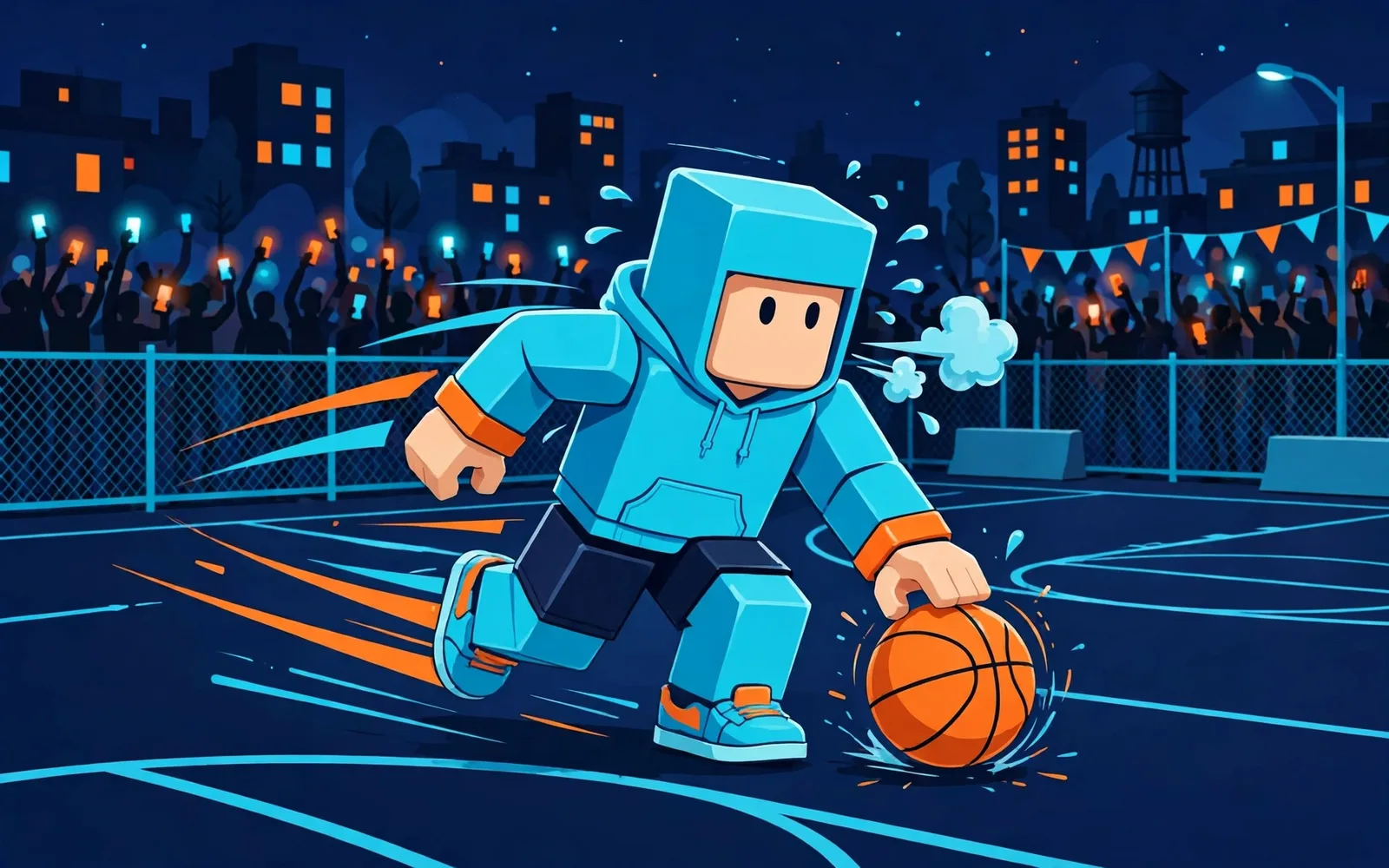
Huss Huss Huss is a TikTok meme from a 13 November 2026 Roblox video in which a blocky character dribbles a basketball and says everyone in his town goes out partying except him, punctuating his training with heavy-breathing 'huss, huss, huss' sounds; in six days it passed 36 million views and became a lip-dub audio used to joke about practising a skill while everyone else socialises.
If your child has spent the last week muttering "huss, huss, huss" while bouncing an imaginary basketball, they are not having a breathing problem. They are quoting the internet's newest obsession. "Huss Huss Huss" is a TikTok meme built on a short Roblox video posted on 13 November 2026, in which a blocky character dribbles a basketball and explains, in a dead-serious voice, that everybody in his town goes out partying except him. Between sentences he pants "huss, huss, huss" — the sound of someone training hard while everyone else is out having fun. In six days the original video passed 36 million views, and by 19 November the sound was attached to more than 284,000 TikTok videos. It is the latest in a long line of Roblox-born jokes to jump the fence into mainstream teen culture, and it is worth understanding properly, because the joke underneath it — staying in to practise while the world parties — is one teenagers actually recognise from their own lives.
The short version is this: "huss" is the sound of effort. The meme is a joke about discipline, loneliness and showing off a skill nobody asked you to learn. And for parents, the good news is that it is almost entirely harmless — no swearing, no sexual content, no dangerous challenge. The thing worth paying attention to is not the sound itself but the idea it carries, because "grind while they party" is a message kids are hearing from a lot of directions at once right now.
What "huss" actually means
"Huss" is an onomatopoeic slang word for the sound of fast, controlled outward breathing — the noise a shadowboxer makes throwing a punch, or a sprinter makes mid-stride. As a verb, "hussing" means sprinting or pushing yourself with that kind of breathing. The word itself is not new. Know Your Meme's guide to the term notes it has been circulating on social media since at least February 2026, and it broke through properly in July 2026 with the "Huss Valley" meme, a fictional town built around the same sprinting joke. Roblox's own third-quarter shareholder letter even name-checked Huss Valley, noting that it was created almost entirely with AI and broke into the platform's top 20 games by concurrent players — a small detail that tells you how fast a word can travel from a joke to a product inside Roblox's world.
What November did was give the word a character, a story and a voice. Before that it was a sound effect. After 13 November it became a person: the guy in the town where everyone parties, who stays home and practises. That is the difference between a slang word and a meme, and it is why "huss" is suddenly everywhere while a hundred other slang words from February are already forgotten.
Parents who have followed our earlier explainers will recognise the pattern. Slang words arrive as sounds first and meanings second — the same thing happened with "mogging", which Collins Dictionary named its 2026 Word of the Year after a summer of gym-mirror jokes, and with "Only in Ohio", which turned a place name into a punchline. The words change; the pipeline does not.
The video that started it
On 13 November 2026, TikTok creator @larpniverse posted a video made inside Roblox. A blocky character stands on a street at night, dribbling a basketball, and delivers a monologue in a calm, almost weary voice: "In this town everybody goes out partying except me. You see, every single night there's a party somewhere. Pool parties, pizza parties, even a birthday party for the mayor's goldfish. Nobody here practices anything. Why would they? There's always another party going on." Between the lines, the character pants "huss, huss, huss" while he keeps dribbling. Know Your Meme's entry on the meme records the same sequence, and a detailed explainer of the trend confirms the video's numbers and the burger variation that followed.
The joke works because of the contrast. The voice is completely serious, like a nature documentary narrator describing a strange species. The animation is deliberately clunky Roblox. And the complaint is both pathetic and proud at the same time: this character has no social life, and he would like you to know that this is because he is better than everyone else. He is not at the party because he is training. Everyone else is at the party because they have, in his words, no talents.
Within six days the video had passed 36 million views. Know Your Meme logged the entry on 19 November, which in meme terms is practically a same-day news cycle. The numbers matter because they explain why your child has heard it: this was not a slow burn. It was one of the fastest-moving sounds on TikTok in November, and the platform's recommendation system pushed it into millions of feeds within days.
How it spread: remixes, lip dubs and the burger version
Memes spread in stages, and this one followed the usual path at unusual speed. On 15 November, TikTok creator @djfunkyehh posted a funk and Jersey club remix of the audio, which passed 3.6 million views in four days. Remixes matter because they turn a spoken joke into music, and music travels further than dialogue — it can play over any video, in any context, without the listener needing to know the original.
From 16 November the lip dubs arrived. TikToker @urbaewinnie posted a lip dub that gained over 5.6 million views in three days; later the same day @the_devonmaid posted another that passed 3.1 million views in the same window. A lip dub is the simplest possible format: a creator mouths the character's monologue into the camera, usually while doing something that matches the boast — training, studying, practising a sport. The format is easy to copy, which is exactly why it spreads. Any teenager with a phone can make one in five minutes, and thousands did.
Then came the variations, and the best of them is the burger version. TikTok creator @thedrizzleshow took the same storytelling format and swapped basketball for burger wrapping. His protagonist is preparing for a job interview at a place called Bun Town. While everyone else is out partying, he wakes up at 5am to stretch his wrists and practise wrapping 200 burgers before breakfast, eventually becoming fast enough to wrap a burger in one second. It is the same joke with a different skill, and it works just as well — arguably better, because the skill is so specific and so useless that the boast becomes funnier. The burger version also has a lineage of its own: it draws on an earlier TikTok by @ryu_da_sigma from October 2026, who filmed himself wrapping a McDonald's burger at speed and passed 35 million views in three days.
By 18 November the fitness creator @wiilliamli had lip-synced the audio shirtless in a large gym, curling a dumbbell on each "huss", for 2 million views. By 19 November, according to trend trackers, the sound was attached to 284,000 TikTok videos, with most of its top creators posting from the United States. A second meme database's entry on the trend records the same spread, from lip dubs to remixes. In less than a week, a Roblox animation had become a format, a sound, a gym joke and a fast-food joke all at once.
The "In This Town" format
"Huss Huss Huss" is not a standalone video. It is the best-known example of a short-form storytelling format that Know Your Meme calls "In This Town" or "In This World", which gained popularity across TikTok, Instagram Reels and YouTube Shorts through October and November 2026. The format is simple: a Roblox character narrates a small, strange world in a flat, serious voice, and the humour comes from how seriously the narrator takes something absurd.
Roblox is the perfect engine for this. The platform's blocky, instantly recognisable characters can be animated by anyone, the worlds are cheap to build, and the audience is already there: Roblox reported 138 million average daily active users in the third quarter of 2026, with nearly 34 billion hours engaged in three months. When a format works on Roblox, it has a built-in audience of tens of millions of children and teenagers who already speak the visual language. A joke that would need expensive animation anywhere else costs one teenager an afternoon in Roblox Studio.
That is also why so many of the memes your child quotes start in Roblox and only later reach TikTok. The platform is not just a game any more; it is a meme factory with its own supply chain. A kid makes a video in Roblox, posts it to TikTok, a musician remixes it, thousands of teenagers lip-sync it, and within a week parents are hearing a word they have never heard before at the dinner table.
The older joke underneath: "While They Are Out Partying"
The most interesting thing about "Huss Huss Huss" is that it is not really new. It is a polished version of a joke that has been running for almost a year. Know Your Meme traces the catchphrase "While They Are Out Partying" — also written "While They're Out Partying BTW" — to a TikTok posted on 14 December 2025 by @bellaa.1e, who mocked another creator's squat technique under the caption "While they're out partying btw". That video passed 6 million views in ten months, and Know Your Meme is careful to note that it is the earliest known example rather than a proven origin. A separate guide to the format and a timeline of its spread tell the same story. Nobody knows who truly invented the line; @bellaa.1e is simply the first person the internet can prove said it.
The format grew through 2026. On 1 January, @itsjus_parker posted a video throwing garbage bags into a dumpster without looking, under the same caption, and passed 23 million views in nine months. In August, @thecameronschmidt parodied the trend by missing shot after shot. On 13 October, @aleexera applied it to Roblox footage and passed 8.5 million views in a week. The peak so far came in mid-October, when @ryu_da_sigma's burger-wrapping video passed 35 million views in three days. The format surged again between September and October 2026, and the "Huss Huss Huss" video landed on 13 November as the trend's most complete expression: the same boast, now with a character, a town and a soundtrack.
The lineage goes back further still. The format is similar to a 2016 precursor, "While You Were Partying, I Studied the Blade" — a copypasta about a katana-wielding loner that was already a joke about the same idea a decade ago: while you were having fun, I was getting good at something. The blade version was a parody of taking yourself too seriously. The 2026 version is the same parody, rebuilt for a generation that grew up on Roblox and short video. The weapons changed — a katana became a basketball, then a burger — but the structure is identical: I stayed in, you went out, and that is why I am better than you. Or at least, that is what the character would like you to believe.
This is worth knowing because it changes how you should think about the meme's lifespan. Individual videos fade in weeks. The joke underneath them has now survived, in one form or another, from 2016 to 2026. When "Huss Huss Huss" fades — and it will, probably by Christmas — the next version will arrive with a different sound and the same structure. Children are not following a video. They are following a format, and formats are much harder to outgrow.
Why this one landed
Not every viral video becomes a format. This one did for four reasons, and each of them says something about how teenagers use the internet in 2026.
First, the joke is built on a feeling teenagers actually have. Most teenagers have been the person who stayed home while their friends went out — or the person who went out and felt left behind anyway. The character's complaint is funny because it is recognisable, and it is flattering because it reframes missing out as a choice. He is not excluded; he is training. That is a much nicer story than the truth, which is usually that nobody invited him. The meme lets teenagers laugh at a feeling — fear of missing out — while pretending they are above it. Our earlier piece on Gen Z's fishing boom found the same pattern in a different hobby: young people are actively looking for ways to opt out of the party without feeling like losers, and a joke that makes opting out look heroic is going to travel.
Second, the format is easy to copy and hard to get wrong. A lip dub needs no editing skill, no props and no script — the audio does the work. A teenager films themselves doing push-ups, or revising, or wrapping a sandwich, and the joke lands. The barrier to entry is so low that participation itself becomes the trend, and every new version pushes the sound to a new audience.
Third, Roblox supplied the visual language for free. The blocky character is funny on sight: a toy person delivering a serious monologue about his neighbours' party habits. The animation does half the comedy before a word is spoken. And because Roblox is where a huge share of Gen Alpha spends its time — the platform's own numbers put daily users at 138 million — the audience did not need the joke explained. They already lived in the world it came from.
Fourth, the timing was right. The "While They Are Out Partying" format had been building for months, the burger-wrapping videos had already proved the structure worked with a different skill, and the audience was primed. @larpniverse's video did not invent the joke; it gave the joke its best delivery. That is usually how the biggest memes work. They are not lightning strikes. They are the tenth version of an idea, arriving at the moment the audience is ready for it.
What the research says about the world behind the joke
A meme about staying in to train while everyone else parties is, underneath the humour, a meme about social comparison — and the research on teenagers and social comparison in 2026 is worth knowing, because it is the context in which this joke lands.
Pew Research Center's December 2025 survey of 1,458 US teenagers aged 13 to 17 found that 36% use at least one of YouTube, TikTok, Instagram, Snapchat or Facebook "almost constantly", and about one in five say the same specifically about TikTok. Nearly all teenagers — 97% — use the internet daily, and 40% say they are online almost constantly, up from 24% a decade ago. That is the environment in which a sound can reach 284,000 videos in six days: teenagers are not dipping in and out of TikTok. A large minority live there. We covered the same numbers in our daily fact on how many teens are on social media almost constantly.
A study published in PLOS One on 18 November 2026 — five days after the original video — adds a useful nuance. Researchers working with the Adolescent Brain Cognitive Development study followed 2,493 adolescents aged 11 to 14 and found that social media use was associated with internalising problems such as anxiety and low mood at both waves they measured, and that the link was roughly twice as strong among teenagers with weaker inhibitory control — the brain's ability to pause, filter and resist impulses. Inhibitory control did not change the link for video games, only for social media. The authors' interpretation is that what matters is not just how much time teenagers spend online, but how they process the social and evaluative content they meet there — the comparisons, the judgements, the feeling of being watched or left out. A meme about being the only person not at the party is, in that light, a joke about exactly the kind of content that study is describing.
A separate four-wave cohort study of 550 Swiss adolescents, posted as a preprint in October 2026, makes a related point: problematic media use — losing control over it, feeling unable to stop — tracked closely with mental health symptoms, while sheer device time on its own barely did. Rising depressive symptoms and falling wellbeing predicted heavier problematic video game use, not the other way round. The implication for parents is one we have repeated before and that the research keeps confirming: counting hours is a poor proxy for what is actually happening. What matters is whether the use feels controlled or compulsive, and whether the content is fuelling comparison and exclusion or connection and fun.
None of this means the meme is harmful. A joke about training while others party is, on its face, a joke about choosing effort over FOMO — and plenty of teenagers use it exactly that way, filming themselves doing homework or going to the gym with a grin. But the same joke can carry a sharper edge for a teenager who already feels left out, and the "grind" framing is worth watching, because it is the same framing that turns up in hustle-culture content aimed at boys, in "no days off" gym content, and in the darker corners of self-improvement social media. The line between "I chose to practise" and "I must practise or I am worthless" is thin, and teenagers are not always good at seeing it. The meme itself is harmless. The message it borrows — that your worth is measured by how hard you grind while others relax — is one parents should be ready to talk about.
What parents should actually do
Start with the reassuring part: there is nothing in this meme to be alarmed about. There is no explicit content, no dangerous challenge, no hidden meaning and no slur. "Huss" is a breathing noise. The video is a cartoon character playing basketball. If your child is quoting it, they are doing what children have always done with a popular joke — repeating it until the adults around them crack. That is normal, and it will pass.
The useful move is to treat the meme as a conversation opener rather than a problem to solve. Ask your child to show you the video. Ask which version they like best — the basketball one, the burger one, the gym one. Ask them what skill they would pick if they made their own version. Those three questions do more than any lecture, because they tell you whether your child is laughing at the joke or living inside it. A child who laughs and picks something silly — wrapping a sandwich, folding laundry at speed — is enjoying the absurdity. A child who answers seriously, who talks about needing to train while everyone else wastes time, may be absorbing the grind message more literally, and that is worth a gentle follow-up.
It is also worth saying the quiet part out loud: the character in the video is lonely, and he copes by deciding he is better than everyone else. That is a very human coping strategy, and teenagers use it too. If your child is the one staying home while friends go out, the meme might be how they are telling you about it. "Huss huss huss" at the dinner table could be a joke, or it could be a small, coded way of saying "I feel left out and I am pretending I chose this." The difference is usually visible in the delivery — a grin means a joke; a flat, repeated mutter means something else — and it is worth paying attention to which one you are hearing.
A few practical points. First, do not ban the word or the video; that only makes it funnier and guarantees your child will quote it more. Second, if your child wants to make their own version, let them — it is creative, it is harmless, and it is a better use of an afternoon than scrolling. Third, use the burger version to make a point about the joke's real structure: the skill is always something slightly pointless, and that is the point. The character is not actually getting good at anything that matters. He is getting very good at something nobody needs. That is why it is funny, and it is also why the "grind" message underneath it is not a philosophy to take seriously. And fourth, if the grind talk ever turns into self-punishment — skipping sleep to study, refusing to rest, talking about themselves as lazy or worthless for taking a break — that is no longer about a meme. That is a conversation about pressure, and it deserves a proper, unhurried talk, or a word with their school if it persists.
Frequently asked questions
What does "Huss Huss Huss" mean?
It is the sound of heavy breathing while training. In the meme, a Roblox character dribbles a basketball and pants "huss, huss, huss" between lines of a monologue about how everyone in his town goes out partying while he stays home to practise. The word "huss" itself is slang for fast, controlled breathing during exertion, and it was already circulating on social media before the video, notably in the July 2026 "Huss Valley" meme.
Where did the meme come from?
TikTok creator @larpniverse posted the original Roblox video on 13 November 2026. It passed 36 million views in six days. A funk and Jersey club remix by @djfunkyehh followed on 15 November, lip dubs by creators including @urbaewinnie and @the_devonmaid spread it from 16 November, and a burger-wrapping version by @thedrizzleshow became the most popular variation. By 19 November the sound was attached to more than 284,000 TikTok videos.
Is it related to "While They Are Out Partying"?
Yes — it is the most polished version of that older format. "While They Are Out Partying" began with a TikTok by @bellaa.1e on 14 December 2025 and grew through 2026, with viral versions including a 23-million-view dumpster throw and a 35-million-view burger-wrapping video. Both formats share the same structure: showing off a skill you perfected alone while everyone else was socialising. The format itself traces back to a 2016 copypasta, "While You Were Partying, I Studied the Blade".
Is the meme safe for kids?
Yes. There is no swearing, sexual content, violence or dangerous challenge in the original video or in the mainstream versions. The lip dubs and remixes are equally clean. As with any viral sound, individual creators can attach it to other content, but the meme itself is one of the most harmless trends of the year. The only thing worth watching is the "grind" message underneath it, and only if a child starts taking it literally.
How long will it last?
Probably not long. Most TikTok sounds peak within two to three weeks and fade as the next format arrives. "Huss Huss Huss" peaked in the second half of November 2026 and will likely be a nostalgic reference by Christmas. The format underneath it, though, has survived since 2016, so expect a new version — a different sound, a different skill, the same joke — within a few months.
The last thing worth saying is the simplest. Memes like this one feel strange to adults because they arrive fully formed, with their own language and their own rules, and because a child can explain the whole thing in ten seconds while an adult needs an article to understand it. That gap is not a problem. It is the normal distance between a generation that grew up inside a platform and a generation that is still learning it. The best response is curiosity, not alarm: watch the video, laugh at the burger version, and ask your child what skill they would practise while everyone else parties. You will learn more from that answer than from any article — including this one.