Italy to Ban Under-13s From Social Media: Parents' Guide
Italy plans to bar under-13s from social media, with parent-linked accounts for ages 13-15. What it says, when it takes effect, and what parents should do now.
Drafted with an AI writing assistant and checked against its sources by the editor before publishing. How we use AI.
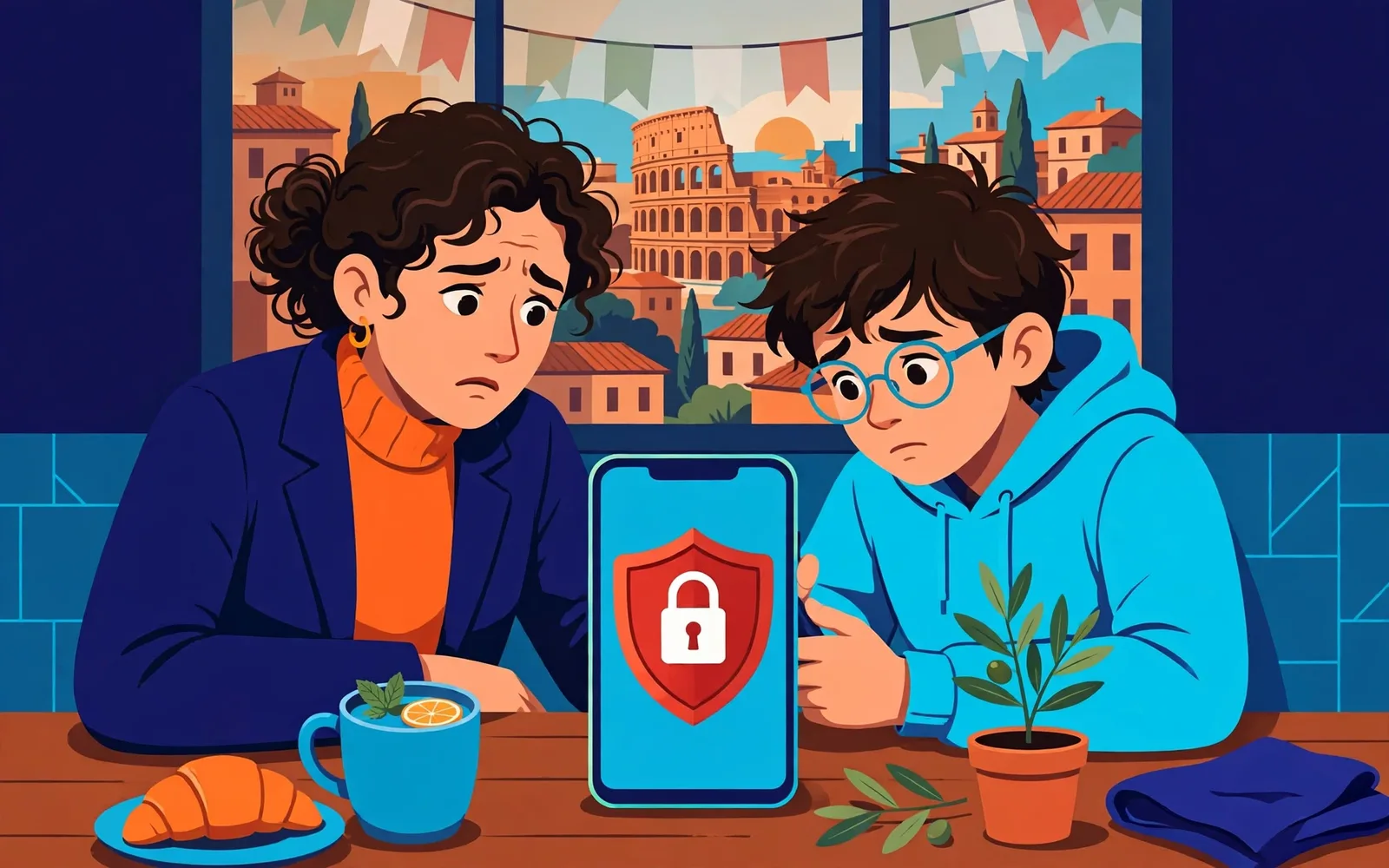
Italy is set to bar children under 13 from social media and video-sharing accounts, allow 13- to 15-year-olds only on accounts linked to a parent, and permit independent accounts from 16, under an amendment to its security decree that parliament is expected to approve by late December 2026.
Italy is about to do something no big European country has tried before: ban children under 13 from social media outright, and put every teenager under 16 on a leash held by a parent. Under a proposal backed by Giorgia Meloni's government, children below 13 would not be allowed a social media or video-sharing account at all. Thirteen- to fifteen-year-olds could use the platforms only through an account linked to one of their parents. Independent accounts would start at 16. The measure is an amendment to a security decree already moving through parliament, and Reuters reported on 18 November that approval is expected by late December, with parliamentary sources calling it almost certain.
That is the short version, and it matters even if your family does not live in Italy. Rome is not acting alone. Australia switched on the world's first under-16 social media ban on 10 December 2025. Britain is preparing its own under-16 rules for spring 2027. And in September, the European Commission proposed the EU KIDS Act, which would set the same under-13 line across the whole European Union. What Italy does in December will shape what your child's phone looks like in 2027, wherever you live.
This is not a law yet. The amendment has been seen by Reuters but had not been formally presented when the story broke, and the text can still change in parliament. But the direction is unmistakable, and the details already on the table are specific enough for parents to take seriously. Here is what Italy is proposing, why it is moving so fast, what Europe is doing alongside it, and what it means for your family.
What Italy is actually proposing
The plan is built on three age tiers, and the simplicity is the point. Under 13: no account on a social network or video-sharing platform, full stop. Ages 13 to 15: an account is possible, but only one linked to a parent's account — the teenager does not hold an independent profile. From 16: a young person can open and run their own account. TBS News, carrying the Reuters report, sets out the same three tiers.
The scope is wider than the word "social media" suggests. The rules would cover social networks and video-sharing platforms, which La Stampa notes would bring YouTube account creation inside the rules. Watching a video without logging in is a grey area the draft does not clearly settle. Educational apps are exempt, as are non-profit encyclopaedias, scientific archives, teaching services and open-source platforms. A 12-year-old doing homework on an educational app would be unaffected; a 12-year-old opening TikTok would not be.
The enforcement teeth are real. Platforms would have to verify users' ages using a method that works with the European Digital Identity Wallets, under technical rules drawn up by AGCOM, Italy's communications regulator, within nine months of the law taking effect. If AGCOM finds a breach, it could give the platform 20 days to comply and then order the service blocked until it does. Accounts opened in breach of the age limits would have their contracts declared void, which matters more than it sounds: it would strip platforms of the legal basis they use to process those children's data. And there is a quirk worth knowing about. Il Post reports that the verification duty would not apply to accounts at least eight years old when the law takes effect — so a teenager who has held an account since they were eight might slip through. The 16-year threshold may also be lowered to 15 to match the EU proposal, which would change the maths for every 15-year-old in the country.
Italy already has an age rule, but it is a different kind of rule. Under the Italian Privacy Code, children under 14 need a parent's consent for their data to be processed by online services, and from 14 they can consent themselves. Most platforms set their own minimum age at 13 in their terms. The new proposal stacks a third threshold on top: a 14-year-old could legally consent to data processing and still not be allowed an independent social media account. That layering is deliberate. Rome is not regulating data any more; it is regulating access.
Why now, and why so fast
The vehicle tells you how urgent the government thinks this is. The age limits are not a standalone bill. They are an amendment to Decree-Law 190 of 2026, a security decree about public safety and juvenile crime issued on 22 October. The bill converting it into law, C. 3159, is before the Chamber of Deputies, and Italian decree-laws lapse if parliament does not convert them within 60 days. That puts the deadline at 21 December 2026, and it is why the coalition sees the decree as a fast track. Captain Compliance's analysis of the proposal lays out the timeline and the mechanics in detail.
The amendment is led by Fabio Rampelli, a Brothers of Italy deputy and vice-president of the Chamber of Deputies, and it has the backing of Prime Minister Giorgia Meloni's right-wing coalition. In a statement quoted by Reuters, Rampelli said the amendment "could represent a decisive turning point for parents struggling with their children's digital addiction, as well as for minors." That word — addiction — is doing a lot of work. The government is framing this as a public-health measure, not a technology policy, and it is putting it inside a security decree precisely so it cannot be slowed down by the usual legislative queue.
Not everyone is happy with the method. Opposition members, and Marianna Madia — a co-author of an earlier cross-party bill on minors and social media — criticised putting the ban inside a decree about juvenile crime rather than in a dedicated law. That earlier bill, led by Senator Lavinia Mennuni, had stalled after the European Commission asked member states to hold off on national rules while it prepared EU legislation. Italy is now moving anyway, and the tension between Rome's timetable and Brussels' timetable is one of the things to watch. The bill was notified to the Commission to check it against EU law, and a national measure that later conflicts with an adopted EU regulation would have to give way.
There is also a court case running in parallel. La Stampa reports that Rome's Court of Appeal is due to rule on 24 November in an action by consumer groups Codacons, Adusbef and Assourt against Meta over checks on under-14s on Instagram. The legal pressure on platforms in Italy is coming from several directions at once.
The EU KIDS Act: the same line, drawn for 450 million people
Italy is not acting in a vacuum. On 17 September 2026, the European Commission adopted the EU KIDS Act, a proposal for a regulation that would set the same basic architecture across the European Union. The Commission's own announcement describes four pillars, and the first is delayed access to social media: no social media accounts under 13, guardian-controlled "mini accounts" for 13- and 14-year-olds with a one-hour daily time limit, and independent accounts from 15.
The details matter, and they differ from Italy's draft in ways that will eventually have to be reconciled. The Commission's explainer page sets out the tiers plainly: under 13, no access to social media services, though children can use specially designed child-friendly video-sharing services through a guardian-managed account; 13 to under 15, a mini account managed by a parent or guardian with limited features and a one-hour daily limit; from 15, a child can open and manage their own account. The full proposal, COM(2026) 681, is published on EUR-Lex.
But the EU proposal goes further than Italy's in a second respect. It does not just decide who gets in; it regulates what the services do to children once they are inside. The safety-by-design pillar would ban addictive features and profiling-based recommender feeds that drag minors into "rabbit holes" of harmful content, require private-by-default profiles, and switch AI companions off by default for under-18s. It would apply to social networks, video-sharing platforms, online games, AI companions and chatbots, and app stores. The European Parliament's legislative tracker shows the file was referred to the Internal Market committee on 22 October 2026, and the Council began examining it the same month. The Commission is seeking feedback until 3 December 2026.
There is a genuine disagreement inside the European institutions about the right number. In a resolution in November 2025, the European Parliament called for a harmonised digital age limit of 16 for social media, video-sharing platforms and AI companions unless parents consent, with an absolute minimum of 13. The Commission's proposal chose 15 for independent accounts. Italy's draft chose 16. Legal 500's overview of the proposed Act notes that the draft, or something close to it, may ultimately become law — and that businesses should prepare now. For parents, the practical upshot is that the numbers will be argued over for months, but the direction is settled: the age of first access to social media in Europe is going up, and the era of a child typing a fake birthday into a sign-up form is ending.
What Australia learned in the first year
The closest thing to a live experiment is Australia, and it has been running for almost a year. On 10 December 2025, the Online Safety Amendment (Social Media Minimum Age) Act 2024 came into effect, requiring platforms to take "reasonable steps" to stop under-16s creating and keeping accounts. eSafety, the Australian regulator, lists the ten platforms in scope: Facebook, Instagram, Kick, Reddit, Snapchat, Threads, TikTok, Twitch, X and YouTube. Messaging apps, gaming services, Google Classroom, WhatsApp and YouTube Kids are not covered. Under-16s can still see public content without logging in.
The design of the Australian law is instructive. Children and parents face no penalty for getting around it; the obligation sits entirely on the platforms, which face fines of up to AUD 49.5 million for systemic non-compliance. DLA Piper's analysis of the eSafety Commissioner's regulatory guidance explains the key point: self-declaration alone does not count as a "reasonable step." Platforms are expected to use a "waterfall" of checks — signals like device history and behaviour first, then stronger checks such as facial age estimation or document verification where the risk is higher. The government has said more than 4.7 million accounts belonging to under-16s were deactivated in the early months.
Australia also shows the limits. The law is officially described not as a ban but as a "delay" — a phrase eSafety uses deliberately, because the accounts come back at 16. Interest in VPNs spiked when the law took effect, and the guidance itself names privacy tools as a workaround. Experts cautioned from the start that age-assurance technology is not foolproof and can misidentify users. And the platforms' own responses were uneven: TikTok said it would deactivate under-16 accounts on 10 December, Snapchat suspended them for three years or until 16, while X said little at all. Italy's drafters will have read all of this. Their answer — wallet-based verification, a regulator that can block a service, void contracts — is a harder version of the same idea.
The age-check problem nobody has solved
Every one of these laws runs into the same wall: children lie about their age, and they are good at it. Ofcom, the UK regulator, found that 22% of 8- to 17-year-olds with a social media profile claim to be 18 or older. Its deeper tracking found that about a third of children with a profile show a user age of 18 or older, and among 8- to 12-year-olds, nearly a fifth show a user age of 18. The BBC demonstrated the problem by creating accounts on major platforms using false ages without any challenge.
The newer evidence is worse. A May 2026 study by Internet Matters, surveying more than 1,000 UK children aged 9 to 16 and their parents, found that 46% of children say age checks are easy to bypass and only 17% say they are difficult. A third — 32% — admitted actually doing it. The most common method is still the simplest: typing a false date of birth. But children also reported using a parent's or older sibling's ID, submitting videos of other people's faces, and feeding facial-recognition systems footage of video-game characters. One mother caught her 12-year-old son drawing a moustache on his face with an eyebrow pencil to fool a facial age-estimation check. It worked; the system verified him as 15.
That is why Italy's proposal leans so heavily on the European Digital Identity Wallet rather than on self-declaration or a selfie. The wallet model is designed so that the platform learns only an age band, not an identity. Italy already runs a version of this for adult content. Under the 2023 "Caivano" decree, AGCOM set rules for age checks on pornographic sites using certified third parties and a "double anonymity" design: the verification provider does not know which service the proof is for, and the site receives a proof containing no identifying data. Those rules took effect for providers established in Italy from 12 November 2025. The social media proposal would adapt the same machinery from a single "over 18" check to several age bands plus a parent-child link. It is the most serious attempt yet to make age-gating actually work — and it is also the reason the timeline stretches into 2027, because AGCOM gets nine months after the law takes effect just to write the technical rules.
What it means for your family
If you live in Italy, the practical effects arrive in stages. Nothing changes until parliament converts the decree, which must happen by 21 December 2026. Then AGCOM writes the rules over nine months. Only then do the checks bite. But the direction of travel is clear enough to plan around, and the same wave is coming to other countries. Here is how to think about it by age.
If your child is under 13, the message from Rome and Brussels is the same: no social media account. That is already the rule in most platforms' terms of service, and it is already widely ignored — remember the Ofcom finding that nearly a fifth of 8- to 12-year-olds with a profile show a user age of 18. The difference now is that the platforms, not the parents, will be on the hook. If your child already has an account, expect it to be deactivated or converted, and use the next few months to talk about it rather than waiting for a platform email to do the talking for you.
If your child is 13 to 15, the Italian model gives you a formal role: the account is linked to yours. That is a genuine change from the current arrangement, where a parent's involvement is informal and easy to evade. Treat the link as a conversation, not a surveillance tool. Agree together what the account is for, who can contact them, and what happens when something goes wrong. The EU version adds a one-hour daily limit on mini accounts, which is a useful starting point for a negotiation even if you live nowhere near Europe.
If your child is 16 or 17, the Italian draft would let them hold an independent account — but the EU KIDS Act's safety-by-design rules would still apply to them as minors, including private-by-default profiles and no profiling-based feeds. The age of 16 is not a finish line. It is the point where the law stops deciding for you and starts expecting you to have taught your teenager to decide for themselves.
And if you live outside Europe, do not assume this stays in Europe. Australia's ban is already live. Britain's under-16 rules are due in spring 2027. In the United States, the pressure is coming through the courts rather than through age bans: eleven states are suing OpenAI over chatbot safety for children, and New York and California have passed chatbot safety laws taking effect on 1 January 2027. We covered that wave in States Are Suing AI Chatbots Over Kids: What Parents Must Know. The pattern is the same everywhere: the free-for-all of the last fifteen years is ending, and the replacement is a patchwork of age gates, design rules and lawsuits that parents will have to navigate one country at a time. Our broader guide to the global picture is Under-16 Social Media Bans Are Spreading: A Parent's Guide, and if you want the basic age question answered for your own household, start with What Age Should Kids Join Social Media? 2026 Rules for Parents.
Why teens are on these platforms in the first place
None of this makes sense without the numbers on how deeply social media is woven into teenage life. Pew Research Center's December 2025 survey of 1,458 US teens aged 13 to 17 found that about three-quarters use YouTube daily, TikTok is used by roughly two-thirds, and about a third of teens say they are on at least one of the five major platforms "almost constantly" — a figure that has stayed steady for several years. The same survey found 64% of teens have used an AI chatbot, and 28% use one daily.
Pew's follow-up study in April 2026, which compared teens' experiences across TikTok, Instagram and Snapchat, adds texture. Roughly nine in ten teens say entertainment is a reason they use these apps, and for TikTok it is a major reason for about eight in ten users. But the platforms are not only entertainment: about six in ten TikTok users go there for product reviews, and about four in ten on TikTok and Instagram say they use the apps for news. About three in ten teen TikTok users say they spend too much time on the app. And about four in ten teens say they feel pressured to post only content that makes them look good.
Those findings cut both ways in the age-ban debate. They explain why parents worry — a third of teens effectively never log off, and a large minority feel judged by what they post. They also explain why a ban is not a complete answer. For many teenagers, these apps are where friendships happen, where news arrives, and where identity is rehearsed. Our daily fact this week captured the other side: 74% of US teens say social media makes them feel more connected to what is going on in their friends' lives. Take the account away and you do not take the need away. The question Italy is really asking is not whether children should be online — they will be — but who decides when, and on whose terms.
What the critics say
The proposal has critics on several fronts, and they are worth hearing, because the same arguments will follow the idea wherever it travels.
The first criticism is about privacy. Age verification that actually works needs to know something real about a child, and the history of data collection by platforms gives parents little reason to trust that the data will be handled carefully. The wallet model is designed to answer this — the platform learns an age band, not a name — but it is new, untested at this scale, and it asks families to trust a chain of providers they cannot see. Italy's own data protection authority, the Garante, has fined Meta €805 million over Facebook's camera-roll suggestions, which shows the regulator is willing to act. It also shows why the regulator is needed.
The second criticism is about displacement. Close TikTok to a 12-year-old and the child does not stop wanting to talk to friends; they move to a messaging app, a game, or a smaller platform the law does not cover. Australia's ban deliberately excludes messaging and gaming services. Italy's draft covers social networks and video-sharing platforms, which leaves the same gap. The risk is not that children stop being online, but that they move somewhere less visible, where parents have fewer tools and moderators have less reach.
The third criticism is about effectiveness. The UK's experience shows that age checks can be bypassed by a third of children, and that even the checks that work are resented. VPN use spiked in Australia when the ban took effect. A law that is easy to evade teaches children that rules about the internet are decorative, which is the opposite of what its supporters want.
The fourth criticism is political, and it is specific to Italy. Putting a social media ban inside a security decree about juvenile crime frames children as a security problem rather than as citizens with rights, and it short-circuits the slower, more careful legislative process a subject like this deserves. The Mennuni bill, which would have done this properly, stalled. The decree is faster, but it is also blunter, and it expires if parliament does not convert it by 21 December.
None of these criticisms is a reason to ignore the proposal. All of them are reasons to watch what happens next, and to remember that the law is only one part of the answer. The other part is what happens at home.
What parents can do now
Whatever parliament decides in December, there are things worth doing this week.
First, find out what accounts your child actually has, and what age is on them. If your 11-year-old's TikTok profile says they are 19, that is not a prank; it is the single most common way children get past age gates, and it is the habit these laws are designed to break. Fix the age together, and talk about why it matters.
Second, if your child is 13 to 15, try the linked-account model before the law forces it on you. Most platforms already offer some form of parental supervision or family pairing. Set it up together, agree on the rules in writing, and revisit them monthly. A linked account imposed by a government in 2027 will feel like surveillance; a linked account you set up together in 2026 feels like a deal.
Third, treat the one-hour figure as a conversation starter, not a rule. The EU's one-hour daily limit for mini accounts is a policy number, not a medical one. Some children will need less, some can handle more. What matters is that there is a limit, that your child understands it, and that it is enforced by something other than willpower at 11pm.
Fourth, remember that the law covers accounts, not access. A child without an account can still watch public videos, still see screenshots from friends, and still hear about everything at school on Monday morning. The age ban changes the front door; it does not lock the building. The conversation about what your child sees, who they talk to, and how they feel afterwards matters more than the account status.
Fifth, keep an eye on the dates. Parliament must convert the decree by 21 December 2026. The European Commission is taking feedback on the EU KIDS Act until 3 December 2026. Rome's Court of Appeal rules on the Meta under-14s case on 24 November. These are the moments when the rules change, and they are worth a five-minute check each time.
Finally, read the privacy rules as well as the age rules. The same wave that is raising the age of social media is rewriting data protection for children: the US Children's Online Privacy Protection Act is being updated, several states have passed their own child-privacy laws, and the EU's design rules would change what a child's feed looks like even after they are old enough to have one. We explained the US side in Kids' Privacy Online: COPPA, KOSA and the 2026 Rules. The age ban is the headline; the privacy rules are the fine print that will shape your child's daily experience for years.
FAQ
Is Italy actually banning social media for children?
Not yet. The proposal is an amendment to a security decree that parliament must convert into law by 21 December 2026. Reuters reported on 18 November that approval is considered almost certain, but the text has not been formally presented and can still change. Nothing applies until the decree is converted and AGCOM writes the technical rules, which takes up to nine months after that.
What ages would the Italian rules set?
Under 13: no social media or video-sharing accounts. Ages 13 to 15: accounts only if linked to a parent's account. From 16: independent accounts. The 16-year threshold may be lowered to 15 to match the EU KIDS Act proposal.
How is this different from the EU KIDS Act?
Both draw the under-13 line. The EU proposal sets 15, not 16, as the age for an independent account, caps mini accounts for 13- and 14-year-olds at one hour a day, and adds safety-by-design rules: no addictive features, no profiling-based feeds for minors, private-by-default profiles and AI companions switched off by default. Italy's draft focuses on who can hold an account; the EU proposal also regulates how the service is designed.
Does Australia's ban work?
It is too early to say. The law took effect on 10 December 2025, more than 4.7 million under-16 accounts were deactivated in the early months, and platforms must now take "reasonable steps" rather than relying on self-declared ages. But VPN use spiked, messaging and gaming apps are exempt, and no one has yet published evidence that children's wellbeing improved. It is a delay, not a solution — and eSafety itself uses the word "delay."
Can children get around age checks?
Yes, and many do. Ofcom found about a third of children with social media profiles show a user age of 18 or older. Internet Matters found in May 2026 that 46% of UK children say age checks are easy to bypass and 32% have actually done it, mostly by entering a false date of birth. Italy's answer is wallet-based verification that checks an age band without revealing identity, but it has not been tested at this scale.
What should I do if my child is under 13 and already has an account?
Talk about it before the platform does. Check what age is on the account, correct it together, and agree on what replaces the account: a messaging app for friends, a shared family account for watching videos, or a supervised account where the platform offers one. The aim is not to punish the child for getting around a rule, but to make the rule something you both understand.
Italy has put a date on the question every parent has been asking for years: how old should a child be before they get a social media account? The answer Rome is offering — 13 to enter with a parent holding the key, 16 to walk in alone — is stricter than anything a big European country has tried, and it arrives alongside a European proposal that would make the same line the law across the whole continent. Whether it works will depend on things no decree can settle: whether the age checks hold, whether children simply move elsewhere, and whether parents use the extra years the law buys them. The law can delay the account. Only a family can decide what the delay is for.