Doomscrolling: What Late-Night Scrolling Does to Teens
Late-night doomscrolling steals teens' sleep, mood, and focus — here is what the research shows and the simple steps parents can take to break the cycle.
Drafted with an AI writing assistant and checked against its sources by the editor before publishing. How we use AI.
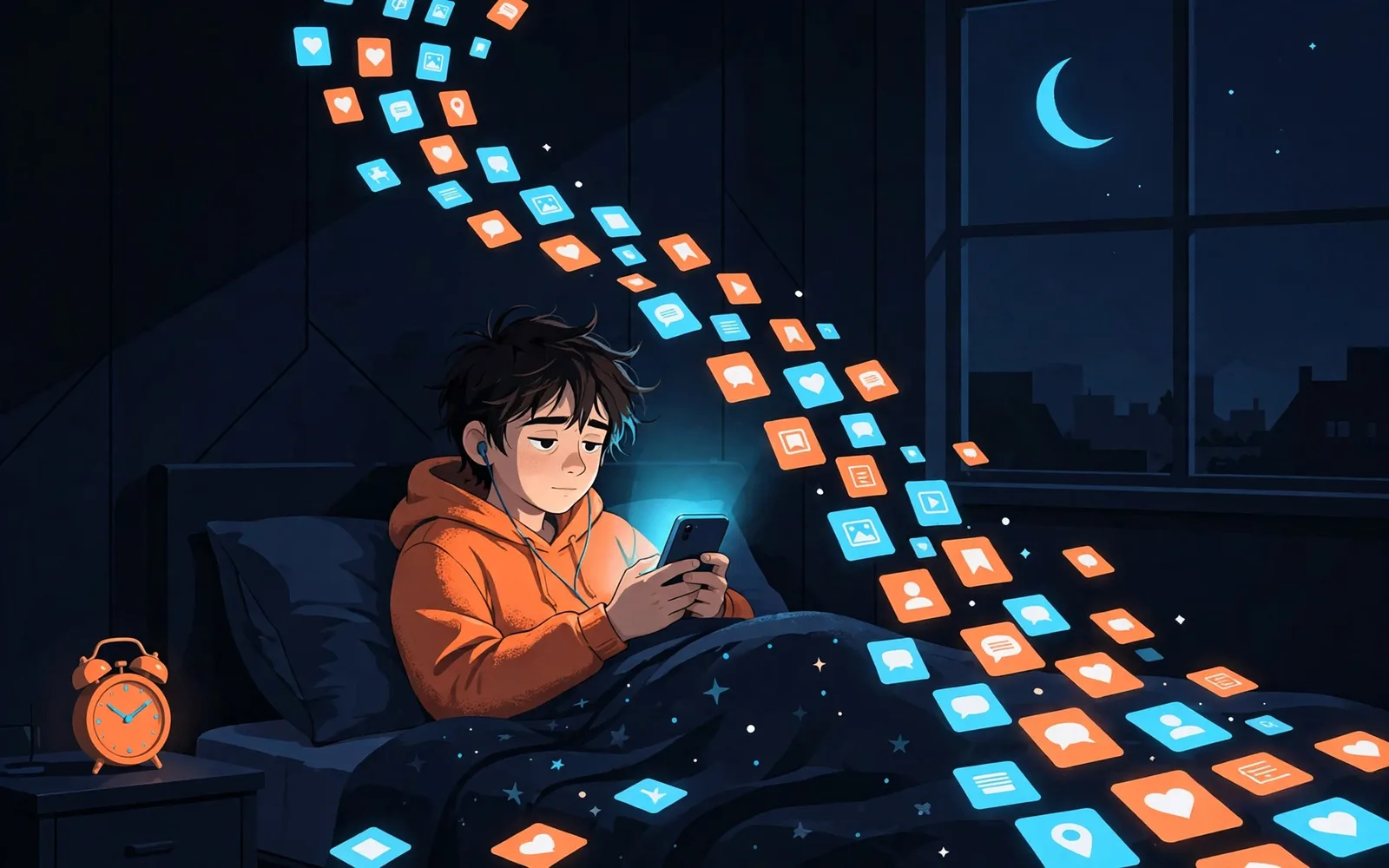
Doomscrolling is the habit of endlessly scrolling through absorbing or negative content late at night. It delays sleep, cuts total sleep time, and leaves teens tired, moody, and less able to focus — but a phone-free bedroom and a fixed cut-off time can break the cycle.
It is 1 a.m., the house is quiet, and your teenager is still awake, thumb flicking through videos, posts, and comments that never seem to end. They planned to check one message. This is doomscrolling: the habit of endlessly consuming online content late at night, often long past the point of enjoyment. It feels harmless, but the research shows it is quietly stealing something teenagers cannot afford to lose: sleep.
Nearly half of American teenagers say they are online almost constantly, according to Pew Research Center, up from 24 percent a decade earlier. And the night is when the habit does its worst damage. A 2026 study from the University of California, San Francisco, found that more than half of teenagers spend an hour or more on their phones between 10 p.m. and 6 a.m. on school nights, with more than half still using their phones between midnight and 4 a.m., as reported by CNN. On those nights, teenagers spent an average of 33 minutes on apps such as YouTube, Instagram, and TikTok alone.
Why the late-night scroll hits so hard
Doomscrolling is not just ordinary screen time moved later in the day. Three things make it especially harmful at night. First, the feed never ends. Unlike a television show or a book chapter, social media has no natural stopping point, so "five more minutes" easily becomes fifty. Second, the content is designed to hold attention: algorithms serve the most dramatic, emotional, or outrageous posts first, which keeps the brain alert when it should be winding down. Third, the phone is usually the last thing a teenager touches before trying to sleep, so the brain goes straight from high stimulation to an expectation of rest.
Teenagers feel the cost themselves. In a Pew Research Center survey of 1,391 American teenagers, 45 percent said social media has hurt the amount of sleep they get. The effect is stronger for girls: half of teen girls said social media hurt their sleep, compared with 40 percent of boys. The same survey found that 45 percent of teenagers say they spend too much time on social media, up from 36 percent in 2022.
What the sleep science actually shows
Teenagers aged 13 to 18 need 8 to 10 hours of sleep every night, according to the American Academy of Sleep Medicine guidance published by the CDC. Yet CDC data show that only about a quarter of high school students get eight hours or more on an average school night. The gap between what teenagers need and what they get is where doomscrolling does its damage, and new research has measured that damage precisely.
A study published in JAMA Pediatrics in October 2026 tracked 425 teenagers across more than 7,500 nights, using phone logs and Fitbit sleep data. On nights when teenagers used their phones more than usual after 10 p.m., they fell asleep about 65 minutes later and slept about 20 minutes less. Each additional 30 minutes of phone use after 10 p.m. was linked to falling asleep about 26 minutes later and losing about 13 minutes of sleep. Phone use in the final five minutes before sleep was also linked to more time awake in the first half hour after falling asleep, and the effect was strongest after midnight.
Research presented at the SLEEP 2026 meeting and covered by Psychiatric Times found that on evenings when teenagers used their phones more than usual in the hour before bedtime, they used them for longer later that same night, averaging about 46 minutes of use in the middle of the night. The UCSF research found a similar pattern: 17 percent of adolescents said they were woken by a call, text, or email at least once a night, and 20 percent said they used their phone if they woke up overnight.
For a deeper look at how the night-time scroll affects the whole household, see our earlier article on the teen sleep crisis and the 3 a.m. scroll, and Pew's daily post on teens who say social media hurts their sleep: the phone is in the bedroom, the feed is endless, and sleep loses.
Doomscrolling versus mindful scrolling
Not all evening screen time is equal: what matters is how, when, and for how long a teenager uses the phone.
| Habit | Doomscrolling | Mindful scrolling |
|---|---|---|
| When it happens | After midnight, often in bed | Earlier in the evening, finished well before bed |
| How it ends | No stopping point; the feed decides | A set time limit or a finished show or chapter |
| Content | Endless dramatic, negative, or outrageous posts | Chosen on purpose: a friend's message, a hobby video |
| Phone at bedtime | In the bed, often until the eyes close | Charging outside the bedroom |
| Next morning | Tired, groggy, hard to wake up | Rested, or at least no worse than usual |
| Mood the next day | More irritable, anxious, and unfocused | Steady, with normal energy |
The goal is not to ban phones. It is to move the phone out of the danger zone: the last hour before sleep and the middle of the night.
How parents can break the cycle
Breaking the cycle works best when parents treat it as a household habit, not a punishment. Teenagers resist rules they had no part in making, so start with a conversation, not a confiscation. Ask your teenager what they notice about their own sleep; many already know they feel worse after a late night.
Then agree on a small set of clear rules together. A fixed phone curfew works well: all phones charge outside bedrooms from, say, 10 p.m. on school nights. Buy a simple alarm clock so the phone is not needed as a wake-up excuse. Turn off non-essential notifications after the curfew, or use the phone's built-in focus mode so messages wait until morning. Keep the charger in a shared space such as the kitchen or hallway.
Model the behaviour you want. If parents scroll in bed, teenagers notice. A family-wide wind-down hour, with books, music, or conversation instead of screens, makes the rule feel fair rather than targeted. Some families use a "one more video, then the charger" deal: the teenager chooses one last video, then the phone goes on charge. A clear ending is exactly what the endless feed never provides.
If sleep problems persist despite a phone curfew, or if your teenager shows signs of anxiety or low mood that do not lift, talk to your doctor or a school counsellor. Sleep problems can have many causes, and a professional can help.
The bottom line
Doomscrolling is not a character flaw, and it is not a sign that your teenager is lazy or careless. It is a habit built by design: an endless feed, a glowing screen, and a tired brain that finds it hard to stop. The research is clear that the habit costs real sleep, and real sleep is what growing brains need most. The fix is refreshingly simple. Set a phone curfew, charge the phone outside the bedroom, and give the night back to sleep. Your teenager may complain for a week. Then they may notice something the research already knows: mornings get easier when nights belong to sleep.
Frequently asked questions
What is doomscrolling?
Doomscrolling is the habit of endlessly scrolling through online content, often negative or dramatic news and posts, for far longer than planned. When it happens late at night, it delays sleep and makes the sleep a teenager does get lighter and more broken.
Why do teens doomscroll at night?
Night is when teenagers finally have privacy, no homework, and no adults watching. The feed is designed to keep them going: each swipe offers something new, and the brain's reward system makes stopping feel harder than continuing, especially when they are already tired.
How much sleep do teenagers actually need?
Teenagers aged 13 to 18 need 8 to 10 hours of sleep every night, according to the American Academy of Sleep Medicine guidance published by the CDC. Most are not getting it: CDC data show only about a quarter of high school students sleep eight hours or more on a school night.
Does doomscrolling really affect school and mood?
Yes. Less sleep makes it harder to concentrate, remember lessons, and manage emotions the next day. In the Pew Research Center survey, 45 percent of teens said social media hurt their sleep and 40 percent said it hurt their productivity, while 22 percent said it hurt their grades.
What is the single best step a parent can take?
Charge the phone outside the bedroom. It removes the midnight scroll, stops notifications waking your teenager, and takes willpower out of the equation. Agree the rule together, set a fixed time, and keep a cheap alarm clock by the bed so the phone is not missed as a clock.