Can your child spot a fake AI photo? Teach them how
AI images now look completely real, so looking closely no longer works. Teach your child the SIFT habit: stop, check the source, trace it back.
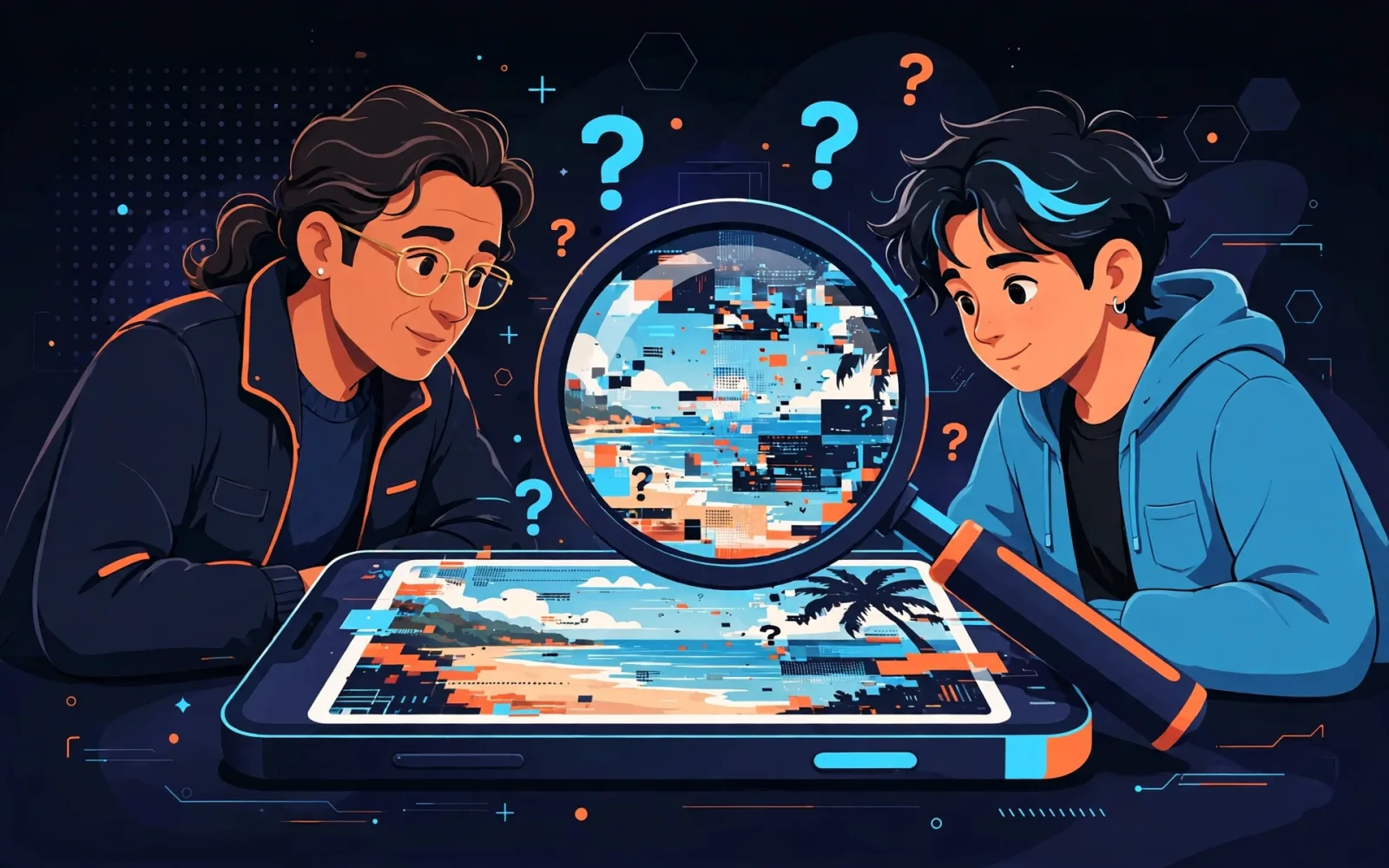
Children cannot reliably spot AI-generated images by looking at them, because modern AI photos can look perfect. Instead, teach them to stop before sharing, investigate who posted it, find other trusted coverage, and trace the image back with a reverse image search.
A photo of a celebrity in a place they never visited. A video of a politician saying words they never said. A picture of a flooded street in your own town that never flooded. Your child will see all of these, and the hardest lesson of their online life is this: a picture is no longer proof. Artificial intelligence can now create images and videos that look completely real, and children, who grew up trusting what they see, are the most likely to believe them.
The good news is that you do not need special software to fight back. You need a habit. The habit is simple: stop, check the source, and only then decide whether to share. This article turns that habit into a skill your child can actually use, with practice games you can try tonight.
Why looking closely no longer works
For years, the advice was to look for glitches: too many fingers, weird teeth, melted text in the background. That advice is now out of date. Modern AI images can look almost perfect, while real photos can contain odd details of their own. As one media-literacy guide puts it, AI-generated pictures can look almost perfect, while real photos might contain unusual details, so visual clues alone cannot settle the question, as explained by TeachMama.
The Better Business Bureau's guide makes the same point: a missing AI label does not prove something is real, because many tools add no label at all and social media often strips labels out when a post is shared. Detection tools are not a verdict either. They can be wrong in both directions. The reliable question is not "does this look fake?" but "where did this come from, and who says so besides this one post?"
The SIFT habit, in child-sized steps
Digital literacy researcher Mike Caulfield's SIFT method was built for students, but it works beautifully for children because each step is one short action. Teach it as four letters, and practise it on silly examples before you need it on serious ones.
S is for Stop. Before sharing, commenting or reacting, pause. Scams and fakes depend on speed. The pause alone stops most damage. Make it a family rule: no sharing a shocking image until someone has checked it.
I is for Investigate the source. Who posted this? Is it a news organisation with a real reputation, an official account, or an anonymous page nobody has heard of? A 30-second check on the poster resolves most fakes, because most of them come from sources that would not pass even a quick sniff test, as described in a guide to teaching children about deepfakes.
F is for Find better coverage. If a story is real, other reliable sources will be reporting it. If only one unknown account has it, treat it with suspicion. This is called lateral reading: instead of digging deeper into the suspicious page, open new tabs and see what trusted outlets say.
T is for Trace it back. Where did this image first appear? Drag it into a reverse image search, such as Google Lens or TinEye, and see where else it has shown up. A real news photo will appear in several reputable places with the same event attached. A fake will often appear first in an AI-art group, or nowhere at all. The New York University library guide notes that no original source at all is a red flag, though not proof on its own.
What to look for, and what it really means
| Clue | What to do | What it actually tells you |
|---|---|---|
| Weird hands, teeth or text | Note it, then verify | A hint, not proof; AI is improving fast |
| Reverse image search finds nothing | Be suspicious | A red flag, not proof of fakery |
| Found on many trusted news sites | Trust grows | Strong evidence it is real and in context |
| Content Credentials present | Read the history | Shows how the file was made, not whether the story is true |
| AI detector says "likely fake" | Check the source anyway | A score, not a verdict |
| Only one unknown account posts it | Do not share yet | The single biggest warning sign |
The Video Librarian guide for educators adds an important caution about Content Credentials, the hidden records that can show how a file was created: they help establish a file's history, but they do not certify that the story attached to it is true, and missing credentials do not prove a file is fake. Teach your child to read credentials as one clue among several, never as the answer.
Practise tonight: the real-or-fake game
Children learn checking by doing it, not by hearing about it. Try this 15-minute game. Pick three images together: a genuine news photo with its original caption, the same kind of genuine photo with a misleading caption, and an AI-generated image. Do not tell your child which is which. For each one, ask the same four questions: who posted it, what evidence supports it, what do other sources say, and what would convince us? Reward the checking, not just the right answer. The SchoolAI teaching guide recommends exactly this approach: start with low-stakes examples, pause videos at key moments, and ask what your child notices before any verdict.
Two more family habits pay off fast. First, agree on a family code word. If someone calls or messages claiming to be a loved one in an emergency, ask for the code word before acting, because a cloned voice will not know it, a tip highlighted by the Better Business Bureau. Second, make "show me the original" a normal sentence in your house. When your child shows you a wild claim, respond with curiosity, not correction: "Wow, let's find where that came from." Curiosity keeps the conversation open; correction shuts it down.
Why schools are teaching this now
This is not a niche skill any more. The News Literacy Project provides free classroom materials on AI, including lesson slides and a "6 Things to Know About AI" infographic, and Stanford researchers reported in January 2026 on which teaching approaches best help people recognise misinformation and scams. Finland even teaches media literacy from early childhood. Your child's school may already be doing this work, which means your job is simpler: back it up at home, with the same questions, so the habit survives outside the classroom.
The goal is not to make your child suspicious of everything. It is to make them confident about something: that they can check a claim before they spread it. In a feed full of pictures that may not be real, that confidence is the most important thing they can learn.
FAQs
Can my child really spot an AI image by looking at it?
Not reliably any more. Visual glitches used to give AI images away, but generators have improved so much that looking closely is no longer enough. Teach source-checking and reverse image search instead of relying on appearance.
What is a reverse image search, and how do we do one?
It is a search that starts from a picture instead of words. On a phone or computer, open Google Lens or TinEye, upload or paste the image, and see where else it has appeared. A real news photo will show up in reputable outlets; a fake often appears only in AI-art groups or nowhere.
What are Content Credentials?
They are hidden records attached to some files that show how the file was created or edited, including whether AI was used. Free checkers can read them. But many tools add no credentials, and social media often strips them, so a missing credential proves nothing.
Should we use AI detector tools?
You can, but never as the only evidence. Detectors make mistakes in both directions, and a score should never be the sole basis for calling something fake or real. Always pair a detector result with a source check.
At what age should I start teaching this?
Start as soon as your child uses the internet independently, usually around age 8 to 10, with simple games and silly examples. Older children can handle real news examples, source histories, and discussions about why someone might create a fake in the first place.
What if my child already shared a fake?
Stay calm. Help them delete or correct the post, and praise them for telling you. Then check the original together, so the correction becomes a lesson instead of a punishment. Every child will share something false eventually; the habit of correcting it is what matters.