Phone-free schools: the 2026 classroom phone ban and what parents should do
UNESCO reports 58% of countries now ban phones in schools. What the research shows, what New York's bell-to-bell law changes, and a parent playbook.
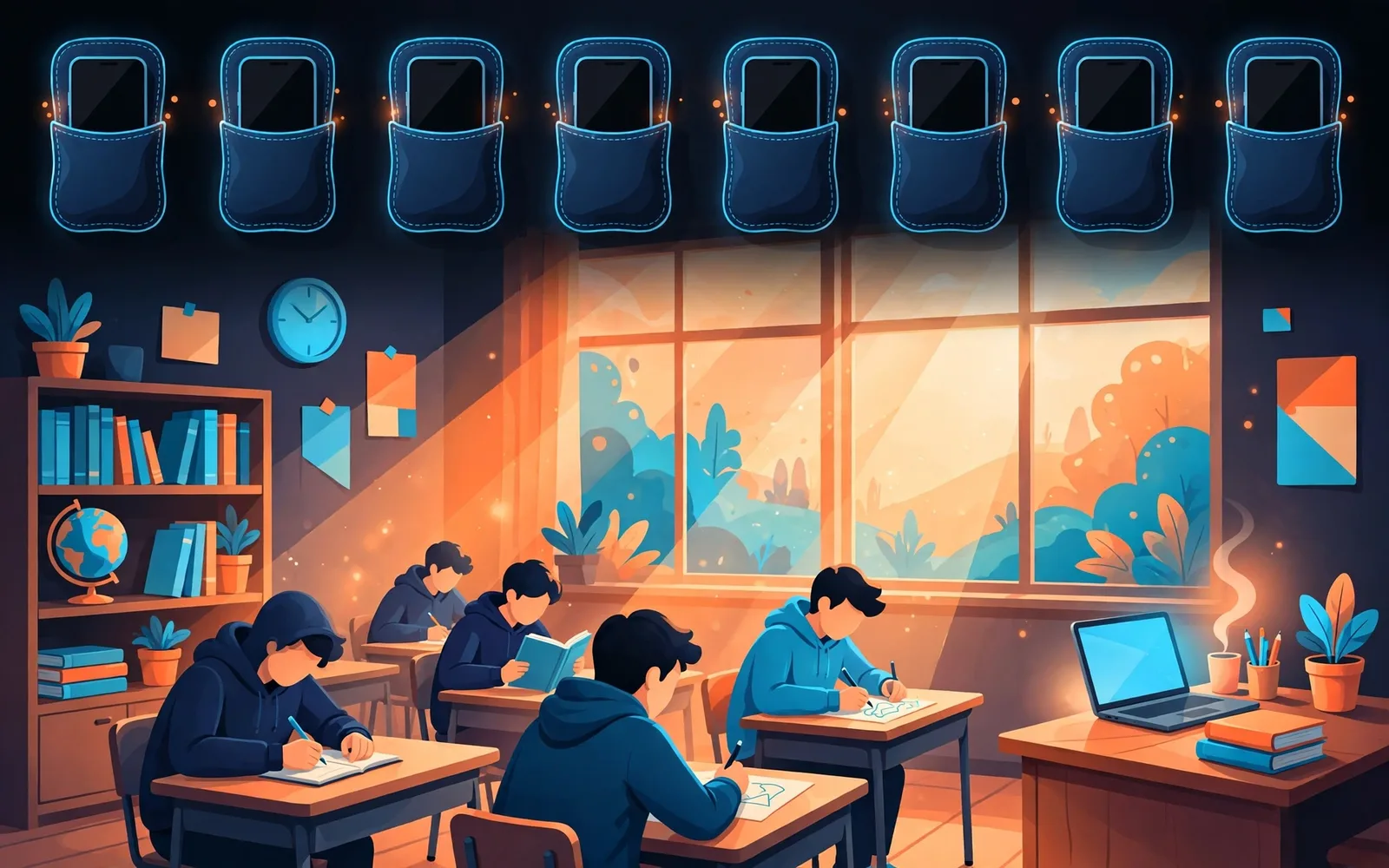
As of 2026, 58% of countries enforce national bans on phones in schools, and the strongest classroom study shows bans raise test scores most for struggling students. New York's bell-to-bell law makes it the largest US state to go phone-free, and parents can adapt with a saved school-office number, a backup basic phone, and phone-free focus time at home.
In March 2026, the school phone ban went from a local experiment to a global reality. UNESCO's Global Education Monitoring team reported that 114 education systems — 58 percent of countries worldwide — now enforce national bans on mobile phones in schools, up from 40 percent in early 2025 and just 24 percent in June 2023, when it was first monitored (Mint).
The newest countries to join the list include Bolivia, Costa Rica, Croatia, Georgia, the Maldives, and Malta. France was one of the earliest movers, prohibiting phone use in primary and lower secondary education, and its parliament is now considering more detailed smartphone legislation (Jagran Josh). In the United States, where no nationwide ban exists, 39 states have introduced bans or regulations requiring school districts to adopt policies restricting phone use (Mint).
Not every country has chosen a strict ban. Some, such as Indonesia, Serbia, and the Philippines, have taken a delegated approach, requiring schools to develop their own policies rather than imposing a single national rule. A UNESCO official cautioned that "the global picture is more nuanced than a simple shift toward prohibition," noting that many bans apply only during the school day or allow exceptions for education, illness, or disability (Mint).
The world is converging on the same conclusion through different routes. If your child has not yet had a phone-free school day, they probably will soon. The good news: the research on what happens next is surprisingly strong.
What the research actually says
The most cited study on classroom phone bans comes from London School of Economics and UT Austin economists Louis-Philippe Beland and Richard Murphy, who examined 91 schools in four English cities — Birmingham, London, Leicester, and Manchester — before and after strict phone policies were introduced between 2001 and 2013 (UT Austin).
Their findings are striking:
- Test scores rose by 6.41 percent of a standard deviation after bans — the equivalent, the authors say, of adding five days to the school year, or an extra hour of school per week.
- Struggling students gained the most: their scores rose 14.23 percent of a standard deviation — double the average gain — and they became 4 percentage points more likely to pass their final exams.
- Students with special education needs gained 10 percent of a standard deviation; students on free school meals gained 12 percent.
- High-achieving students and 14-year-olds saw little effect. The researchers suggest strong students concentrate regardless, and younger teens simply owned and used phones less often.
The authors' bottom line matters for parents: "allowing phones into schools would be the most damaging to low-achieving and low-income students, exacerbating any existing learning inequalities." A phone ban is not just an attention policy — it is an equity policy. The students who need the most help benefit the most (Phys.org).
New York goes bell-to-bell: the case study to watch
Starting with the 2025-26 school year, New York became the largest US state to require statewide, bell-to-bell restrictions on smartphones in all public K-12 schools, including charter schools and BOCES schools (NY Governor's Office).
Here is what "bell-to-bell" means in practice:
- No unsanctioned use of smartphones or other internet-enabled personal devices on school grounds for the entire school day — classrooms, lunch, and study halls included.
- $13.5 million in state funding for schools that need help buying storage solutions such as pouches or lockable cabinets.
- Schools must give parents a way to contact their kids during the day when necessary.
- Teachers, parents, and students must be consulted in developing each school's local policy.
- Enforcement plans must prevent inequitable discipline.
- Simple cellphones without internet capability are still allowed, as are school-issued devices like laptops and tablets used in lessons.
- Exemptions cover medical needs (such as a device used to manage a medical condition), requirements in a student's Individualized Education Program (IEP), translation, family caregiving, and emergencies.
New York's report behind the policy, "More Learning, Less Scrolling," found that phone-free environments do not compromise student safety and that they support the mental health of students and teachers. Districts had to publish their plans by August 1, and nearly 150 had already finalized and submitted them in advance (NY Governor's Office).
The emergency question: "But what if something happens?"
This is the number-one parent objection, and it deserves a real plan rather than vague reassurance.
- Save the school office number in your own phone — not your kid's. When something urgent happens, calling the office reaches your child faster, and through an adult.
- Ask your school to publish its parent-contact route. In New York this is a legal requirement; even where it is not law, every school should be able to tell you exactly how to reach your child during the day (NY Governor's Office).
- Agree on a family emergency protocol and say it out loud: "If there is an emergency, the school office calls me. I do not expect you to call." Stating this directly removes your child's anxiety about being unreachable.
- Do not call or text your child during a school emergency. Emergency guidance consistently warns that contacting kids during an active incident can slow the response and create panic. Let the school's emergency protocol do its job.
Logistics without a smartphone: pickups, schedules, and after-school life
The second big worry is logistics: pickups, practice changes, "I'm staying late for robotics club." Practical fixes:
- A basic phone fills nearly every gap. A call-only phone handles "practice ended early" and "pick me up at the east door." New York's law explicitly allows simple cellphones without internet (NY Governor's Office).
- Write the week down. Keep a shared pickup calendar — on the fridge, on paper, or on the parent's phone — filled in the night before: who picks up whom, when, and where.
- Use the adults' channels. Ask the coach or team parent for the group chat that runs through parents, so schedule changes still reach you in real time.
- Pack a paper backup. For the first month of a phone-free policy, put a printed weekly schedule and the school office number in your child's bag. Physical backups remove the panic of "I don't know what time practice ends."
Three models of phone-free school, compared
| Model | Where it is used | What happens to the phone | Key detail for parents |
|---|---|---|---|
| Strict national ban | France — one of the earliest adopters | Phones prohibited in primary and lower secondary education | Parliament is now considering more detailed smartphone legislation (Mint) |
| Statewide bell-to-bell | New York, from the 2025-26 school year | No unsanctioned use all day; $13.5M in funded storage; schools must provide a parent-contact route | Largest US state to do it; exemptions for medical needs, IEPs, translation, caregiving, and emergencies (NY Governor's Office) |
| School-level delegation | Indonesia, Serbia, the Philippines, and others | Each school writes its own policy restricting use | UNESCO describes a shift toward delegating responsibility to school leaders while still requiring restrictions (Mint) |
No model is clearly "best" — the delegated approach gives schools flexibility, while the national model gives everyone clarity. But all three land in the same place: the school day belongs to learning, and parents need a reliable contact plan.
Model phone-free focus at home
Kids detect hypocrisy faster than anything. If school is phone-free but home is a free-for-all, the rule feels like punishment rather than a principle. A few moves that actually work:
- Create one phone-free zone at home. Dinner table, homework hours, or bedrooms at night — pick one and keep it consistent.
- Narrate your own focus. "I'm putting my phone in the other room so I can finish this." Children imitate habits, not lectures.
- Replace the slot, don't just remove it. New York's policy pushes schools to connect more students with clubs, sports, and arts to fill phone-free hours. Do the same at home: a book, a project, a board game.
- Explain the why. Tell your child the ban exists to protect attention, learning, and real conversation — not just to control them. Kids comply with rules they understand.
The bottom line
Phone-free school is no longer an experiment in a handful of progressive schools. It is the policy of most of the world's education systems, backed by the strongest classroom study we have, and it is now rolling out at scale in the largest US state. The parents who handle it best are not the ones who fight it or fear it — they are the ones with the school office number saved, a backup basic phone in the backpack, and a home that practices the same focus the school is asking for.