Deepfakes and Teens: What Parents Need to Know
Deepfakes can put a teen's face or voice into a video they never made. Here is how they work, the real risks, and the steps parents can take today.
Drafted with an AI writing assistant and checked against its sources by the editor before publishing. How we use AI.
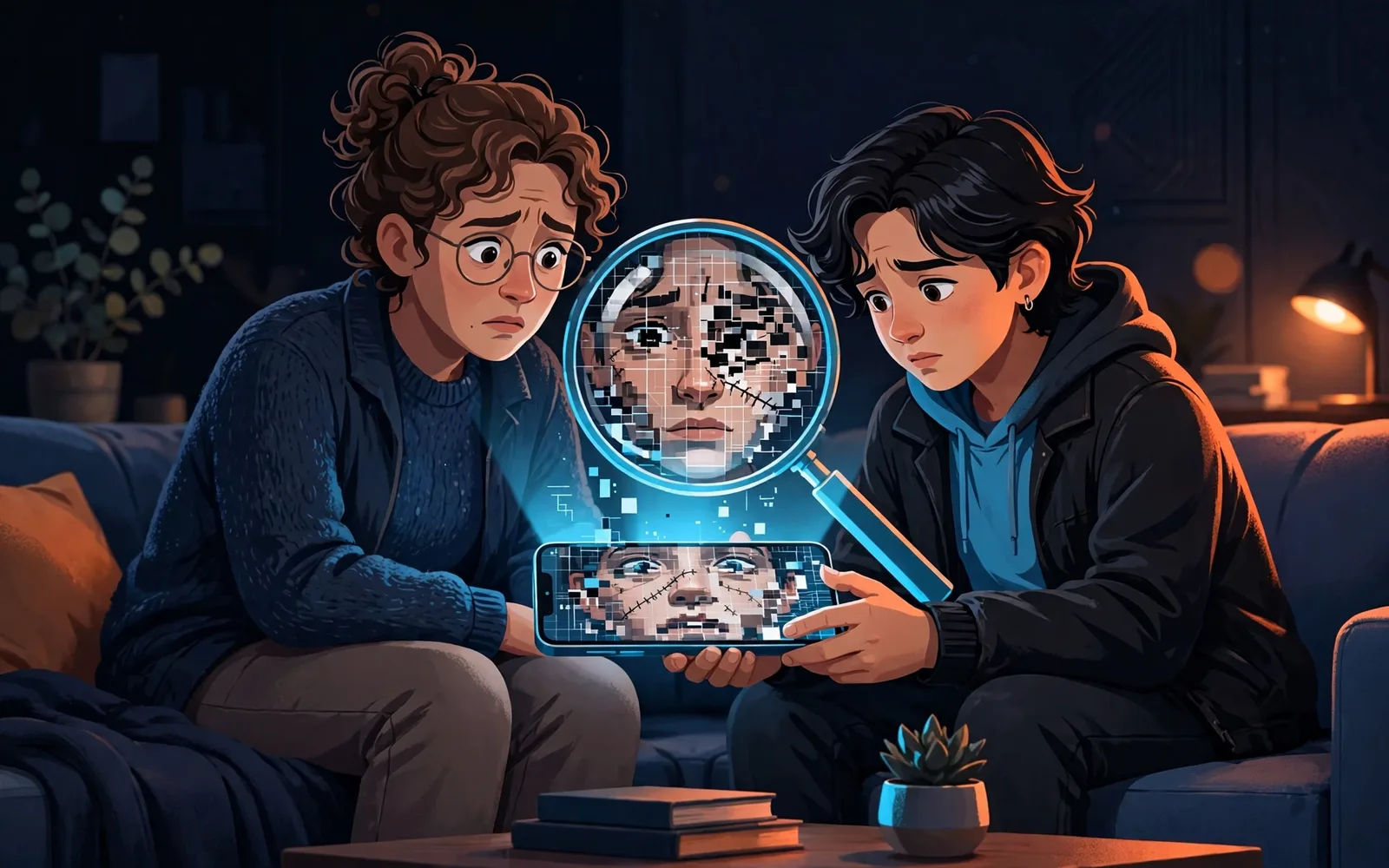
A deepfake is an AI-made image, video, or voice clip that makes a real person appear to say or do something they never did. Teens meet them as face swaps, voice clones, and fake nude images, so parents should teach them to pause, check the source, and report anything harmful instead of sharing it.
Imagine your teenager shows you a video of a singer saying something shocking, or a classmate doing something embarrassing. The video looks real. The voice sounds right. But none of it ever happened. That is a deepfake: an AI-made image, video, or voice clip that makes a real person appear to say or do something they never did. Free apps can now make one from a single photo, and teens meet them daily — in jokes, in scams, and sometimes in serious harm. This guide explains how they work and what your family can do.
What is a deepfake, and how does it work?
AI software trained on photos or recordings of a real person makes a deepfake. A face swap puts one person's face onto another person's body in a photo or video. A voice clone copies how someone sounds from a short clip — a few seconds from a TikTok video can be enough. A full video deepfake can even copy facial expressions and lip movements. The tools keep getting easier to find — some are built into popular photo apps. That is why your teen needs to know that seeing is no longer believing.
Why teens run into deepfakes so often
Teenagers live much of their social life on camera, and their selfies, videos, voice notes, and livestreams give AI tools the raw material to copy a face or a voice. Deepfakes also spread fast in group chats, where a funny face swap can travel around a school in an afternoon. Research from the nonprofit Thorn found that 41% of young people aged 13 to 20 had heard the term "deepfake nudes," including about 1 in 3 teens. In the same survey of 1,200 young people, 1 in 10 teens knew someone targeted this way, and 1 in 17 said it had happened to them. Most — 84% — said deepfake nudes cause real harm. Full findings are in Thorn's March 2025 report.
The four risks parents should know
1. Fake nude images. The most serious risk is a fake nude image made from an ordinary photo. Someone takes a normal picture from social media, uses an "undress" app to create a fake explicit version, then shares it to embarrass, bully, or blackmail the person in it. The picture is fake, but the harm is real. Tell your teen that making or sharing such an image is never a joke — and that if it happens to them, they are the victim.
2. Voice-clone scams. Scammers clone a family member's voice and call with a fake emergency: a car crash, an arrest, a hospital bill. The US Federal Trade Commission warns that all a scammer needs is a short audio clip of your family member's voice, taken from content posted online, and a voice-cloning program. The FTC's advice is simple: do not trust the voice. Hang up and call the person back on a number you already know. If money was sent, report it at ReportFraud.ftc.gov.
3. Bullying and reputation damage. A deepfake can put a classmate's face into a video saying something cruel, or make it look like a teacher did something they did not. Because the fake looks real, others may believe it before anyone checks. Teach your teen never to forward a suspicious video, even to ask "is this real?" Forwarding is sharing, and sharing gives the fake its power.
4. Fake news. Deepfakes of politicians and celebrities saying things they never said are now common in elections and breaking news. Teens get much of their news from short video feeds, where a fake clip can look exactly like a real one. Internet Matters suggests a "PAUSE check": read beyond the headline and ask whether the image matches the claim — or could be AI-generated. Checking the source before believing a clip protects against most fakes. Our guide to how teens get news from TikTok has more on checking sources together.
Real or fake? Red flags to teach your teen
No checklist is perfect — the newest deepfakes can pass every visual test — so checking the source matters most. Still, these clues help:
| Clue | A real video usually shows | A deepfake often shows |
|---|---|---|
| Face and eyes | Natural blinking, eyes that focus smoothly | Very little blinking, or glassy, unfocused eyes |
| Hands and teeth | Normal-looking, even if imperfect | Extra fingers, warped hands, teeth that blur |
| Voice and lips | Lips match the words, natural pauses | Lips out of sync, flat tone, odd pauses |
| Light and shadows | Light and shadows match the scene | Face brighter or darker than the background, wrong shadows |
| The story itself | Plausible, from a checkable source | A shocking claim, urgent tone, no trusted source |
The FBI's Internet Crime Complaint Center has warned that criminals now use AI-generated videos in live video chats, impersonating executives and law enforcement officers, and it advises watching for distorted hands, unrealistic accessories, inaccurate shadows, and lag on calls. See the FBI IC3 public service announcement.
What does the law say?
Laws are catching up. In the United States, the Take It Down Act requires covered platforms to remove non-consensual intimate images — including AI fakes — within 48 hours of a valid request. If a platform misses that deadline or has no working removal process, report it at TakeItDown.ftc.gov. Possessing or sharing explicit images of a child, including AI-generated ones, can be a serious crime. In the United Kingdom, creating or sharing a non-consensual intimate deepfake is a criminal offence, and the UK Safer Internet Centre advises reporting illegal images, including AI-generated ones, to the Internet Watch Foundation and the platform. Rules differ by country and state, but the direction is clear: fake does not mean harmless, and it does not mean legal.
What parents can do today
- Talk before trouble starts. Tell your teen what a deepfake is, in plain words, and that anyone can be targeted — and they will not be in trouble for telling you.
- Set a family code word. Agree on a secret word only your family knows, and ask for it before acting on any emergency call.
- Shrink the raw material. Keep your teen's profiles private, limit public photos and voice clips, and turn off location sharing — fewer public photos mean fewer ingredients for a fake.
- Practise spotting fakes together. Watch a few well-known harmless deepfakes next to real clips and talk about the clues above — a "spot the fake" game beats a lecture.
- Make a reporting plan. If a fake image of your child appears, do not download or forward it. Save the link and screenshots, report it to the platform and the school, and contact the police. In the US, report suspected exploitation of a minor to NCMEC's CyberTipline.
- Keep the conversation open. Teens hide things when they fear punishment. If your teen tells you about a deepfake, thank them first, then act together.
- Model the habit. Check a surprising video before sharing it in the family group chat.
Frequently asked questions
Can a deepfake be made from just one photo?
Yes. Many face-swap and "undress" apps need only a single clear photo, usually taken from social media. That is why private profiles matter.
How can my teen tell if a video is a deepfake?
Use the clues in the table above. But the best test is the source: if only one unknown account shares a shocking clip, treat it as fake until proven real.
Is making a deepfake of a classmate illegal?
It can be. In the US, making or sharing AI-generated explicit images of a minor can be a serious crime, and the Take It Down Act gives families a 48-hour removal route. In the UK, creating or sharing a non-consensual intimate deepfake is a criminal offence, and schools treat it as bullying or harassment.
What should we do first if a fake image of my child is shared?
Stay calm and do not download or forward the image. Save the link and screenshots, report it to the platform and the school, and contact the police. In the US, also report it to NCMEC's CyberTipline. Tell your child they have done nothing wrong and you will handle it together.
Should I ban my teen from apps that make deepfakes?
A ban rarely works — the apps are easy to find. Talk about how they work, agree on family rules, and keep the conversation open.
Deepfakes are not going away, but they are not unbeatable. A teen who pauses, checks the source, and talks to a parent is far harder to fool than any filter or app. Start the conversation tonight. Keep building your teen's media skills with our guide to how teens get news from TikTok and our skibidi slang explainer.